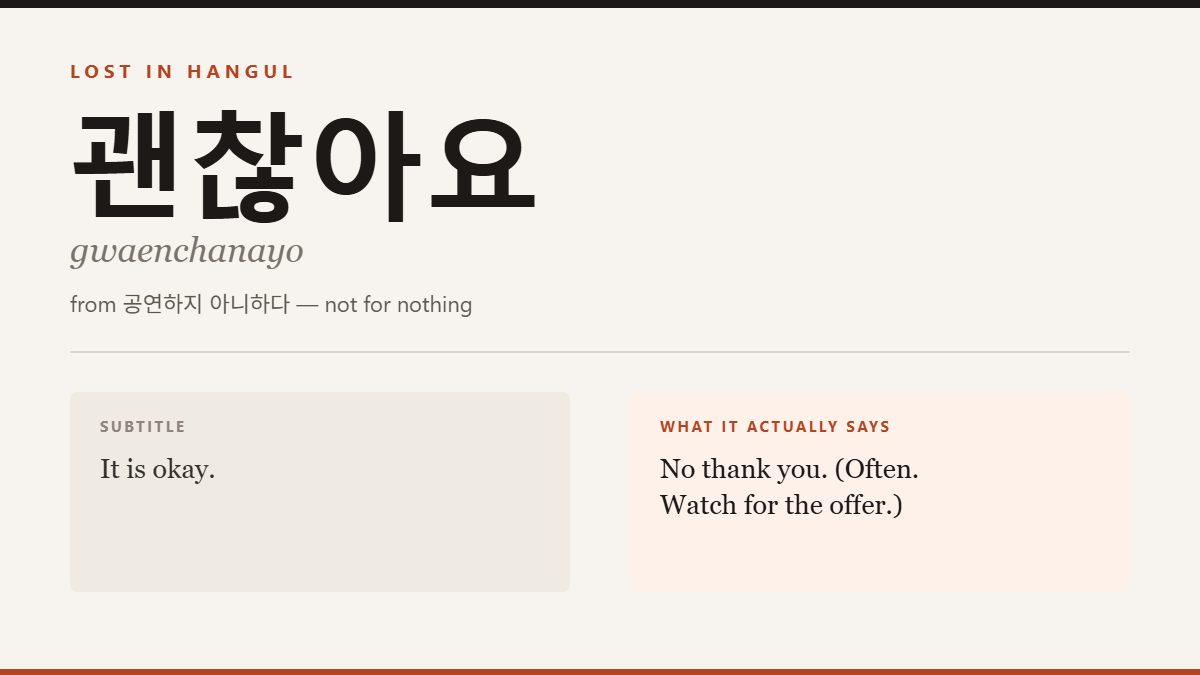
Short version: 괜찮아요 means “it’s fine”, “I’m fine”, and “no thank you”. The third one catches learners constantly, because the subtitle says “It’s okay” and the character has actually just declined.
Where the word comes from
The usual account traces 괜찮다 back to 공연하지 아니하다 — 공연 being 空然, “in vain” or “for nothing” — which contracted over time through 괜하지 않다 into the modern form. So the original sense is something like “not for nothing”, “not without reason”, and from there into “acceptable”.
This is the standard explanation and it is widely repeated; the intermediate steps are reconstructed rather than documented at every stage. It fits the shape of the word well enough to be worth knowing, with that caveat attached.
The three jobs
1. Reassurance — “it’s fine”
Someone apologises, someone worries, someone spills something. 괜찮아요 releases them. This is the meaning every textbook teaches first and it is the least problematic.
2. Self-report — “I’m fine”
Asked if you are hurt, tired, upset. 저 괜찮아요. Frequently untrue, as it is in every language, and Korean drama runs on characters saying this while visibly not fine.
3. Refusal — “no thank you”
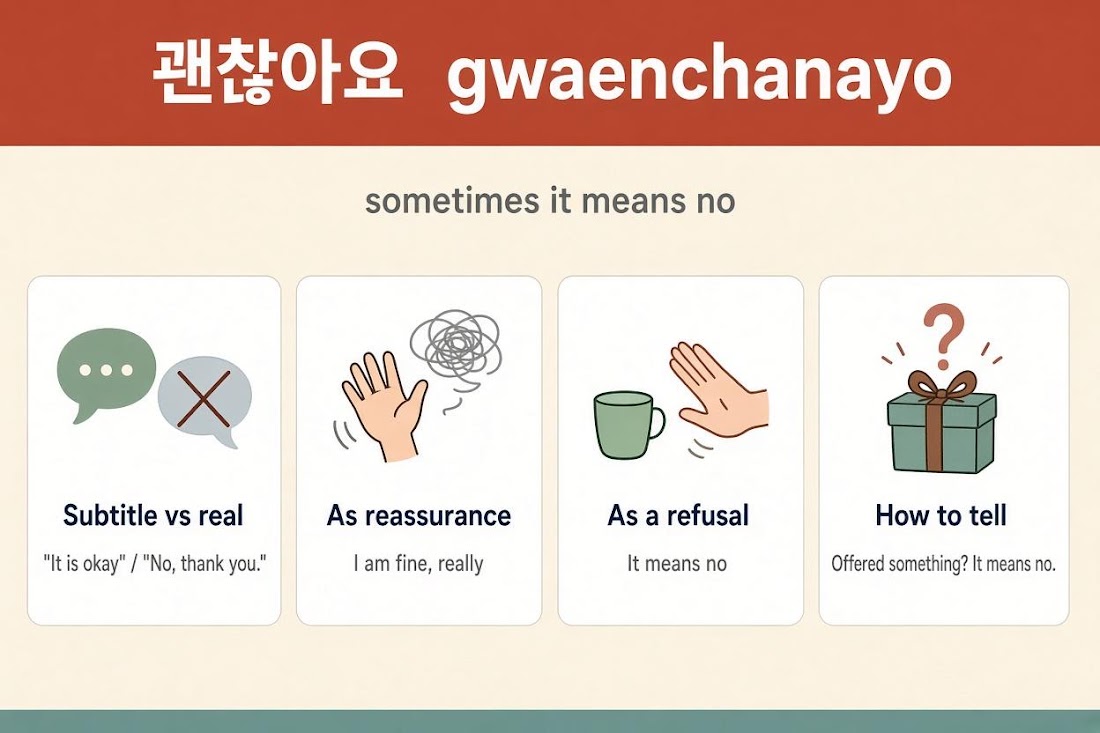
This is the one. Offered more food, a lift home, help with a bag, a drink: 괜찮아요 is a polite no.
It is not ambiguous to a Korean speaker, because the situation disambiguates it. An offer was made; the answer declines it. But in a subtitle it becomes “It’s okay”, and an English-speaking viewer reasonably reads that as acceptance. A scene where someone politely refuses three times and is overruled reads, in English, like everyone agreeing and then arguing about nothing.
How to tell which one
- Was there an offer? If yes, it is a refusal. This one test covers most cases.
- Is there a small hand gesture? A raised palm or a slight wave almost always marks the refusal.
- Was there an apology or a worry? Then it is reassurance.
- Was there a question about you? Then it is the self-report.
The relatives
| Word | Means | Tone |
|---|---|---|
| 괜찮아요 | It’s fine / I’m fine / no thanks | Neutral, polite |
| 됐어 | Enough. Forget it. | Sharp. Can be rude. |
| 아니에요 | No, it’s not / no thank you | Polite, clearer refusal |
| 괜찮으세요? | Are you all right? | Concerned |
됐어 deserves a flag. It also refuses, and it does so with a slam. Used on a friend it is fine; used on a stranger or upward it is a rebuke. Learners sometimes pick it up from dramas, where it is usually being said by someone who is furious.
If you want to use it
The practical rule for learners: if someone offers you something and you actually want it, do not say 괜찮아요. Say 네, 감사합니다 or 네, 주세요. Half the “I was somehow never given any food” stories foreigners tell about Korea start here.
And when you do want to decline, 괜찮아요 is the right tool. Warm, polite, complete. Add a small hand raise and nobody will press you.
Read next
- “Jal meokgetseumnida” (잘 먹겠습니다) — not “bon appétit”
- “Ani” (아니) — the word that usually is not “no”
- “Aigoo” (아이고) — one sound doing six different jobs
Last reviewed: September 21, 2026