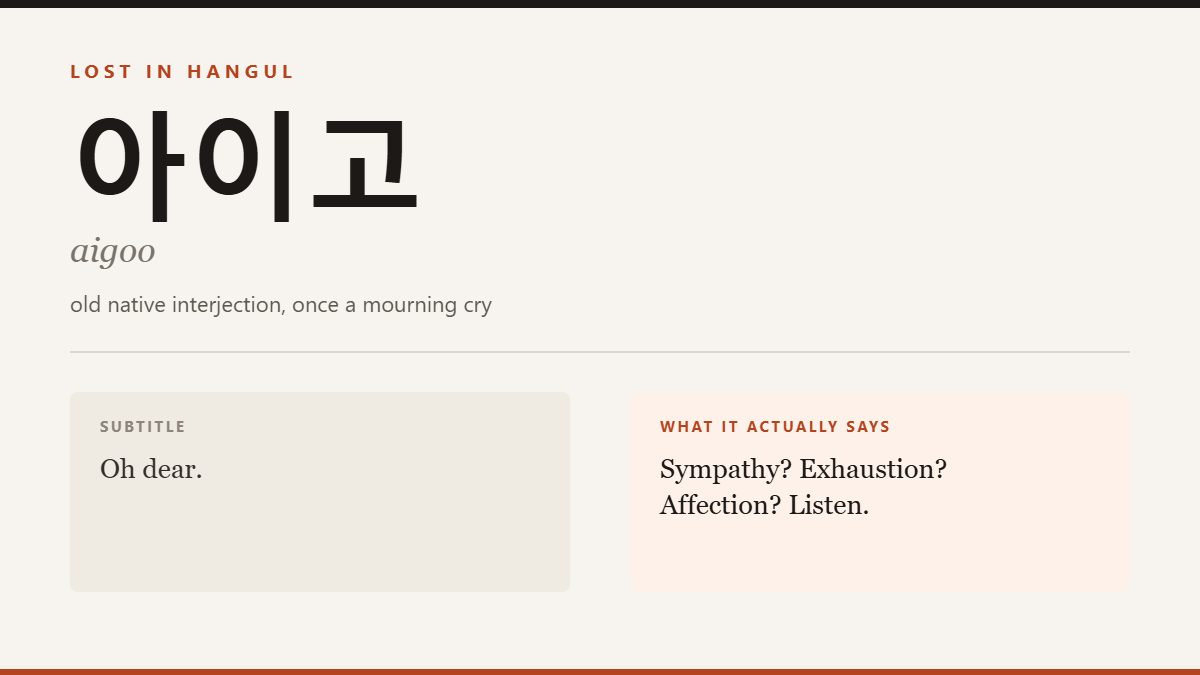
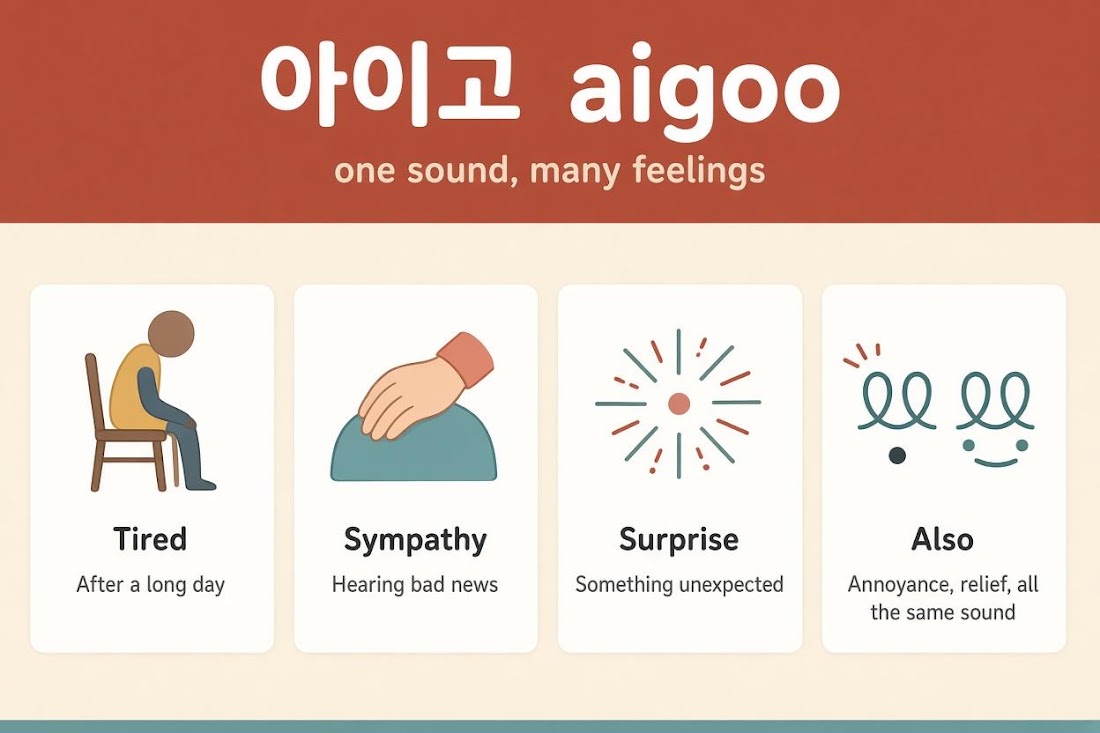
Short version: 아이고 (aigoo) is not a word so much as a sound with an unusually wide range. Sympathy, weariness, affection, mild exasperation, shock and grief all come out of it, and only the delivery tells you which.
Where it comes from
It is a native Korean interjection and an old one, appearing in classical texts in forms like 애고. It has a heavier history than its everyday use suggests: 아이고 is traditionally associated with the formal wailing of mourning, the ritual cry at a funeral.
That origin is not audible in ordinary use, where the word does mostly light work. But it explains why the same sound can still carry real grief without any adjustment.
The range
| Situation | What it means there |
|---|---|
| Someone tells you they had a rough week | Sympathy — “oh, that’s rough” |
| Standing up from a low chair | Effort — the Korean equivalent of an old-man grunt |
| A toddler does something | Affection — “oh, look at you” |
| A friend does something stupid again | Exasperation — “oh, for heaven’s sake” |
| Dropping something | Frustration — “oh, come on” |
| At a funeral | Grief, in its original register |
One sound, six jobs. English splits these across “oh dear”, “ugh”, “aww”, “for goodness sake” and “oh no”, and none of them cover more than one row.
It skews older, and younger speakers know that
아이고 reads as slightly older. A twenty-year-old saying it while getting off a sofa is doing a small impression of their parents, and everyone hears it that way.
That does not make it rare among the young. It makes it self-aware. The word gets used affectionately and half-ironically, which is its own kind of fluency.
The variants
- 아이구 — same word, softer spelling. Common in captions.
- 어이구 — leans exasperated or teasing.
- 아유 — shorter, lighter, often mild annoyance.
- 아이고야 — extended, for genuine surprise or a real problem.
- 아이고 허리야 — “aigoo, my back”. A fixed phrase and a standing joke about ageing.
Why subtitles struggle
English interjections are narrow. Each one covers one emotional band, so a subtitler has to decide which band this instance belongs to and commit, before the actor has finished making the sound.
“Oh dear” is the usual fallback and it has a problem: in English it reads as prim, mildly British, and distinctly mild. 아이고 is none of those. It is the most ordinary sound in the language and it can be enormous.
Fansubs often leave it as “aigoo”, which is now widely understood by K-content audiences and neatly sidesteps the choice.
If you want to use it
Almost impossible to get wrong once the tone matches the situation. Low and slow for sympathy, sharp and short for annoyance, soft and rising for affection.
The main thing to avoid is deploying it at a genuinely solemn moment unless you mean the heavy version. The word still has that register underneath, and it will surface if the room is quiet enough.
Read next
- “Jal meokgetseumnida” (잘 먹겠습니다) — not “bon appétit”
- “Ani” (아니) — the word that usually is not “no”
- “Gwaenchanayo” (괜찮아요) — it also means “no thank you”
Last reviewed: September 21, 2026