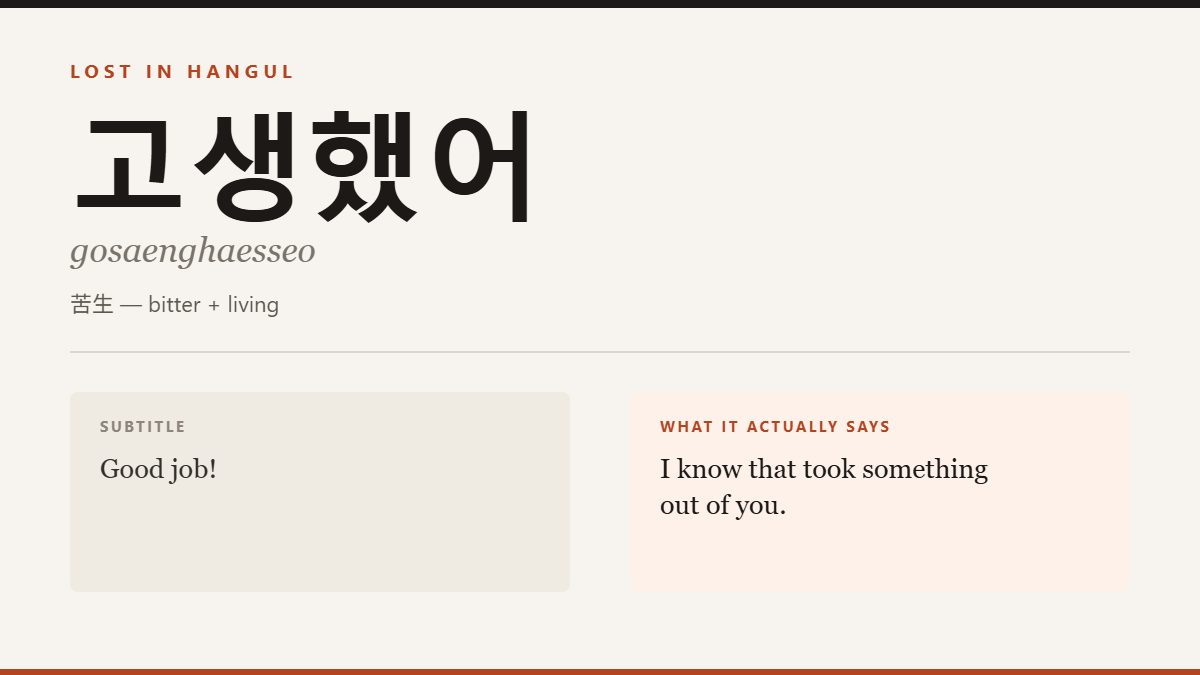
Short version: 고생했어 (gosaenghaesseo) is not praise. It is acknowledgement. It says nothing about whether you did well. It says that what you just went through cost you something, and that the person speaking watched it cost you.
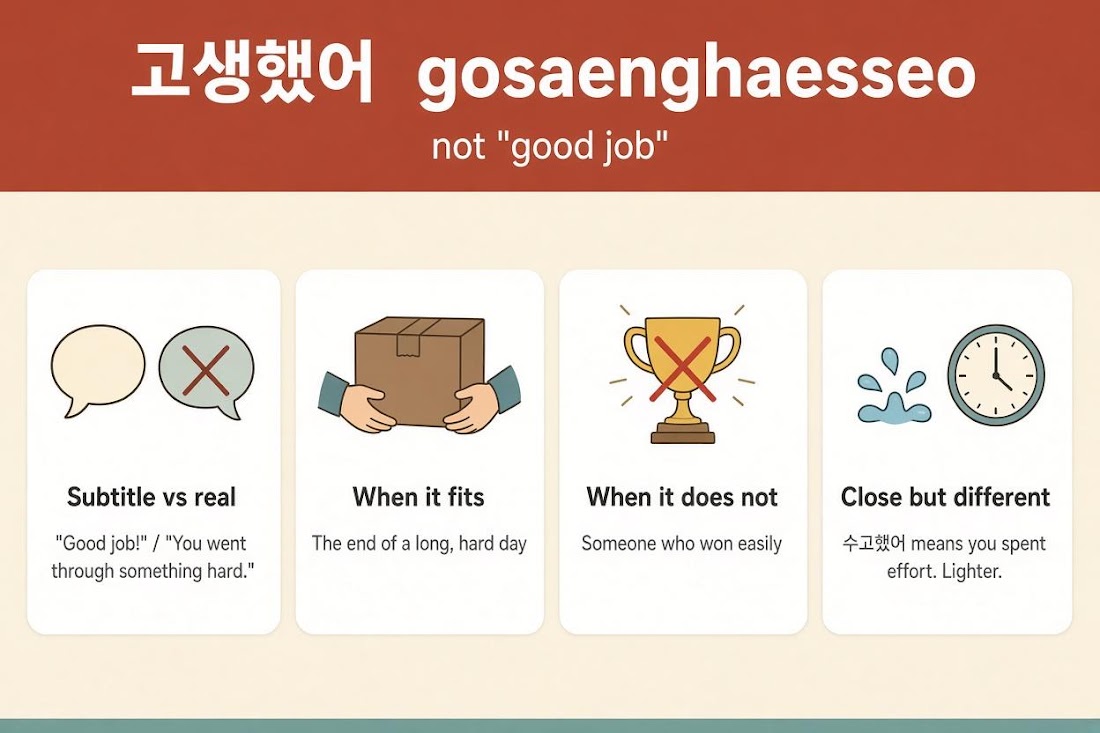
That distinction is why English subtitles keep reaching for “Good job” and why English-speaking fans keep getting confused about why everyone on screen is suddenly crying.
Where the word comes from
The noun 고생 is Sino-Korean, written 苦生 in hanja. The first character, 苦, means bitter or painful. The second, 生, means living. So the word is literally bitter living: a stretch of life that was hard to get through. Add 하다 (“to do”) and you get 고생하다, to go through hardship. 고생했어 is the past tense, said to another person: you did bitter living.
This is worth sitting with, because the whole meaning of the phrase falls out of that structure. The word is built around the cost of the thing. It is not built around the result of the thing. English “good job” is the opposite: it is a verdict on output, and it carries no information about what the output took.
There is nothing slangy or modern about it either. 苦生 is old, plain vocabulary, the kind of word used about farm work, war, poverty, illness. When an idol says it to another idol at 2am after a concert, they are using a word that a grandmother would use about a hard winter.
What the subtitle drops
Three things, and they compound.
- It drops the direction. “Good job” flows downward, from someone qualified to judge toward someone being judged. 고생했어 flows sideways. It is the language of a witness, not an evaluator.
- It drops the fact that the outcome is irrelevant. This is the big one. You can say 고생했어 to someone who just lost. You can say it to someone who got eliminated in the first round, whose album underperformed, whose drama got cancelled. “Good job” in that situation reads as sarcasm. 고생했어 reads as kindness.
- It drops the shared time. The phrase implies the speaker was there for at least part of it. Saying it about something you did not see is odd. That implied “I watched you do this” is doing most of the emotional work.
Once you know that, a lot of scenes rearrange themselves. Members who have been together for years say it to each other at the end of a tour and break down. The subtitle says “Good job, everyone!” and an English-speaking viewer reasonably thinks: that seems like a lot of crying over a compliment.
Where you will actually hear it
- The last day of filming, from the director to the cast and from the cast back to the crew.
- The end of a concert or a tour, between members, usually with the polite ending stripped off because they are close.
- When someone finishes military service. This is close to the canonical use of the word.
- After a move, an exam, a hospital stay, a long flight, a funeral. Anything with a clear end and an obvious toll.
- From a parent to an adult child who has just had a rough year. Here it often comes as 고생 많았어, which is heavier again.
The sibling word: 수고했어
수고 is usually traced to 受苦, “to receive hardship,” though in modern Korean it is felt as an ordinary word rather than a hanja compound. The two overlap constantly, and Koreans do not agonise over the choice. But there is a real difference in weight.
| 수고했어 (sugohaesseo) | 고생했어 (gosaenghaesseo) | |
|---|---|---|
| Weight | Routine effort | Genuine difficulty |
| Typical trigger | End of a normal work shift, a task finished | Something that was actually hard or long |
| Said to a stranger? | Yes, commonly (수고하세요 to staff) | Rarely, it is too intimate |
| If you use the wrong one | Sounds slightly cold | Sounds like you are overdramatising a small thing |
A rough rule that holds most of the time: 수고했어 is for the work, 고생했어 is for what the work did to you.
Who can say it to whom
The ending changes with the relationship, as always in Korean.
- 고생했어 — banmal. To someone younger, or someone you are close enough to drop honorifics with.
- 고생했어요 — polite, everyday.
- 고생하셨습니다 — formal, and the one to be careful with.
The trap: saying 고생하셨습니다 or 수고하셨습니다 upward, to someone clearly senior to you. Some older Koreans read it as passing judgment on a superior’s labour from above, which is not your place. Younger workplaces mostly do not care and use it freely, so this is one of the genuinely generational ones. If you want to be safe going upward, 감사합니다 does the job with no risk.
If you want to use it yourself
Two things to avoid. First, do not use it as a compliment on a result, because it is not one. If someone nailed a performance and you want to say so, that is 잘했어. Second, do not use it for something small. 고생했어 for a five-minute errand sounds like you are teasing them.
And if someone says it to you, the normal reply is to hand it straight back: 너도 고생했어, you too.
Why translators still write “Good job”
Worth saying plainly, because this site is not here to dunk on subtitlers: “Good job” is a defensible choice. A subtitle gets roughly two lines and about forty characters per line, and it has to be readable at the speed people actually read, which is slower than people think. It also has to land inside the same beat as the delivery, so a line that is grammatically fine but rhythmically wrong will feel off even if the meaning is perfect.
“I know that took something out of you” is accurate and useless as a subtitle. It is too long, it lands a full beat late, and it sounds like a therapist. Faced with that, “Good job” is the sane call. Some subtitlers go with “You worked hard” or “Thank you for your hard work,” which are closer and still lossy in the same direction: they put the emphasis on effort expended rather than on being seen.
The loss is real. It is also mostly unavoidable. What is avoidable is the viewer never finding out that anything was lost, which is the only reason this site exists.
Three moments, three different English lines
| Situation | Typical subtitle | Closer to what was meant |
|---|---|---|
| Members to each other at the end of a tour | Good job, everyone! | We got through that together. |
| A parent to an adult child after a rough year | You did well. | I know what this year cost you. |
| A director to the crew on the last day of filming | Good work. | Thank you for putting up with all of that. |
| Someone who just got eliminated from a competition | Good job. | That was hard, and it counted. |
The fourth row is the one that breaks English. There is no natural English sentence that praises nothing, promises nothing, and still comforts. Korean has one, and it is four syllables long.
Two things people get wrong
“Can I use it in a text message?”
Yes, constantly. 고생했어 and 고생 많았어 are extremely common in messages, usually at the end of a day or after the other person has finished something. It is not a formal or ceremonial phrase. It is closer to how English speakers use “hope you get some rest.”
“Is 고생하세요 the polite version?”
No, and this one is a genuine trap. 수고하세요 works as a present-tense send-off, the thing you say to a shop worker or a colleague you are leaving behind, roughly “keep at it, and thanks.” 고생하세요 is not the same move. Because 고생 carries real hardship rather than ordinary effort, telling someone to go do it sounds like you are wishing a bad time on them. Native speakers will hear it as sarcastic or hostile.
Past tense, safe. Present tense, pick 수고.
Read next
- “Sugohaesseoyo” — the everyday phrase that can still get you in trouble
- “Jal meokgetseumnida” (잘 먹겠습니다) — not “bon appétit”
- Two lines, forty characters: the rules subtitlers actually work under
Last reviewed: September 20, 2026