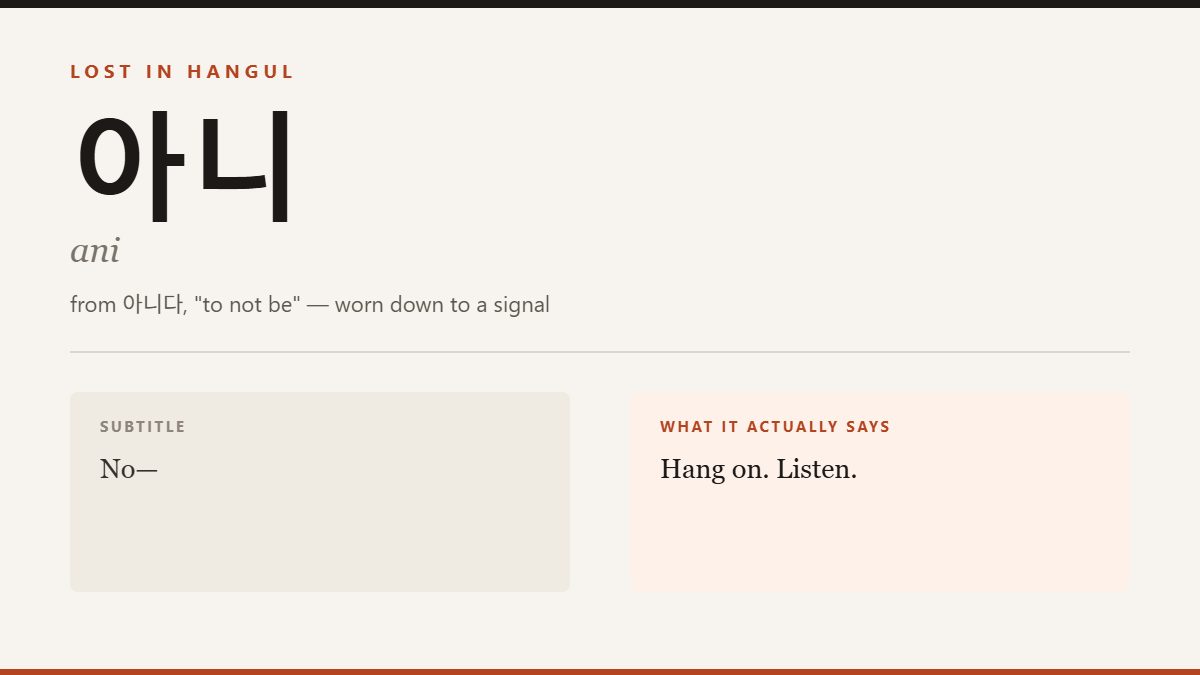
Short version: when a Korean sentence opens with 아니, it usually is not a “no”. It is closer to “wait”, “hang on”, or “okay, so”. Subtitles print “No—” and viewers spend the next line confused, because the speaker then agrees with everything that was just said.
Where it comes from
The source is 아니다, the verb meaning “to not be”. That is a real negation and it still works as one: 아니요 is no, 아니야 is “it isn’t”.
What happened is ordinary and happens in every language. A word that carried meaning got used so often at the front of sentences that it wore down into a signal about the conversation rather than about the content. English did the same thing to “well”, which no longer has anything to do with wells, and to “look” in “look, I already told you”, which is not an instruction to look at anything.
So 아니 at the start of a sentence is doing discourse work. It flags that something about the current direction of talk needs adjusting. It does not say what.
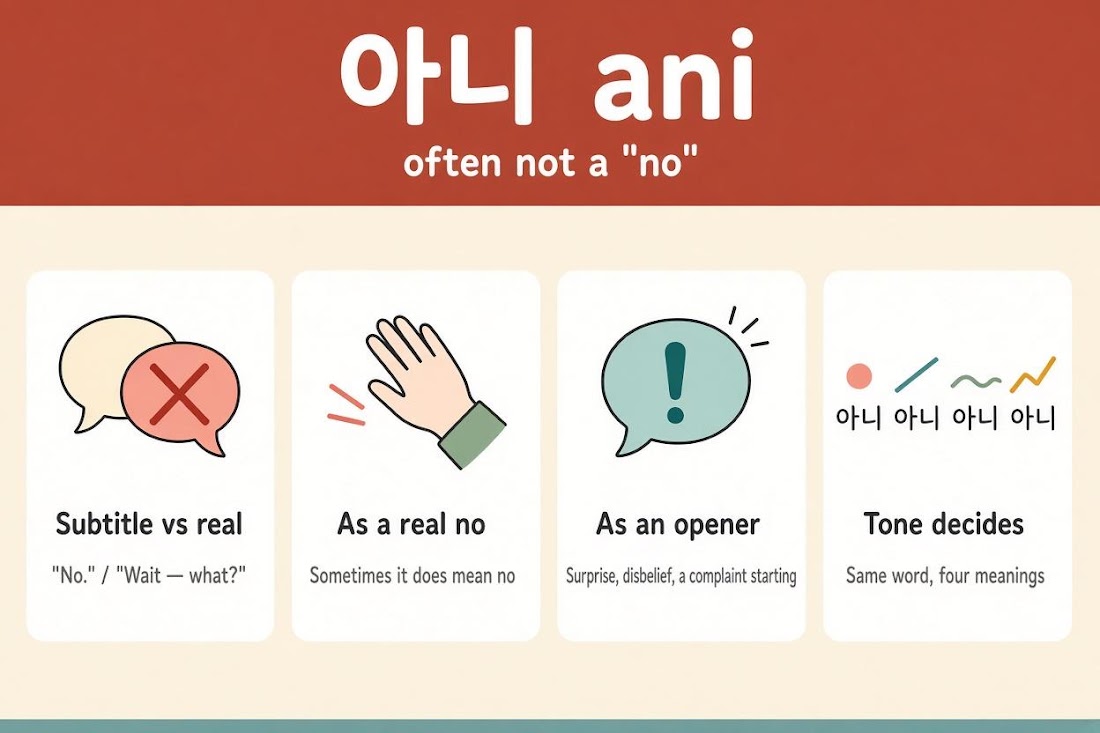
The four things it actually signals
1. Surprise
아니 진짜? — “wait, really?” Nothing is being denied. The speaker is registering that new information has arrived and they need a beat to take it in.
2. Mild protest
아니 왜? — “hang on, why?” This is the tone of someone who has just been told to do something unreasonable. There is friction in it, but the friction is about fairness, not about facts.
3. A restart
아니 그게 아니고 — “no, that’s not it, what I mean is”. Here the second 아니 is the real negation and the first one is just clearing the runway. Speakers stack them constantly and the first is almost always the discourse marker.
4. Pure emphasis
Someone launches into a story with 아니 내가 어제… — “so yesterday I—”. There is no contradiction anywhere in sight. The word is functioning as a throat-clear that says listen to this one.
Why this one causes real confusion
Because the mistranslation is not subtle. A subtitle that reads “No.” followed immediately by enthusiastic agreement is not a small loss of nuance. It makes the character look erratic.
The situation where it does the most damage is an argument scene. Korean speakers pepper heated speech with 아니 — at the start of nearly every turn, sometimes twice — and an English subtitle that renders each one as “No” turns a person making a point into a person refusing everything.
Watch a variety clip with subtitles and count how many lines begin with “No” while the speaker nods.
The closest English equivalents
| Korean | Usual bad subtitle | Closer |
|---|---|---|
| 아니 진짜? | No, really? | Wait, seriously? |
| 아니 왜? | No, why? | Hang on, why? |
| 아니 그게… | No, that’s… | I mean, the thing is… |
| 아니 잠깐만 | No, wait a minute | Okay hold on |
The one English word that covers the most ground here is “wait”. It is short enough to fit a subtitle, it signals interruption without denial, and it works in three of those four rows.
How to tell which is which
One reliable test: if 아니 is followed immediately by another word rather than by a pause, it is almost certainly the discourse marker. A real “no” tends to stand alone, or take the polite ending, or be followed by a beat.
아니요 and 아니야 are always genuine negations. It is the bare 아니 running into the next word that you should stop reading as “no”.
If you are learning
This is one of the fastest ways to sound less like a textbook. Starting a reaction with 아니 is completely natural and will not be heard as rude among friends.
Going upward, be a little careful. Because the word does carry a flavour of protest, opening a sentence with it toward someone senior can read as pushing back. 아, 네 or simply starting the sentence is safer until you know the person.
The rest of the openers
아니 is the one that causes real confusion, but it belongs to a small family of sentence-openers that subtitles handle badly for the same reason: they signal something about the conversation rather than about the world.
| Opener | Usual subtitle | What it is doing |
|---|---|---|
| 아니 | No— | Wait, hang on |
| 근데 | But | Anyway / changing subject, often with no contrast at all |
| 그니까 | So | Exactly, that is my point |
| 뭐 | What | Well / whatever / I suppose |
| 아 진짜 | Oh really | Come on. (Usually exasperated, not curious.) |
근데 is worth flagging alongside 아니, because it has the same failure mode. It contracts from 그런데 and is usually translated “but”, and half the time there is no contrast being drawn at all — the speaker is simply moving on. A subtitle full of “but” makes a character sound argumentative for no reason.
In writing
Online you will see 아니 stretched and decorated — 아니ㅋㅋㅋ, 아니 진짜, 아니 잠깐 — almost always at the start of a comment reacting to something. It is the Korean comment-section equivalent of opening with “okay so”.
If a comment begins with it, the writer is not disagreeing. They are winding up.
Read next
- The Korean words subtitles always delete (and why translators do it)
- Two lines, forty characters: the rules subtitlers actually work under
- “Aigoo” (아이고) — one sound doing six different jobs
Last reviewed: September 20, 2026