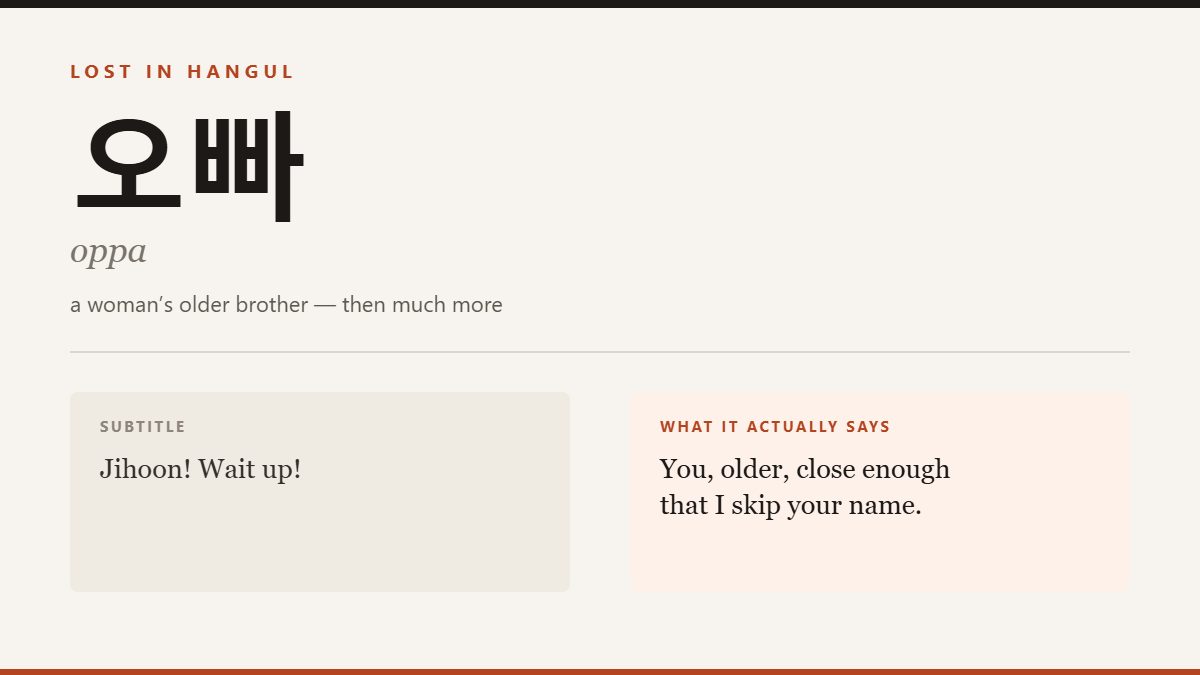
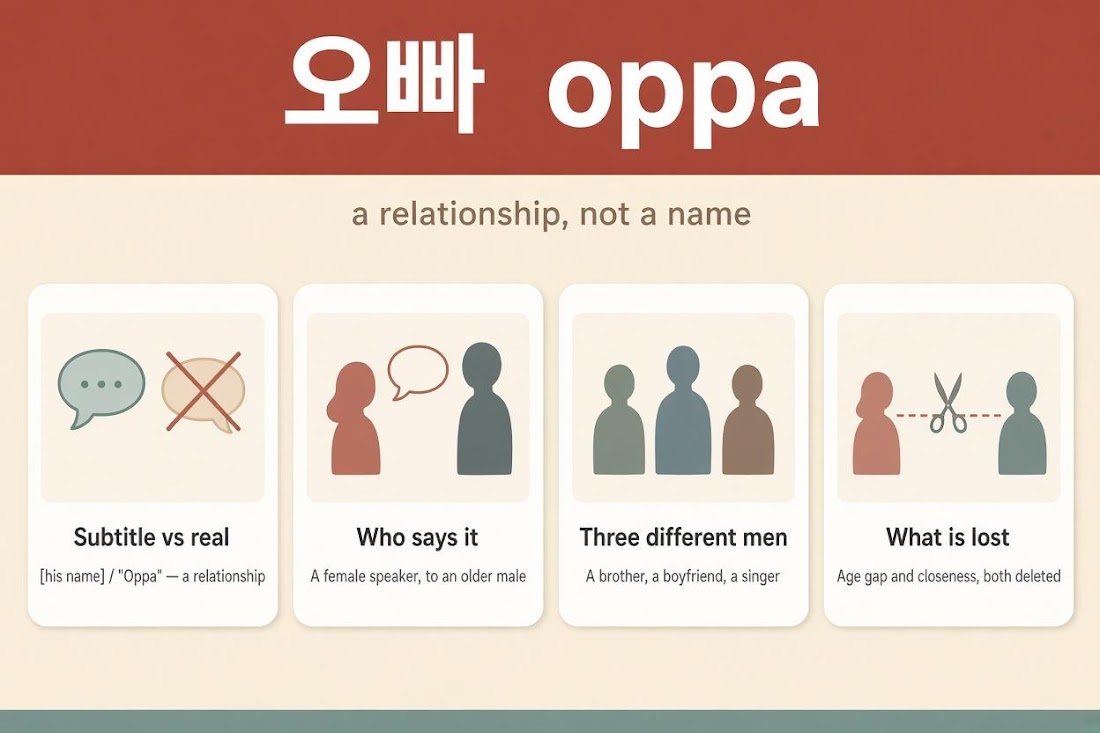
Short version: 오빠 (oppa) is what a female speaker calls an older male who is close to her. It encodes three things at once — the speaker is a woman, the person addressed is a man, and he is older — and English has no word that carries any of them. So subtitles substitute his name, and three pieces of information quietly vanish.
Where the word comes from
This is a native Korean kinship term, not a Sino-Korean import. The older and more formal forms are 오라비 and 오라버니, both still alive: you will hear 오라버니 in period dramas, and it sounds exactly as archaic to a modern Korean ear as “brother dear” does in English. 오빠 is the everyday contracted form, and it has drifted a long way from pure kinship.
The literal meaning is still “a woman’s older brother.” Everything else the word does is extension from there, and the extensions are what cause trouble.
The four things it can mean
In rough order of distance from the original sense:
- An actual older brother. The core use. Nothing complicated here.
- An older male friend, senior or colleague. No blood relation, no romance implied. A woman at university will call a male student two years above her 오빠 once they are on comfortable terms.
- A boyfriend or husband. Extremely common, and it persists well past the age where “older brother” makes any sense. Plenty of married women in their forties call their husband 오빠.
- A male idol or actor, from a female fan. Here it is doing something closer to a fan-culture address than a kinship one, and the age arithmetic frequently does not work at all.
One thing holds across all four: the speaker is female. A man does not say 오빠. He says 형. Korean kinship terms encode the speaker’s gender as well as the listener’s, which is why a single word tells you who is in the room.
The switch is a plot event
Because the word can be used for a senior or for a boyfriend, the move between those two uses is a real social event, and Korean dramas use it as a beat constantly.
A woman has been calling a man 선배 — senior — for eight episodes. Then in episode nine she calls him 오빠. The music does something. He stops walking. Nothing else in the sentence changed.
An English subtitle for that scene reads: “Jihoon.” It is not the subtitler’s fault. There is no English word that means “I am reclassifying our relationship,” and the alternative — a footnote in the middle of a love scene — is worse. But if you have ever wondered why an entire fandom lost its mind over a line that looked completely ordinary in English, this is usually the reason.
Fan use, and why it makes some people uncomfortable
Fans calling an idol 오빠 is standard and not in itself flirtatious. It functions as the default warm address for a male idol from a female fan, in the same slot where an English-speaking fandom might use a nickname.
The friction is that the word does have the boyfriend sense sitting right next to it, and the age logic often breaks: a thirty-five year old fan calling a twenty-two year old idol 오빠 is common enough to be unremarkable and still odd if you think about it for two seconds. Korean fandom discusses this. Some idols have gently asked fans to use their name instead. Some fans use 오빠 precisely because it is warmer than a name.
None of that reaches an English subtitle, which will render the whole thing as a name or simply as “you.”
If you are learning: be careful with this one
If you are a woman learning Korean, 오빠 is not a neutral substitute for a man’s name. Used on a man you do not know well, it reads as either a deliberate move toward intimacy or as slightly performative cuteness, depending on your tone. Neither may be what you meant. The safe options are his name with 씨 attached, or 선배 if he is senior to you in a school or workplace. Wait until he uses a casual register with you first.
If you are a man: you do not use this word at all. 형 is your equivalent, and using 오빠 will get a confused look at best.
What to listen for
Two moments are worth watching for. The first is the switch described above, from name or title to 오빠. The second is the reverse: a woman who has been using 오빠 suddenly using his full name. In Korean that is a slap, and in English it reads as nothing at all.
The tone variants
The word is short enough to be stretched, softened and played with, and each variation carries its own reading.
오빠야 is the Gyeongsang-province form, and outside that region it gets used deliberately for effect, usually playful. Dragging the vowel out into 오빠아 is straightforward 애교, the performed cuteness that Korean variety runs on. In writing, fans stretch it further than anyone would say it out loud.
Because of that association, a woman using the word with a heavy sweetened delivery is doing something quite different from a woman using it flatly to a colleague. Same word, and the two uses are barely related. Subtitles render both as a name.
Can a man ever say it?
As a joke, yes, and Korean variety does this constantly. A male cast member calling an older man 오빠 in an exaggerated voice is a standard bit, and it works precisely because the word is so firmly gendered. It reads as camp, and the laugh comes from the violation.
What does not happen is a man using it sincerely. If you hear it played straight from a male speaker, something unusual is going on in the scene.
Subtitling practice has actually changed
Ten years ago the standard approach in official subtitles was to substitute a name and move on. That is still common, but leaving 오빠 untranslated has become noticeably more acceptable as the audience has changed.
The argument for translating it is that a subtitle should not require homework. The argument for keeping it is that the audience already knows the word, often better than they know the character names, and that substituting a name introduces information the speaker did not give. Streaming platforms have drifted toward keeping it, and fan subtitles were there first by about fifteen years.
Read next
- Hyung, Nuna, Sunbae — three words your subtitle turned into “you”
- “-ssi” and “-nim” (씨 · 님) — the suffix that sets your rank
- The moment they switch to 반말 — what just happened between them
Last reviewed: September 20, 2026