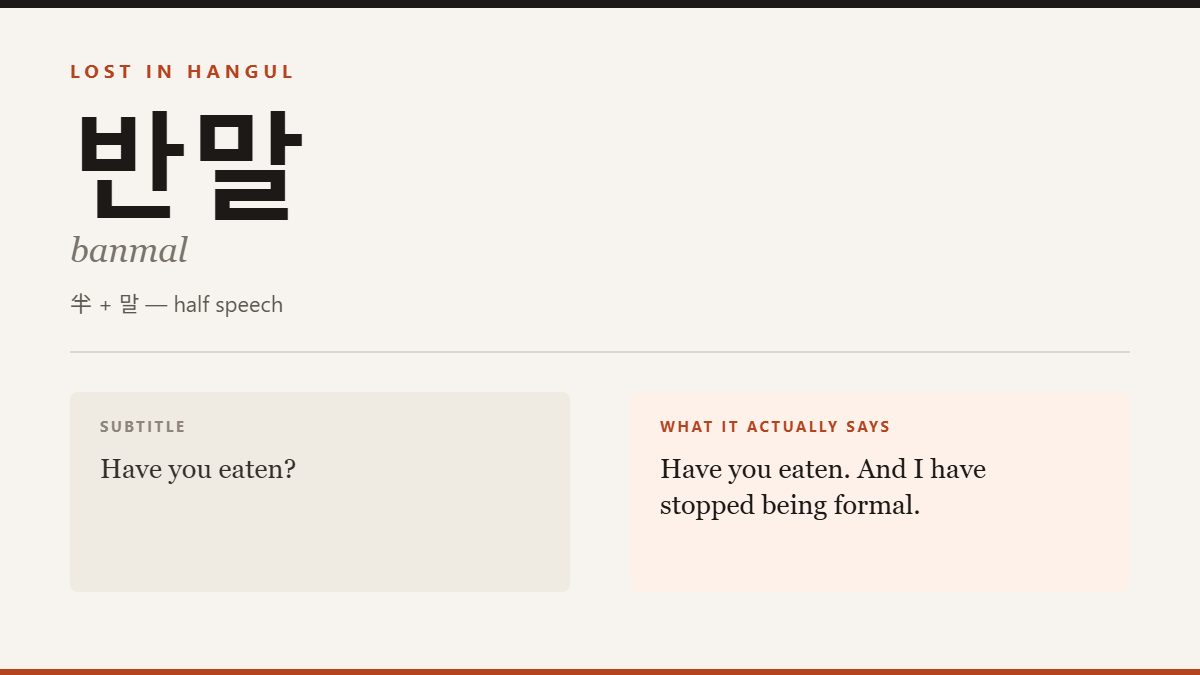
Short version: every Korean sentence has to pick a speech level, and the choice is made per listener. 반말 is the casual level. Switching into it is a visible act with two completely opposite meanings: either you have just been let in, or you have just been insulted.
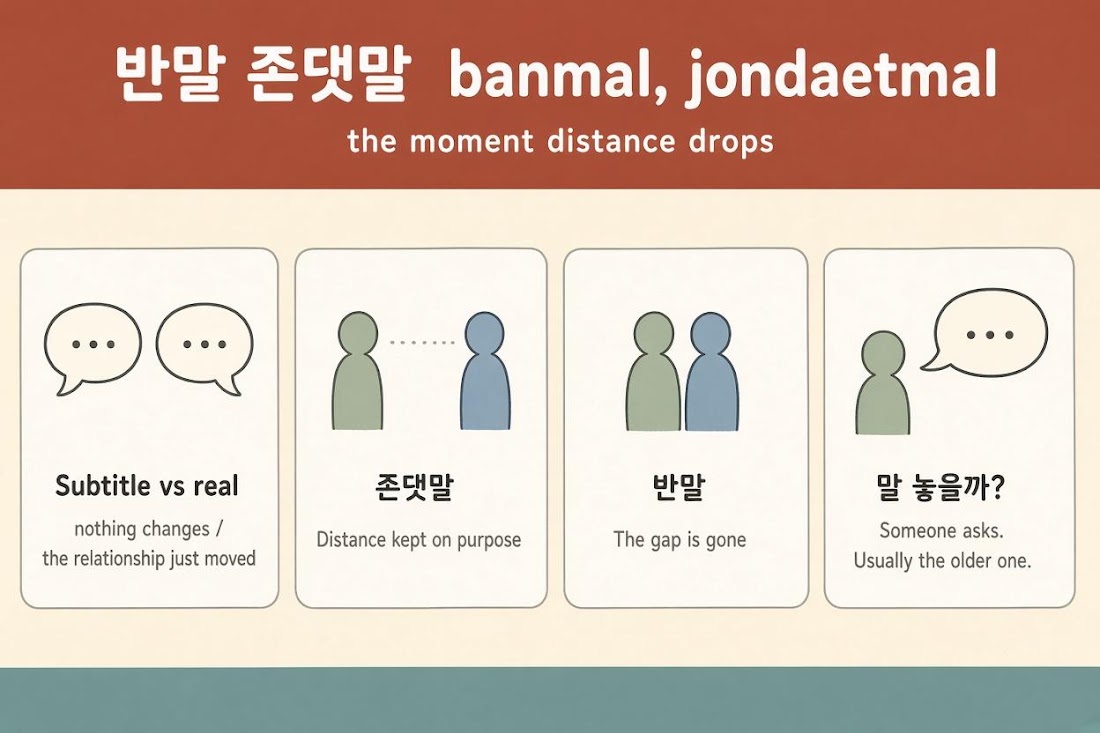
Where the words come from
반말 is 반 (半, half) plus 말 (speech). Half speech, in the sense that the polite endings have been cut off rather than that it is a different language. Its opposite is 존댓말, from 尊待, to treat with respect.
The mechanics are as simple as the names suggest. The sentence does not change. The ending does.
- 밥 먹었어요? → 밥 먹었어? — have you eaten?
- 어디 가세요? → 어디 가? — where are you going?
- 감사합니다 → 고마워 — thanks.
One or two syllables at the end of a clause, carrying the entire relationship. There is no English equivalent, because English politeness lives in word choice and hedging rather than in grammar. This is why a subtitle cannot show you the switch.
Three kinds of switch
1. Negotiated, both ways
The friendly one. Someone proposes it: 말 놓을까요? — shall we drop the formality? — or 편하게 해. If both agree, both switch, and the relationship has officially changed state.
Korean variety turns this into content. Two guests spend a whole segment working out whether they are there yet, someone gets politely refused, the edit adds a sound effect and a caption. It is a real negotiation and everyone watching understands the stakes.
2. One way, by right
A senior speaks 반말 downward while the junior answers in 존댓말. This is the default in most age-gapped Korean relationships and it is not rude. A teacher to a student, an older cousin to a younger one, a manager to a new hire.
English subtitles for these scenes read as two people speaking identically, which removes the visible asymmetry from every conversation in the show.
3. One way, without the right
And here is the fight. Using 반말 to someone who has not granted it, and who outranks or outages you, is a direct insult. It says you do not consider them worth the ending.
왜 반말이야? — “why are you speaking banmal to me?” — is a line that precedes a confrontation. In a drama, the villain establishes himself by using casual endings on someone older. A subtitle can only show that as ordinary dialogue, possibly a bit clipped.
The reverse move, which is worse
Less obvious and more brutal: switching up. Two friends who have used 반말 for years, and one of them starts answering in 존댓말.
That is not respect. It is the withdrawal of closeness, delivered grammatically, and it is unmistakable. Korean speakers describe the feeling as a door closing. In English this scene plays as one character suddenly being oddly polite, which reads as mild and is not mild at all.
What subtitlers can actually do
There are only bad options, and you can usually tell which one was chosen.
- Contractions and register. Formal lines get “Did you have dinner?” and casual lines get “You eaten?” It is subtle and it works better than it sounds.
- Adding “sir” or a title. Fast and blunt, and it makes Korean speech sound more stilted than it is.
- Ignoring it. Most common. The information simply does not cross.
For the confrontation scenes, some subtitlers write the meaning rather than the words — “Who do you think you’re talking to?” for 왜 반말이야?. That is not literal and it is usually the right call.
If you are learning
Default to 존댓말 with everyone, and never initiate the switch yourself unless you are clearly the older person. Being over-polite in Korean is a small, forgivable oddity. Being casual too early is not, and the person on the receiving end will not correct you. They will simply file it.
If someone offers, accept and actually switch. Being offered 말 놓자 and continuing to use polite endings reads as a refusal of the friendship, which is rarely what the learner means.
What to listen for
Watch the ending syllables rather than the subtitle. -요 and -습니다 mean the speaker is maintaining distance. When those drop out of one character’s lines and not the other’s, the relationship has just become unequal on purpose, and your subtitle will not mention it.
It is not a two-way switch
Calling it 반말 versus 존댓말 is the practical shorthand, but Korean actually runs several speech levels, and three of them turn up constantly.
| Level | Ending | Where you hear it |
|---|---|---|
| 해체 (banmal) | -아/어 | Friends, juniors, family. Most drama dialogue between equals. |
| 해요체 | -요 | The everyday polite default. Strangers, colleagues, shops. |
| 합쇼체 | -습니다 | Formal. News, announcements, the military, a junior to a senior in front of others. |
The jump from -요 to -습니다 is its own signal. A character who has been saying 했어요 and switches to 했습니다 has just made the conversation official, and often has bad news.
Written Korean does it too
On-screen captions in Korean variety shows are written in 반말 to the viewer. That is a deliberate choice: the caption is your friend elbowing you, not the programme addressing you formally. Idol messages to fans switch between levels depending on how intimate the platform is meant to feel.
None of this survives into an English subtitle, which has exactly one register available and uses it for everything.
Read next
- Hyung, Nuna, Sunbae — three words your subtitle turned into “you”
- “-ssi” and “-nim” (씨 · 님) — the suffix that sets your rank
- The Korean words subtitles always delete (and why translators do it)
Last reviewed: September 20, 2026