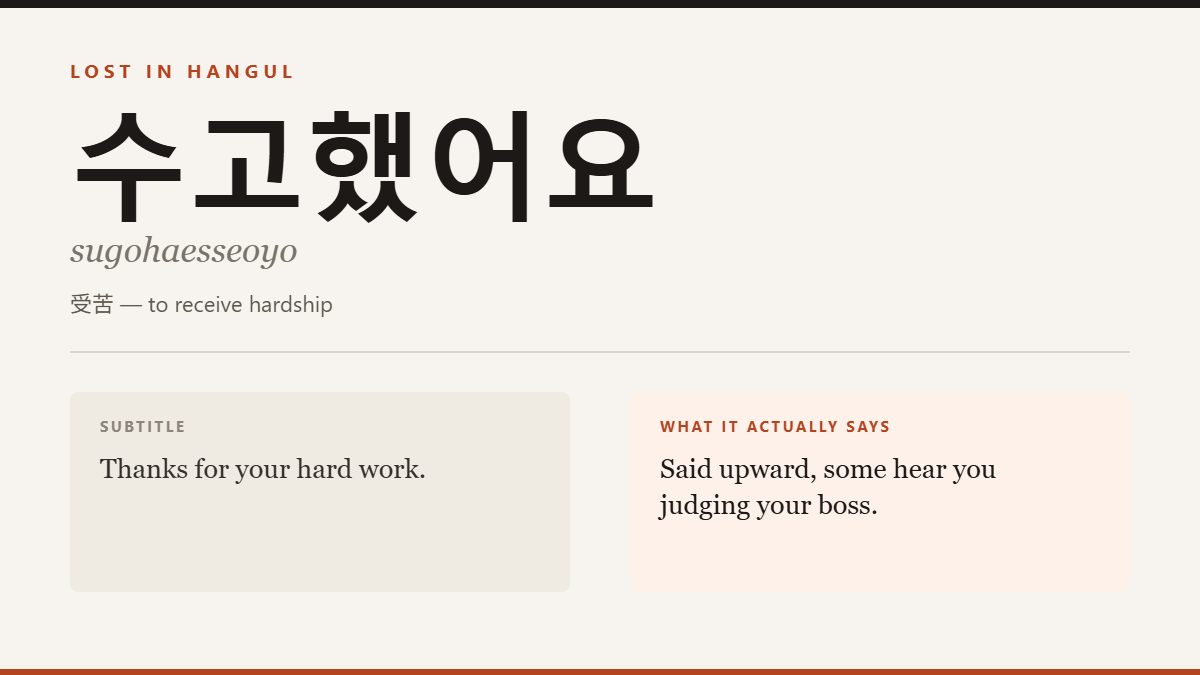
Short version: 수고 is the word for ordinary effort, and the phrases built on it are the most-used workplace sentences in Korea. They are also a minefield in exactly one direction: upward.
Where the word comes from
Dictionaries generally list 수고 as Sino-Korean, from 受苦 — to receive hardship. Some argue for a native origin, and modern speakers do not feel the hanja at all; it behaves like a plain Korean noun. Either way the root idea is the same as 고생: trouble taken, effort spent, something endured.
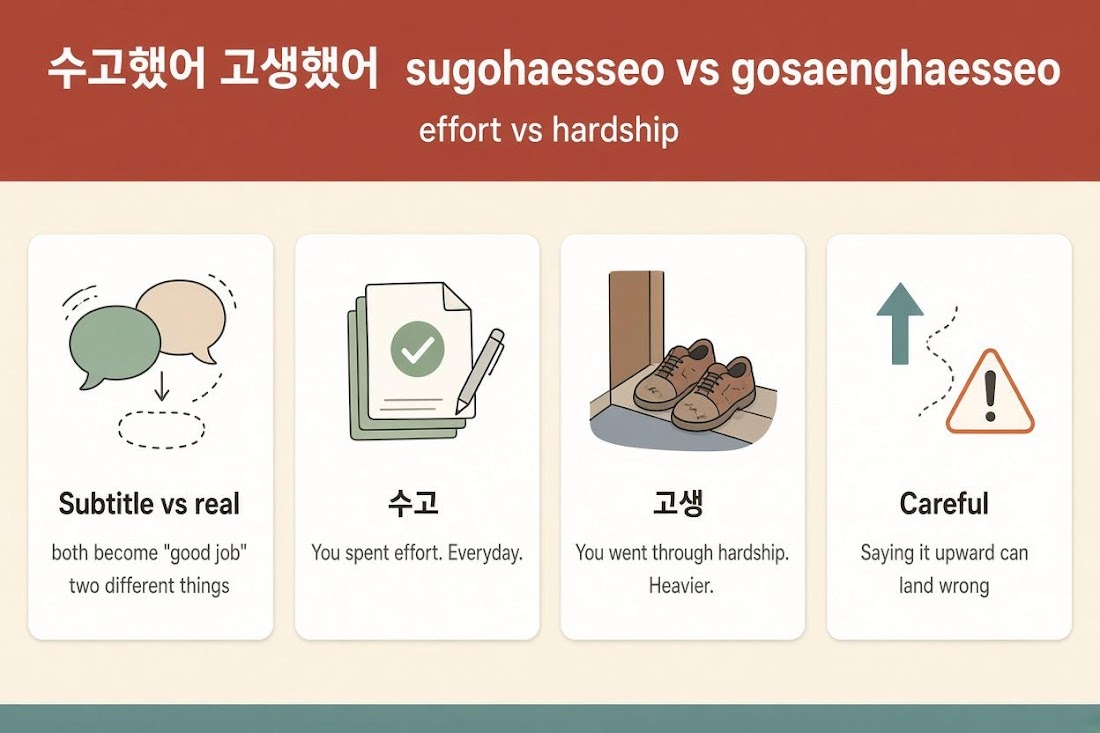
The practical difference is one of weight. 고생 is hardship. 수고 is just effort, the ordinary kind that a normal working day contains.
The three sentences
- 수고했어 — casual, past. To someone junior or close, at the end of something.
- 수고하셨습니다 — formal, past. The standard end-of-shoot, end-of-meeting, end-of-shift line.
- 수고하세요 — formal, present. Said to someone who is staying while you leave. Roughly “keep at it, and thanks.”
That third one has no English equivalent at all. English has no standard phrase for acknowledging that the person you are walking away from still has work to do. Subtitles usually render it as “goodbye”, which is accurate about the function and silent about the content.
The problem with saying it upward
Here is the part that gets written up in Korean etiquette columns every few months.
A meaningful number of older Koreans consider 수고하셨습니다 inappropriate when said to a clear superior. The reasoning is that the phrase evaluates someone’s labour, and evaluating is something that flows downward. A new employee telling a director they worked hard is, on this reading, standing in the wrong place to make that judgment.
Whether you find that convincing is beside the point. The relevant fact is that some people in the room believe it, and they are usually the ones with authority.
What to say instead, going upward
- 감사합니다 — thank you. Always safe, never wrong, and by far the best default.
- 고맙습니다 — thank you, slightly warmer and more native-feeling.
- 애쓰셨습니다 — “you exerted yourself”. Often recommended as the polite upward alternative, though it has its own critics who say it does the same evaluating.
If you take one thing from this article: going upward, use 감사합니다 and stop thinking about it.
It is also a generational split
Younger Korean workplaces use 수고하셨습니다 in every direction without anyone flinching. Group chats end with it. It is the last line of most work emails. Plenty of Koreans under forty have never heard the objection and are startled when they do.
This is one of the entries where the honest answer is that Koreans disagree with each other. It is not a rule with a clean edge. It is a live etiquette argument, and which side you encounter depends on the age of the person across from you.
And saying it to strangers
수고하세요 to a delivery driver, a cashier, a security guard at the door is extremely common and generally warm. There is a counter-current here too: some people find it condescending coming from a young customer to an older worker, for the same evaluating-from-above reason, and prefer 감사합니다.
You will hear both constantly. Neither will start a fight.
Where you hear it in variety and behind the scenes
At the end of a shoot, everyone says 수고하셨습니다 to everyone. Cast to crew, crew to cast, in overlapping waves. Idol group behind-the-scenes footage is full of it, usually shouted, often while people are already half out of the door.
The English subtitle for that scene is normally “Good work, everyone!” — which is fine, and misses that what is being performed is a small closing ritual rather than a compliment.
Quick comparison
| 수고 | 고생 | |
|---|---|---|
| Covers | Ordinary effort | Real hardship |
| To a stranger | Yes, normal | Rarely, too intimate |
| Present tense | 수고하세요, standard | 고생하세요, sounds hostile |
| Upward | Contested | Contested, same reason |
The present-tense row is the one that bites learners. 수고하세요 is a kindness. 고생하세요 tells someone to go have a hard time.
The leaving-work script
Because 수고하세요 handles the specific situation of walking away from people still working, it sits inside a small fixed exchange that plays out in every Korean office at the end of every day.
The person leaving says 먼저 들어가 보겠습니다 — “I will go in first,” meaning go home first — or the shorter 먼저 가 보겠습니다. The people staying answer 수고하셨습니다 or 들어가세요.
Every part of that is doing work. The leaver apologises, mildly and formulaically, for leaving first. The stayers release them. An English subtitle renders the whole exchange as “Bye” and “See you tomorrow”, which is what it functionally is and not remotely what it says.
In fandom
Fans use 수고했어요 constantly toward idols after a schedule, a concert or a comeback promotion. It is one of the most common phrases in fan messages, and it is doing the same thing it does in an office: acknowledging the day rather than praising the output.
Which is also why it can read oddly when translated. “Good work today!” from a stranger to a performer sounds presumptuous in English. 수고했어요 does not, because it is not a verdict.
Read next
- “Gosaenghaesseo” (고생했어) — why “good job” isn’t what he said
- “Jal meokgetseumnida” (잘 먹겠습니다) — not “bon appétit”
- The moment they switch to 반말 — what just happened between them
Last reviewed: September 20, 2026