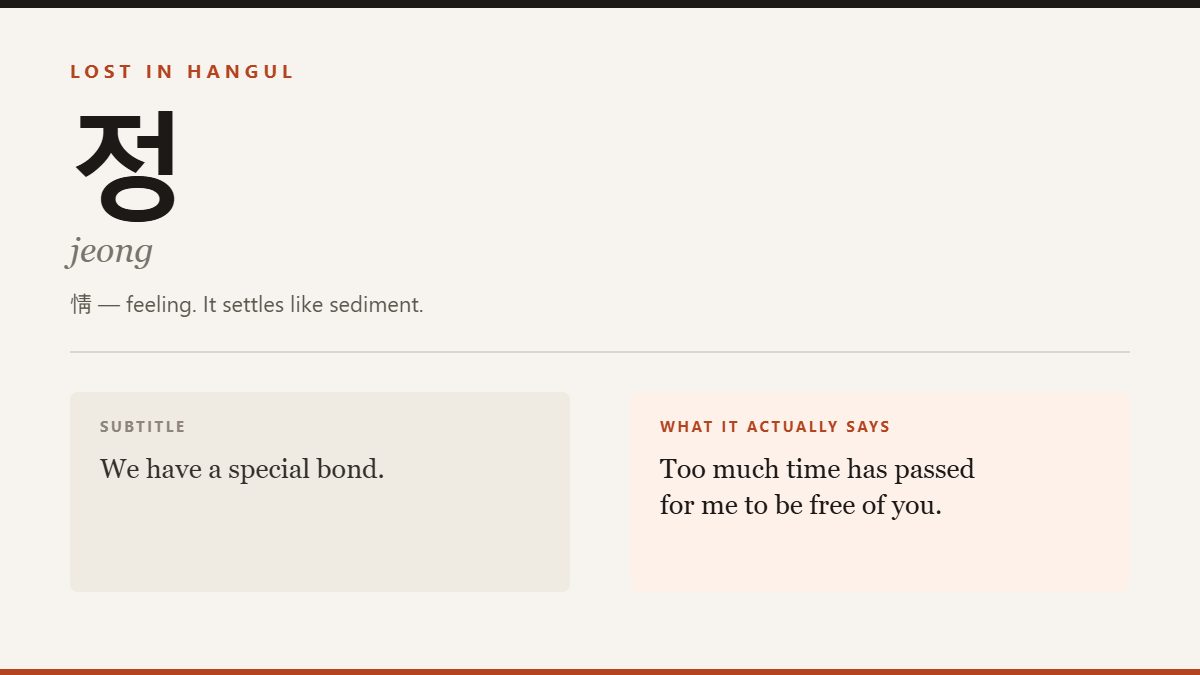
Short version: 정 (jeong) is the attachment that builds up between people through sheer time and proximity, whether or not they like each other. It is not a feeling you choose. It is closer to sediment than to affection.
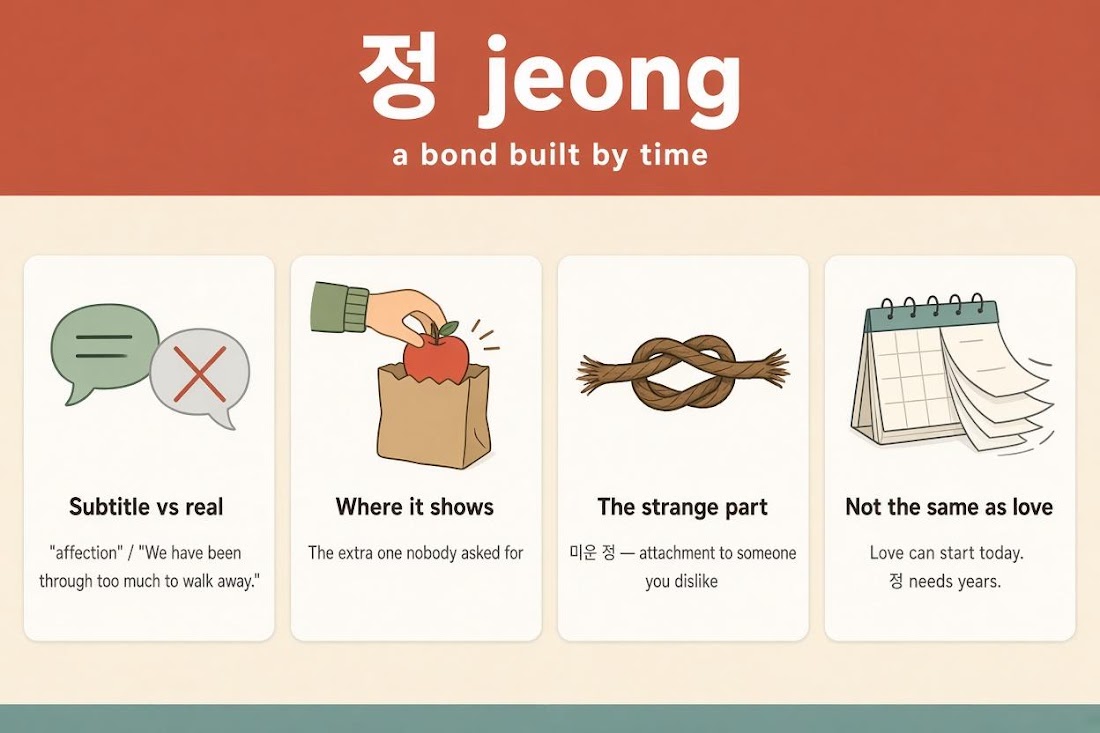
Every English word a subtitle reaches for here — affection, bond, attachment, warmth — smuggles in an assumption the Korean word never makes: that you feel positively about the person. Strip that assumption out and 정 starts working.
Where the word comes from
The character is 情, a Sino-Korean import meaning feeling or emotion in the broadest sense. The same character sits inside plenty of ordinary vocabulary across the region. What is distinctive in Korean is not the character but the fact that 정 survives as a standalone noun naming one specific social phenomenon, with its own set of verbs attached.
Those verbs are the tell, because they treat 정 as a substance rather than an emotion:
- 정이 들다 — jeong enters. It forms on its own, like damp.
- 정이 많다 — to have a lot of jeong, said of someone who attaches easily.
- 정이 떨어지다 — jeong falls off. Something the person did has detached you from them, usually permanently.
- 정을 주다 — to give jeong, and almost always said as a warning: do not give jeong to a stray, you will not be able to let it go.
You do not feel jeong the way you feel anger. It accumulates on you, and one day you notice it is there.
The property that breaks English: you can have it for someone you dislike
Ask a native speaker to explain the word and there is a stock phrase they will produce almost reflexively: 미운 정 고운 정 다 들었다. Roughly, both the ugly jeong and the lovely jeong have set in.
미운 정 is jeong for someone who has irritated you for years. It is not sarcasm and it is not a joke. Long marriages, difficult siblings, a boss you complain about daily and would still show up for. The phrase says the annoying years also built attachment, and that this is ordinary rather than a contradiction.
English has no word that does this. Bond gestures at it and immediately turns sentimental. That is the single biggest reason a subtitled 정 always feels softer than the original.
It is made of time, not chemistry
Two people can find each other mildly irritating for a decade and end up with more jeong than two people who clicked instantly six months ago. Which is why it turns up as an explanation in places where English would want a completely different reason.
| Situation | What jeong is doing there |
|---|---|
| Staying in a job everyone agrees is bad | You cannot leave the people. The work has nothing to do with it. |
| Not moving out of an old neighbourhood | The shopkeepers, the route home, twenty years of routine |
| A relationship continuing past the point of romance | 정 때문에 — “because of jeong”, said with resignation |
| Crying when a group disbands | Years in the same van at four in the morning |
That third row is not a compliment. “We are still together because of 정” is a fairly bleak thing to say about a relationship, and Korean listeners hear it that way.
It gets expressed by handing you things
Where English marks closeness with words, 정 tends to move through objects, usually food. The side dishes nobody ordered. The shopkeeper dropping one extra in the bag, which has its own word, 덤. A neighbour arriving with a plate. A mother packing food for an adult child who owns a perfectly good kitchen.
In variety shows, watch what happens right after someone is described as 정이 많은 사람. The edit will almost always cut to them feeding somebody.
One honest caveat
There is a lot of writing online claiming 정 is a uniquely Korean emotion that outsiders are incapable of feeling. That overstates it. People everywhere form attachments through time and proximity, including to people who annoy them. What is genuinely Korean is the packaging: that there is one short noun for it, that the noun has its own verb set, and that people offer it as a socially accepted reason for major life decisions. Having a word changes how often a thing gets named, not whether it exists.
Two neighbours it gets confused with
정 and 사랑 (love)
사랑 is directed and chosen. 정 is accumulated and largely involuntary. They sit in the same relationship all the time, and Korean talk about long marriages tends to frame it as love thinning while jeong thickens.
정 and 우정 (friendship)
우정 is friendship proper and requires mutual liking. 정 requires neither. You can have jeong with a landlord.
What to listen for
The line that gets flattened most often is 정들었어, jeong has set in, usually said right before a separation. A departing cast member, a final episode, a disbandment announcement. The subtitle will say “I have grown attached to you,” which is not wrong so much as thin.
What the speaker is actually saying is closer to this: time has done something to me that I never agreed to, and now leaving is going to hurt.
The rest of the 정 family
Once you can hear the root, a whole shelf of ordinary vocabulary opens up, and each member tells you something about how the concept is understood.
| Word | Literally | What it describes |
|---|---|---|
| 다정하다 | much jeong + to be | Warm, attentive, the person who notices you are cold |
| 무정하다 | no jeong + to be | Cold in a specifically unfeeling way, close to heartless |
| 정겹다 | jeong-laden | Used of places and scenes more than people. A market street, an old alley. |
| 인정 (人情) | person + jeong | Common decency, the human warmth you owe strangers |
| 정나미 떨어지다 | the taste of jeong falls off | Complete, final disgust with someone you used to be attached to |
The last one is worth keeping. It is much stronger than 정이 떨어지다 and it is what people reach for when a relationship is not just over but spoiled.
How it shows up on screen
Three recurring setups, all of which get thinned in subtitles.
- The market scene. A cast member buys something and the vendor adds extra without being asked. The show will caption this as generosity. What is being demonstrated is jeong as a transaction norm rather than a personal feeling.
- The reluctant goodbye. Someone is leaving a programme they claimed for months they did not enjoy. They cry anyway. This is not inconsistency and the audience does not read it as inconsistency, because jeong does not require having enjoyed it.
- The house guest who will not stop cooking. Feeding people is the default way to perform jeong, which is why so much Korean variety content is structurally just people making food for each other.
Is it the same as 한 (han)?
No, and it is worth separating them because they get bundled together constantly in English writing about Korea. 정 is relational and pretty concretely observable: it forms between specific people over specific time. 한 is usually described as accumulated grief or unresolved resentment, it is applied to a whole people rather than a pair, and it is a far more contested idea. A number of Korean scholars argue the popular version of 한 was shaped during the colonial period and later turned into a national branding exercise.
Put simply: ask ten Koreans about 정 and you will get ten similar answers. Ask them about 한 and you will get an argument.
If you want to use it
The safest sentence for a learner is 정들었어요, “I have grown attached,” said when leaving somewhere you stayed a while. It is warm, it is normal, and it does not overclaim.
What to avoid is announcing that you understand 정 as a concept. It lands the way “I really get your culture” lands in any language. Use the word about a specific place and a specific stretch of time and it will do its job.
Read next
- “Nunchi” (눈치) — subtitles say “reading the room,” and still miss it
- “Seounhada” (서운하다) — the hurt you feel slightly embarrassed about
- “Aswipda” (아쉽다) — a shame, and not the same as 서운하다
Last reviewed: September 20, 2026