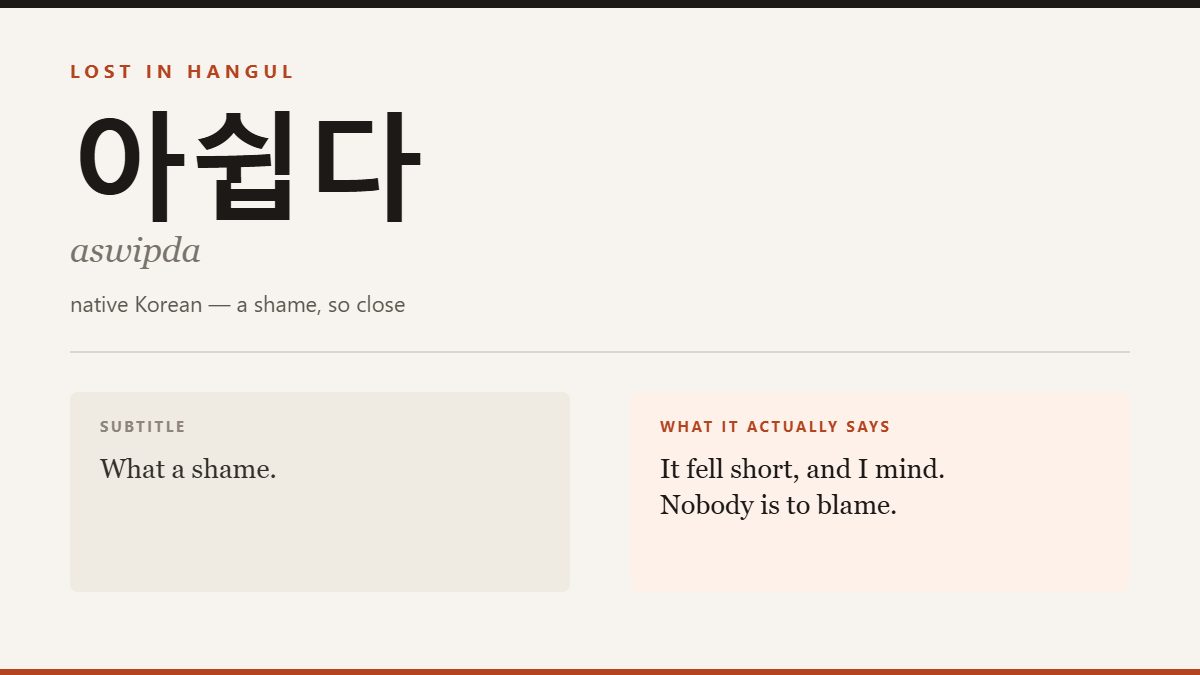
Short version: 아쉽다 (aswipda) is the feeling that something fell short or is ending, and that you mind. It is not sadness and it is not disappointment in a person. It is the ache of so close, or of already over.
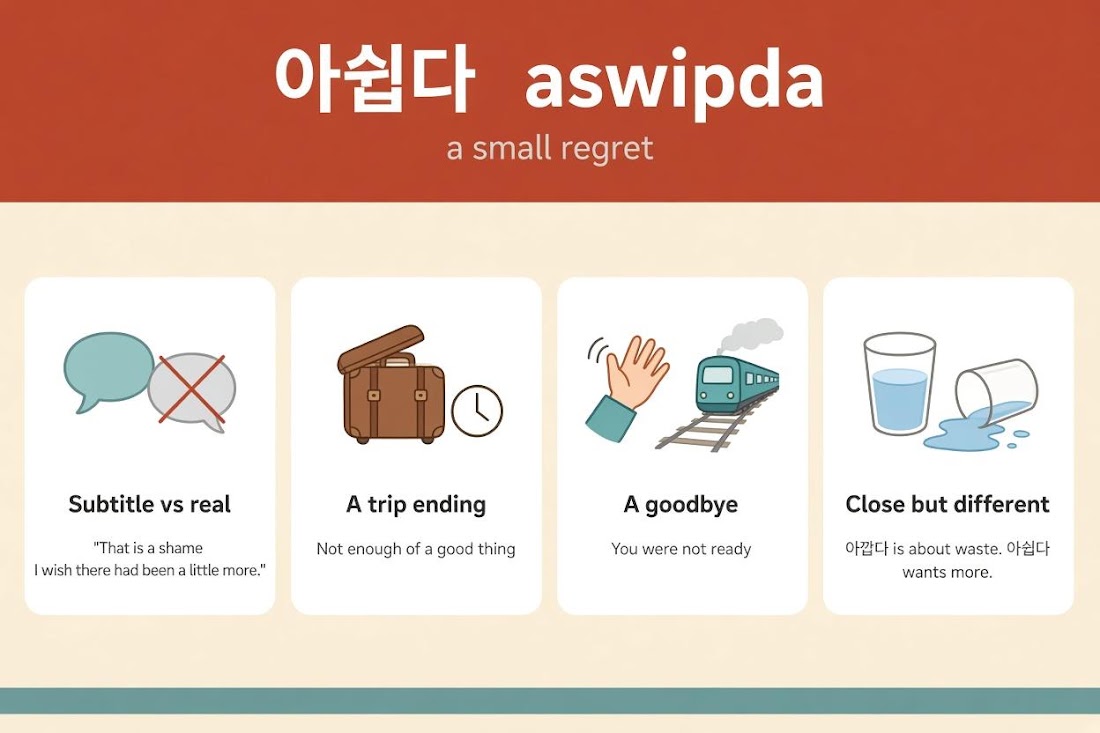
Where the word comes from
This is native Korean with no hanja behind it, and unlike 억울하다 or 정 there is no tidy character breakdown to hand you. The derivation of native Korean adjectives of feeling is often simply not documented, and it is better to say that than to invent a story.
What is clear is the shape of its use, and it splits cleanly into two situations.
Situation one: it fell short
A match lost by one point. An exam missed by two marks. A photo that would have been perfect if someone had blinked a second later.
Korean reaches for 아쉽다 in the gap between what happened and what nearly happened. The closer the near-miss, the stronger it gets. Losing 10-0 is not 아쉽다; losing 10-9 is.
English “what a shame” covers this and carries none of the proximity. “So close” carries the proximity and none of the feeling.
Situation two: it is ending
The last day of a trip. The final episode. Saying goodbye at an airport. A season of a show wrapping.
Here 아쉽다 means something like “I am not ready for this to be over”, and this is the use you will hear most in variety and interviews. The standard closing line of half the programmes in Korea is some version of 벌써 끝이라니 아쉬워요 — I can’t believe it’s already over.
The distinction that matters most
If you learn one thing here, learn the difference between 아쉽다 and 서운하다. They both describe a mild, wistful unhappiness, and they point at completely different things.
| 아쉽다 | 서운하다 | |
|---|---|---|
| Blames | Circumstances | A person |
| Implies | Nothing about anyone | That someone let you down |
| Safe to say to a colleague | Yes, always | No, it is an accusation |
| Typical trigger | A trip ending | Not being invited |
So when somebody leaves the company and you want to say something warm, 아쉬워요 is correct and kind. 서운해요 says you are hurt by them, which is not what you meant and is exactly what they will hear.
This is the single most useful pair on this site for anyone actually speaking Korean. One is a warm goodbye. The other is a complaint. They look equally mild in English.
The other neighbours
- 후회하다 — regret, about your own choice. 아쉽다 does not require that you did anything wrong.
- 안타깝다 — pity for someone else’s misfortune. Aimed outward, often at strangers or news stories.
- 섭섭하다 — the near-twin of 서운하다, so it falls on the person side of the line.
안타깝다 is worth separating carefully. If an athlete you have no connection to loses narrowly, you can feel either: 아쉽다 if you were invested in the result, 안타깝다 if you feel for them personally.
It also works as a mild complaint
In reviews and commentary, 아쉽다 is the polite way to say something was not good enough. 연출이 좀 아쉬웠어요 — “the direction was a bit lacking” — is gentler than any direct criticism and completely unambiguous to a Korean reader.
This is the use that gets flattened hardest. English subtitles write “it was a little disappointing”, which is blunter than the Korean and points at the work rather than at the gap between the work and what it could have been.
If you want to use it
아쉽다 or 아쉬워요 as a complete sentence. 아쉽네요 adds the “oh, I am noticing this” ending and sounds natural in conversation.
For a goodbye: 벌써 가신다니 아쉬워요 — “it’s a shame you’re already leaving.” Warm, safe, and correct for a colleague, a host, or someone you have just met and liked.
Read next
- “Seounhada” (서운하다) — the hurt you feel slightly embarrassed about
- “Eogulhada” (억울하다) — wronged, and unable to prove it
- “Nunchi” (눈치) — subtitles say “reading the room,” and still miss it
Last reviewed: September 21, 2026