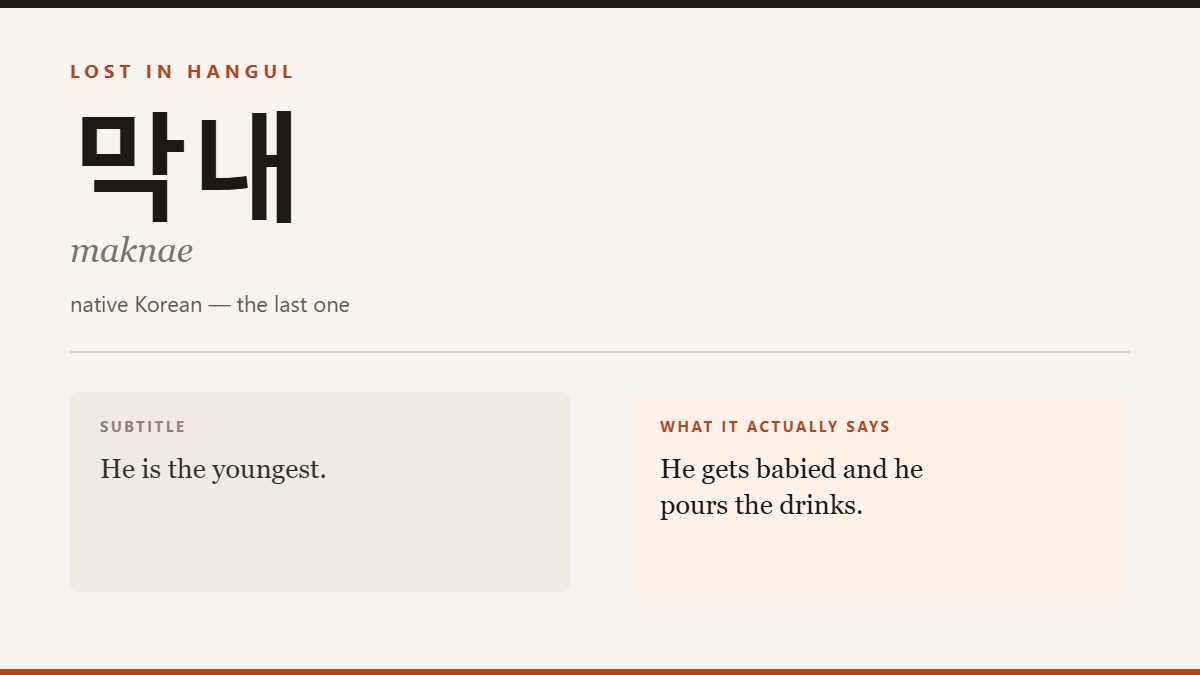
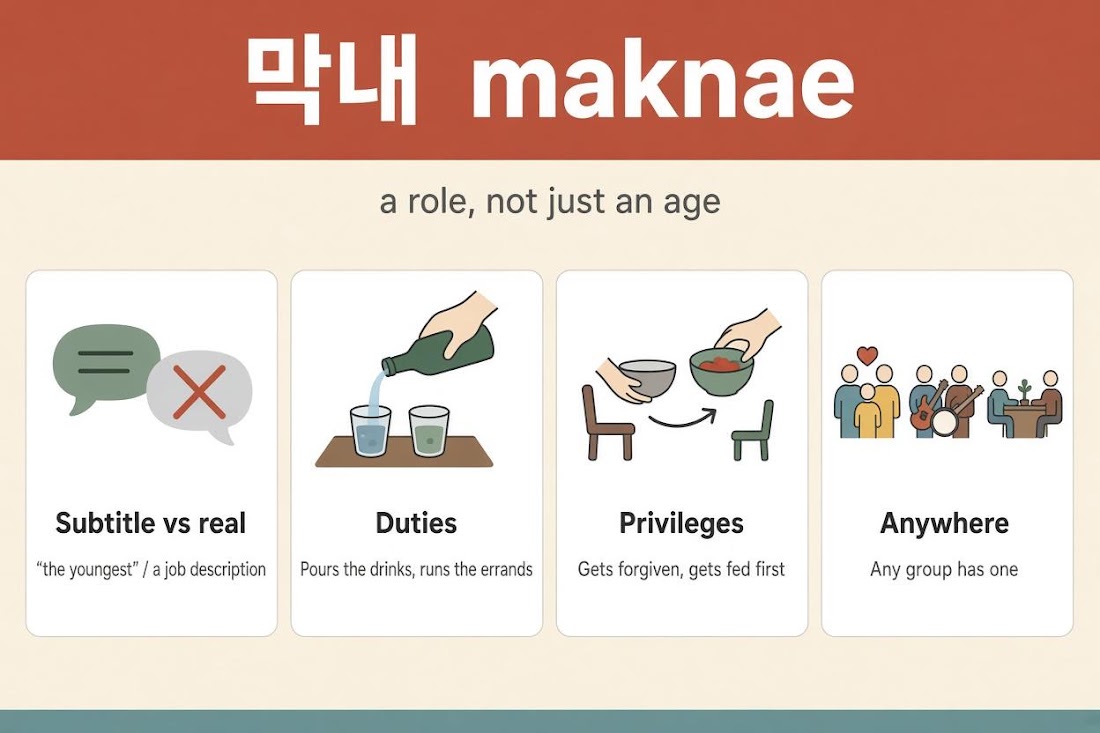
Short version: Korean does not just note who is youngest in a group. It turns birth order into a role with duties. 막내 is the youngest, and the word carries a job description that English “the youngest” does not.
Where the words come from
Both are native Korean. 맏 is a prefix meaning eldest, and it is productive: 맏형 eldest brother, 맏딸 eldest daughter, 맏이 the eldest child of a family. 막내 is the matching term at the other end.
There is a parallel Sino-Korean set that shows up in formal writing and paperwork: 장남 (長男) eldest son, 장녀 (長女) eldest daughter, 차남 second son. These are the words on a family register. The native ones are the words at the dinner table.
What the 막내 is actually for
The role comes with expectations, and Korean groups apply them fairly consistently whether the group is a family, an idol group, a workplace team or six friends at a barbecue.
- Gets indulged. The youngest is allowed to be spoiled, to complain, to be cute about it. Nobody minds.
- Does the errands. Pours the drinks, runs to the counter, carries things. This is not resented; it is the deal.
- Is protected. When something goes wrong externally, the older members put themselves in front.
- Is allowed less authority. The flip side. A 막내 who tries to direct the group is stepping out of position.
Which is why 막내 is a genuinely useful word and “the youngest” is not. One of them tells you what the person does.
In idol groups, it is a public identity
Fandoms use these words untranslated because there is nothing to translate them into. A group has a 맏형 or 맏언니, a 막내, and often a 형 라인 — the older members as a bloc.
There is also 막내온탑, “maknae on top”, for the youngest member who bosses everyone around anyway. The term only works because the expectation is so firm that violating it is funny.
It happens at work too
In a Korean office, 막내 means the most junior person, and the duties transfer almost unchanged: arrive first, handle the small logistics, pour for the seniors at dinner.
This is one of the things about Korean working life that gets criticised inside Korea, not just by outsiders. Younger employees increasingly push back on the 막내 errand expectations, and plenty of workplaces have dropped them. It is a live argument, not a settled custom.
The words around them
| Word | Means | Where you hear it |
|---|---|---|
| 막내 | Youngest, with duties | Everywhere |
| 맏형 / 맏언니 | Eldest, with responsibility | Families, groups |
| 맏이 | The eldest child | Families |
| 장남 / 장녀 | Eldest son/daughter (formal) | Documents, serious conversation |
| 늦둥이 | A child born long after the others | Families, affectionately |
맏이 carries its own weight, and it is the mirror image of 막내: the eldest is expected to absorb responsibility, to be sensible, and to be the one who does not get to fall apart.
What subtitles do
“The youngest” and “the oldest”, which are correct and inert. The information that gets lost is that these are positions rather than facts, and that everyone in the room is behaving according to them.
The scene that breaks is the one where someone says 내가 막내야? — “am I the maknae here?” — meaning why am I the one doing this. In English it reads as a question about age.
Read next
- Hyung, Nuna, Sunbae — three words your subtitle turned into “you”
- “-ssi” and “-nim” (씨 · 님) — the suffix that sets your rank
- Why she calls him “Oppa” (오빠) — and why the subtitle just uses his name
Last reviewed: September 21, 2026