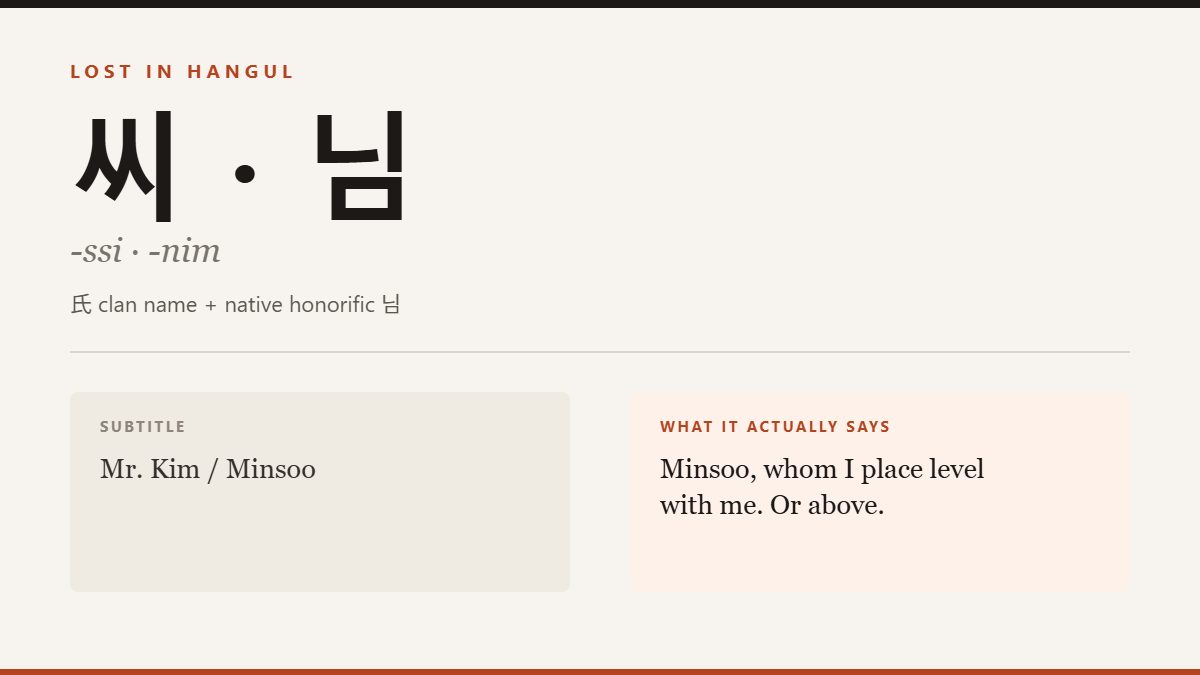
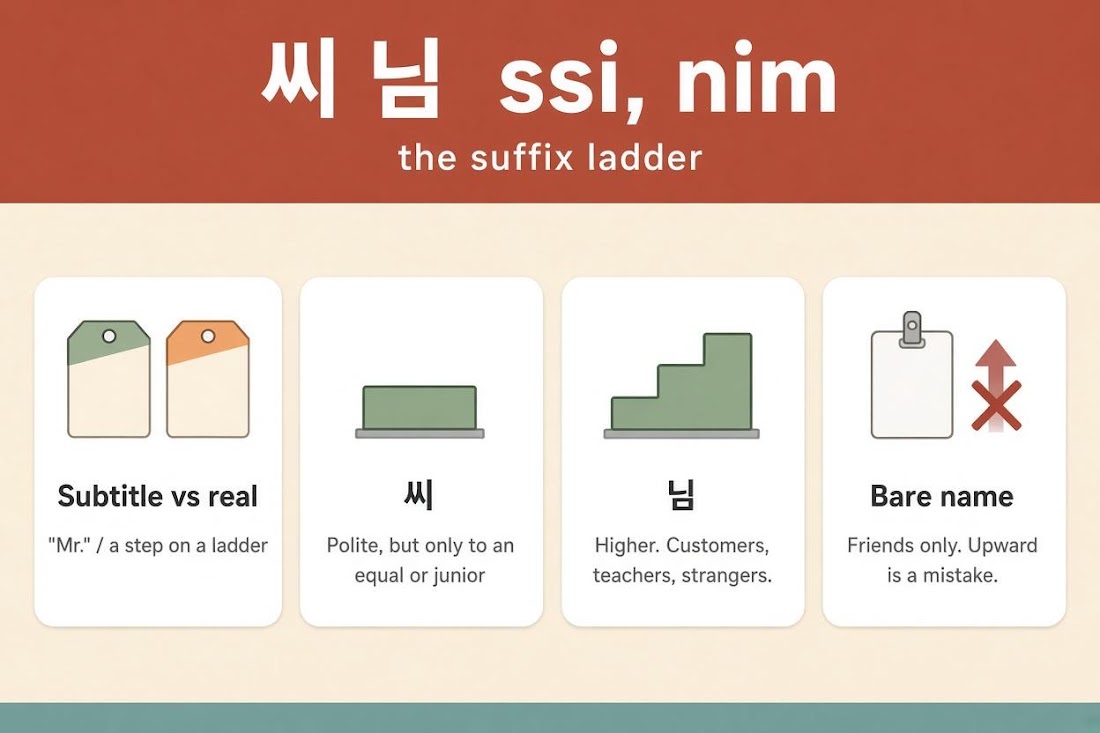
Short version: Korean attaches a suffix to names, and which one you pick is a statement about rank. 씨 is polite and level. 님 lifts the other person above you. Getting it wrong is one of the fastest ways to cause offence without noticing.
Where they come from
씨 is 氏, the hanja for a clan or family name. 님 is native Korean, and it is the same element you find welded onto 선생님 (teacher), 사장님 (company head) and 하느님 (God). It elevates whatever it is attached to.
There are two older ones you will meet in period dramas and almost nowhere else: 군 (君) for a young man and 양 (孃) for a young woman. Both now read as dated at best and patronising at worst.
The rules for 씨
This is where learners get into trouble, because 씨 behaves differently depending on how much of the name it is attached to.
| Form | Reads as |
|---|---|
| 김민수 씨 (full name + 씨) | Polite, neutral, slightly distant. Safe with a peer. |
| 민수 씨 (given name + 씨) | Polite and warmer. Colleagues who know each other. |
| 김 씨 (surname only + 씨) | Rude. Dismissive, the way you would refer to a stranger you are annoyed with. |
That third row surprises people, because it looks like the closest analogue to “Mr. Kim”. It is not. Surname plus 씨 is the form used for a labourer whose name you did not bother to learn, and it lands accordingly.
The other half of the 씨 problem: it is a peer-level suffix. Using it on someone clearly senior to you — an older colleague, a manager, a professor — is a downgrade, even though it feels polite. This is the mistake foreigners make most often, because every textbook introduces 씨 as “the polite one”.
What to use upward: title + 님
Korean workplaces mostly do not use names upward at all. They use the job title, with 님 attached.
- 사장님 — company president
- 부장님 — department head
- 선생님 — teacher, and also the default respectful address for a professional whose title you do not know
- 고객님 — customer, which is why every Korean shop assistant calls you this
선생님 is the useful one to remember. Aimed at a doctor, a lawyer, an older stranger you want to be respectful to, it works and costs nothing.
님 on its own, which is new
In the last couple of decades 님 detached itself and became a standalone pronoun online. 님 어디 사세요? — “where do you live?” — addressed to a stranger in a comment thread or a game lobby.
This is internet-native and would be strange in speech. It solves a real problem, though: Korean has no polite second-person pronoun, and the internet needed one for talking to people whose age and rank you cannot see.
What subtitles do
They drop it. Every time. English dialogue cannot carry a suffix, so 민수 씨 becomes “Minsoo”, 사장님 becomes “sir” or the person’s name, and the constant low-level rank marking in Korean dialogue disappears.
The visible casualty is the scene where someone changes the suffix. A character who has said 민수 씨 for twenty episodes and says 민수야 once has crossed a line. The subtitle says “Minsoo” both times.
If you are learning
Three rules that will keep you out of trouble. Never surname alone plus 씨. Never 씨 to someone senior. When unsure, use their job title plus 님, and if you do not know their title, 선생님.
Read next
- Hyung, Nuna, Sunbae — three words your subtitle turned into “you”
- “Maknae” (막내) — the youngest is a job, not a fact
- The moment they switch to 반말 — what just happened between them
Last reviewed: September 20, 2026