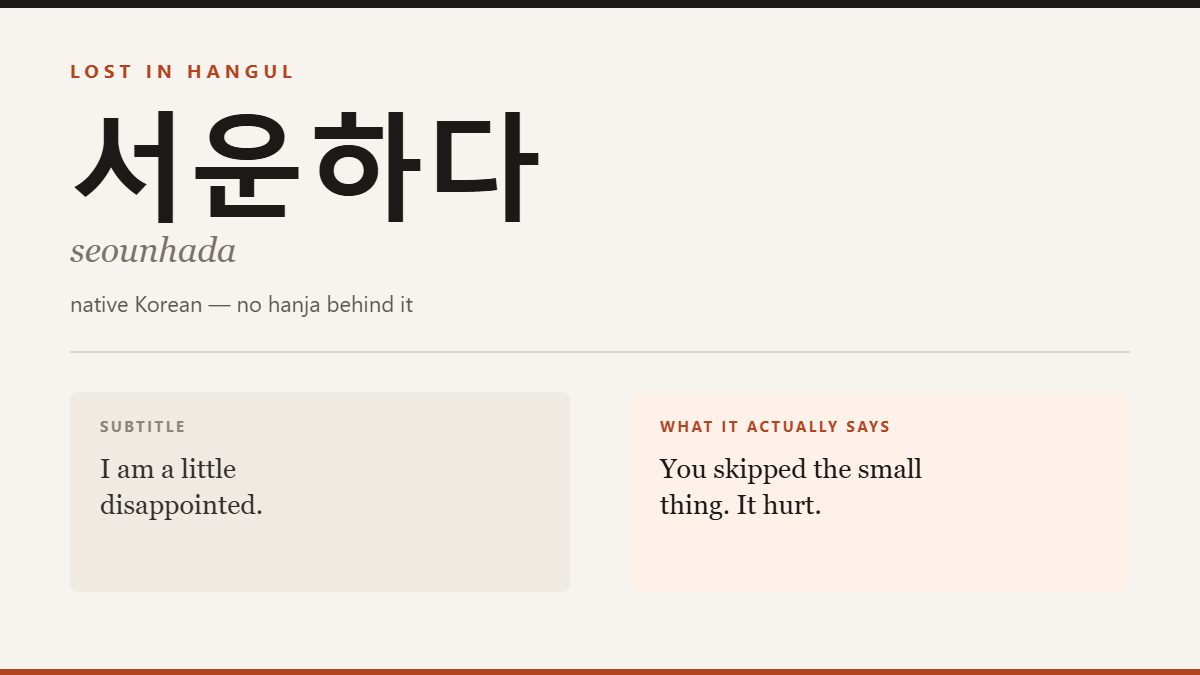
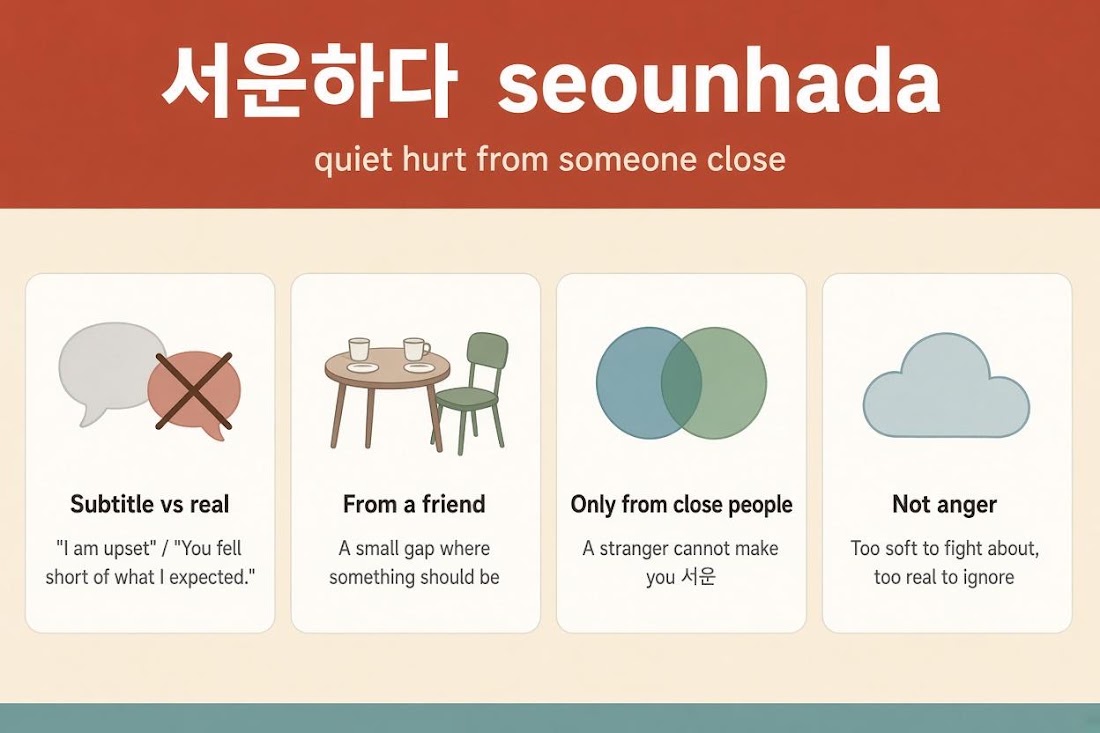
Short version: 서운하다 (seounhada) is the quiet hurt when someone close to you did not do the small thing you expected. Not anger. Not betrayal. A disappointment you feel slightly embarrassed about having.
Where the word comes from
This one is native Korean with no hanja behind it, and its derivation is not well documented. That is normal for Korean adjectives of feeling and it is worth saying plainly rather than inventing a story. It has a close cousin, 섭섭하다, which covers almost identical ground and sounds slightly more old-fashioned.
What the word does is much clearer than where it came from.
It only works with people you care about
This is the load-bearing property. A stranger cannot make you 서운. A colleague you are indifferent to cannot either. The feeling requires an existing relationship and an expectation that came with it.
So the word carries an admission. Saying 서운했어 means I expected something from you, which means you matter to me. That is why it is difficult to say and why it lands so heavily when someone does.
The triggers are always small
- Not being told first about something.
- Not being invited, even to something you would have declined.
- A birthday that went unmentioned.
- Someone leaving without saying goodbye.
- A friend who moved cities and stopped replying quickly.
None of these are offences. That is the point. 서운하다 is specifically the hurt that you cannot justify as an accusation, and Korean has a word for it precisely because it is so common and so hard to raise.
Saying it is the move
In Korean relationships, 서운해 functions as a checkpoint. It is how the smaller hurt gets put on the table before it becomes something bigger.
The standard reply is not defence. It is 미안해, 몰랐어 — sorry, I didn’t realise — and the matter usually closes there. A relationship where 서운하다 never gets said is not a relationship without friction. It is one where the friction is accumulating somewhere else.
The neighbours
| Word | What it means | Who it is aimed at |
|---|---|---|
| 서운하다 | Quietly hurt by a small omission | Someone close |
| 섭섭하다 | Near-identical, slightly older register | Someone close |
| 삐지다 | To sulk. Visible, and a bit childish on purpose. | Someone close |
| 아쉽다 | A shame, fell short | A situation, not a person |
| 화나다 | Angry | Anyone |
The distinction between 서운하다 and 아쉽다 is the one learners need most, and it is simple: 서운하다 blames a person, 아쉽다 blames circumstances. Telling a departing colleague 서운해요 implies they have done something to you. 아쉬워요 is the safe and warm one.
What subtitles do with it
“I’m disappointed” is the usual choice and it is too heavy. In English that sentence is a judgment, the thing a parent says. 서운해 is closer to a confession than a verdict.
“That hurt my feelings” is nearer in meaning and sounds more childish in English than the Korean does. “I was a bit sad” loses the fact that someone specific caused it.
There is no good option, which is why this word survives untranslated in fan discussion more often than most.
If you want to use it
서운해 to a friend, 서운했어요 politely. Use it about a specific thing that did not happen rather than as a general state.
Do not use it upward at work. Telling a manager 서운합니다 claims a closeness that may not be there and reads as a complaint dressed up as feelings. 아쉽습니다 is the version that will not cost you anything.
Why it is hard to say
There is a small social cost to 서운하다 that English “I’m disappointed” does not carry. Saying it concedes that you were keeping track, that you noticed, and that it mattered to you. For a certain kind of person that is more exposing than anger would be.
Which is why it so often arrives late, attached to something trivial, weeks after the fact, prefaced with 아니 근데. The delay is part of the shape of the word.
The reply matters
Answering 서운했어 with a justification — explaining why you did not call, why you did not invite them — is the wrong move and Korean speakers know it instinctively. The statement was not a charge to be defended against. It was a disclosure.
The right answer is short. 미안해. Sometimes 그랬구나, “so that’s how it was”, which acknowledges without agreeing to anything. Drama scripts use that second one constantly and subtitles render it as “I see”, which sounds cold and is not.
Read next
- “Aswipda” (아쉽다) — a shame, and not the same as 서운하다
- “Eogulhada” (억울하다) — wronged, and unable to prove it
- “Jeong” (정) — the bond English never got a word for
Last reviewed: September 20, 2026