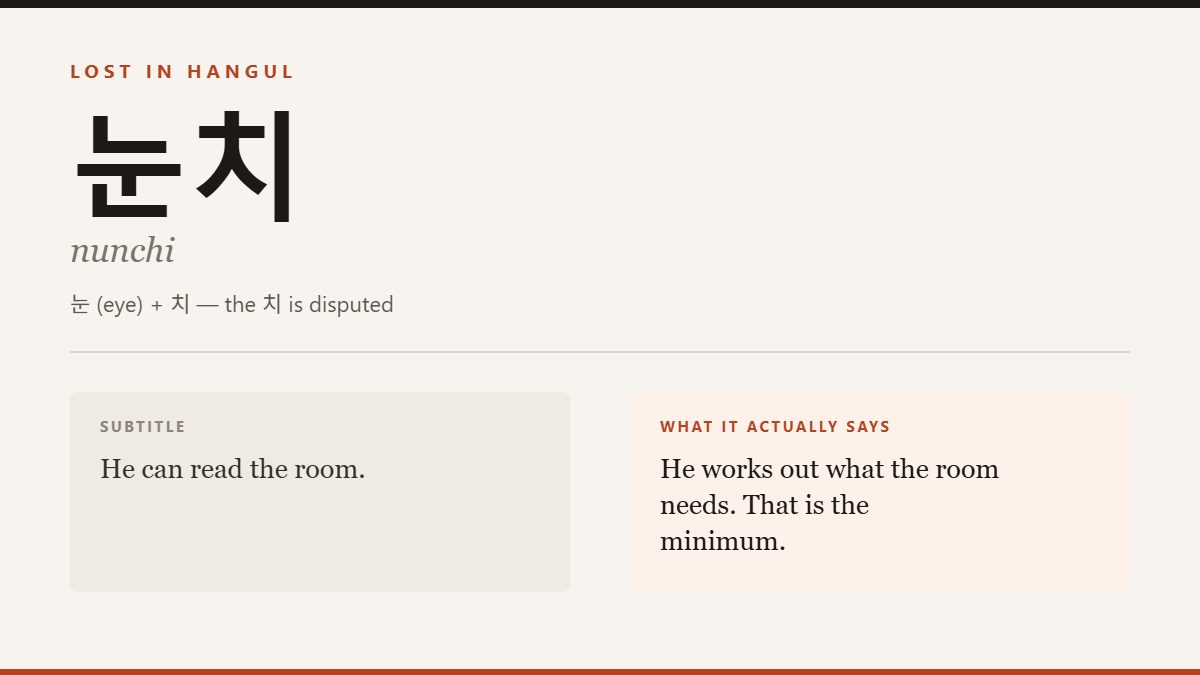
Short version: 눈치 (nunchi) is the ability to read a situation quickly and adjust without being told. The part subtitles never carry is that it is not a talent. It is an obligation. Not having it is a character flaw.
Where the word comes from
The first half is clear: 눈 is eye. The second half, 치, is where honest sources start hedging. It is generally treated as a noun-forming element, and you will find confident explanations online tying it to one hanja or another. Those explanations disagree with each other, which is usually a sign that nobody actually knows. What is safe to say is that the word is built on the eye, and that the whole concept is framed as something you do by looking.
That framing matters, because 눈치 is about information you take in through observation rather than through being told. Everything the word does follows from that.
It behaves like a possession
Korean treats 눈치 as a quantity a person has, which is why it takes such a strange spread of verbs.
| Phrase | Literally | What it means in practice |
|---|---|---|
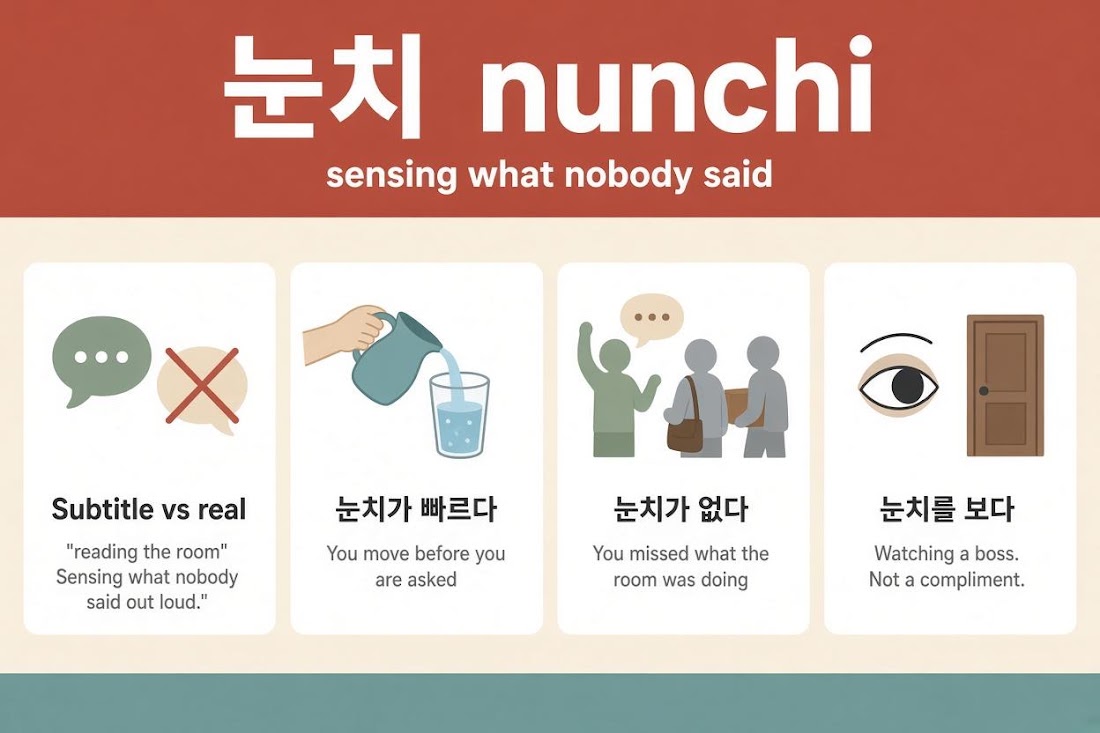
| 눈치가 빠르다 | nunchi is fast | Quick on the uptake. A compliment. |
| 눈치가 없다 | to have no nunchi | Oblivious. A real insult, not a light tease. |
| 눈치를 보다 | to watch someone’s nunchi | To keep checking someone’s mood, usually anxiously |
| 눈치를 주다 | to give nunchi | To signal disapproval without saying anything |
| 눈치채다 | to catch nunchi | To notice, to twig |
Two of those deserve a closer look, because they pull in opposite directions.
눈치를 주다 — the silent telling-off
This is the look across the table. The slight throat clear. The person who has said nothing and has made themselves completely clear. In a variety show it is the moment a cast member freezes mid-sentence because someone senior has done something with their face.
Subtitles usually cannot render this at all, because there is no dialogue to subtitle. The information is in the cut.
눈치를 보다 — and why it is not a compliment
Having fast nunchi is good. Watching someone’s nunchi is not. 눈치를 보다 describes the state of constantly monitoring a more powerful person for signs of displeasure, and it carries a distinct note of pity. 눈치 보지 마 — stop watching for my reaction — is something a decent boss or a kind older sibling says, and it means you do not have to be this careful around me.
So the same root covers both a prized social skill and the exhaustion of being the person who has to use it. That double edge is the thing English writing about nunchi almost always leaves out.
Why the skill is load-bearing
A lot of Korean interaction leaves the important part unsaid, because saying it plainly would force someone to state a status difference out loud. A senior does not usually refuse; they say something that a listener with working nunchi will correctly decode as a refusal.
The standard test case: you are the junior, it is late, and the senior says 괜찮아, 먼저 가 — “it is fine, go on ahead.” Do you go?
Sometimes yes, and sometimes that sentence means the opposite, and the difference is carried entirely by timing, tone, what happened an hour ago, and whether anyone else is still sitting down. Nobody is being manipulative. This is simply where the information lives.
Worth being careful here. This is not a claim that Koreans cannot say what they mean or that English speakers always do. Every language has indirect refusal. What differs is how much weight rests on it and how openly the decoding skill is named, graded and complained about.
The game named after it
If you watch variety, you have seen 눈치게임, the nunchi game. Everyone stands, and players call out numbers one at a time in order. Nobody is assigned a number. If two people speak at once, both are out. If you are the last one left, you lose.
There is no skill in it except watching everybody else and guessing when they are about to move. The game is a joke about the concept, and it is also a fairly exact model of it: read the others, commit at the right moment, and do not be the one who speaks over somebody.
Compliments and insults built on it
- 눈치 100단 — “level 100 nunchi”. High praise, usually for someone who defused a situation before anyone noticed there was one.
- 눈치가 밥 먹여주냐 — “does nunchi feed you?” Said by someone tired of tiptoeing.
- 눈치도 없이 — “with no nunchi at all”, attached to a description of someone barging into a moment they should have read.
Is it the same as emotional intelligence?
Close, and not the same. Emotional intelligence as usually described is about recognising and managing feelings, including your own. 눈치 is faster, more external, and much more concerned with rank. It is less “I understand how you feel” and more “I have worked out what this room now requires of me, and I have about two seconds.”
It also applies to things that are not emotional at all. Knowing which seat to take, when to refill someone’s glass, or when a meeting has actually ended regardless of what the agenda says, is all nunchi.
One caveat about the English-language version
Nunchi has had a run as a self-help concept in English, presented as a kind of quiet superpower. That version is flattering and somewhat off. In Korean the word is ordinary, frequently negative in use, and often describes a burden carried by whoever has the least power in the room. A junior employee with excellent nunchi is not living a life anyone envies.
What to listen for
When a subtitle says “he is quick” or “she caught on,” check whether the Korean was 눈치가 빠르다. And when a character is being criticised in a way that seems disproportionate for a small social misstep, it is usually because the accusation was 눈치가 없다, which in Korean is closer to calling someone careless with other people than to calling them clueless.
Three lines that need nunchi to parse
None of these are trick sentences. They are ordinary things people say, and in each case the surface meaning is not the operative one.
| What is said | Said by | What it usually means |
|---|---|---|
| 괜찮아, 먼저 가 “It’s fine, go on ahead.” | A senior, late at night | Sometimes exactly that. Sometimes: nobody leaves yet. |
| 생각해 볼게요 “I’ll think about it.” | Anyone, about a request | Usually no. Occasionally yes. The tone carries all of it. |
| 밥 한번 먹자 “Let’s get a meal sometime.” | An acquaintance | A friendly closing, not a plan. Proposing a date in reply is a nunchi failure. |
The third one catches learners constantly, and it is the most forgivable of the three, because English has the same move with “we should catch up sometime.” The difference is that Korean has a word for failing to notice.
Read next
- The moment they switch to 반말 — what just happened between them
- “Jeong” (정) — the bond English never got a word for
- “-ssi” and “-nim” (씨 · 님) — the suffix that sets your rank
Last reviewed: September 20, 2026