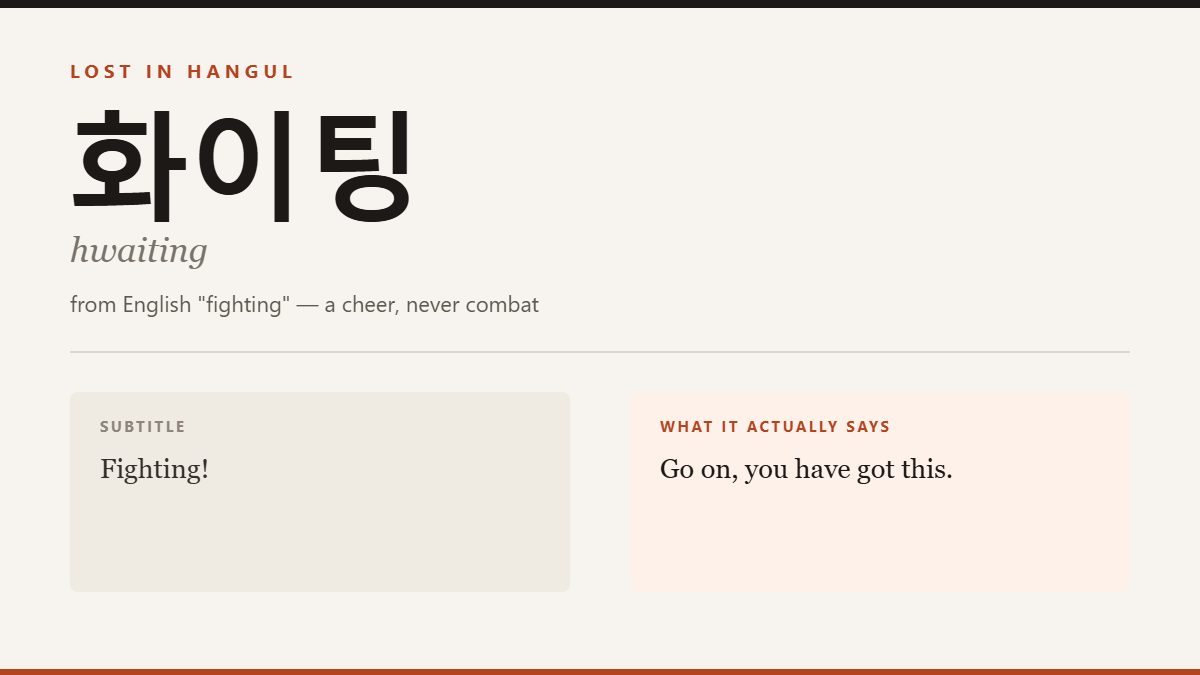
Short version: 화이팅 (hwaiting) comes from the English word “fighting” and has nothing to do with fighting. It means roughly “you can do this”, and it is said before the difficult thing, not during it.
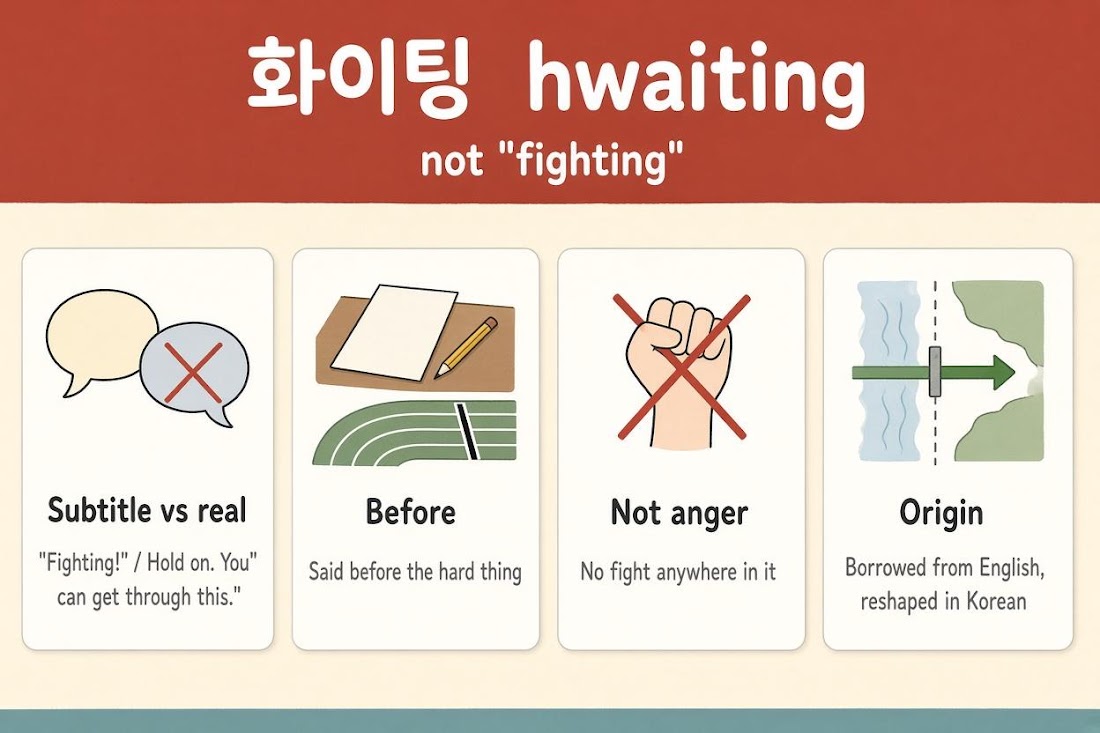
This is probably the single most familiar Korean word among non-Korean fans, and also one of the most reliably mistranslated, because the honest English subtitle is not a translation at all. It is a different sentence.
Where the word comes from
It is a loanword from English “fighting”, and it is generally traced into Korean through sports-cheering usage rather than from ordinary English conversation. The Japanese cheer 화이토 / faito is usually named as the intermediate step, though the exact route and timing get argued about and nobody produces a receipt. What is not in question is that the word arrived as a cheer and never meant combat in Korean at any point.
There is a small spelling curiosity attached. The National Institute of Korean Language prescribes 파이팅, following the standard rules for transcribing an English f. Almost nobody writes that. 화이팅 is what you will see on banners, in captions and in messages, by a wide margin. The prescribed form and the actual form have simply agreed to disagree for decades.
What it actually does
The timing is the thing English speakers get wrong. 화이팅 is said before, at the threshold of something demanding.
- Before an exam, an audition, a performance, a surgery, a job interview.
- At the start of a workday, often to nobody in particular.
- At the end of a message, the way an English speaker might sign off with “good luck”.
- Shouted by a group with fists raised, often after 아자아자.
It is not said to someone in the middle of suffering. That is a different word, and mixing them up is the most common learner mistake here.
The word it is not: 힘내
힘내 means “produce strength” — 힘 is strength, 내다 is to put out. It is for someone who is already struggling, grieving, exhausted or losing.
| 화이팅 | 힘내 | |
|---|---|---|
| Timing | Before the hard thing | During or after it |
| Mood | Energetic, upbeat | Gentle, sometimes sombre |
| Said at a funeral? | Never | Yes |
| Closest English | “You’ve got this” | “Hang in there” |
Saying 화이팅 to someone who has just failed something badly lands as cheerful and slightly deaf. Saying 힘내 to someone about to walk on stage reads as though you expect them to lose.
Why the subtitle “Fighting!” is a problem
Leaving it as “Fighting!” preserves the sound and destroys the meaning, because an English speaker hearing “Fighting!” reads either aggression or nonsense. A viewer who has watched a lot of Korean content eventually learns to read it as a cheer, which is the only reason the practice survives.
The alternatives all trade something away. “You can do it” is accurate and long. “Let’s go” is the right energy and loses the direction — 화이팅 is usually aimed at someone else, not at the speaker. “Good luck” is close but implies chance, where 화이팅 implies effort.
Increasingly subtitlers just keep it, in the same way they have started keeping 오빠. The audience got there first.
In fandom
The word is everywhere in fan culture, on banners, in fanchants, in the standard 오늘도 화이팅 — “fighting today as well” — that gets posted every morning by everyone to everyone. Idols say it to fans, fans say it to idols, and cast members say it to each other before a game segment that has no stakes whatsoever.
That last case is worth noticing. The word is not reserved for serious moments. It is closer to a verbal fist-bump than to a blessing, and its frequency is part of the meaning: constant, low-stakes, slightly performative encouragement.
If you want to use it
Almost impossible to get wrong, as long as the timing is right. 화이팅! on its own is complete. 오늘도 화이팅 works as a morning message to anybody you are on casual terms with. For politeness, 화이팅하세요.
One caution: it is casual. It would be an odd thing to say to a senior colleague in a formal setting, not because it is rude but because it is too breezy for the room.
The gestures that come with it
The word is physical in a way that does not reach a subtitle at all. The standard accompaniment is a fist raised to shoulder height, sometimes both, sometimes with a small downward pull as the second syllable lands. Groups do it in unison, badly, and that is part of the joke.
아자아자 화이팅 is the full chant version. 아자 on its own is an older exclamation of self-encouragement, roughly “come on”, and pairing the two doubles the energy. You will see it before game segments, before a group photo, before absolutely nothing at all.
There is also the quiet version: 화이팅 said flatly, under the breath, to oneself, before walking into a room. Korean uses the same word for a stadium chant and for a person steadying themselves at a door.
What to listen for
Watch for 화이팅 being used sarcastically, which happens often in variety. A cast member about to do something humiliating gets a chorus of it, and the humour is in the gap between the word’s sincerity and the situation. English subtitles print “Fighting!” with an exclamation mark and the irony evaporates.
Read next
- “Gosaenghaesseo” (고생했어) — why “good job” isn’t what he said
- “Daebak” (대박) — one word, four completely different meanings
- “Aigoo” (아이고) — one sound doing six different jobs
Last reviewed: September 20, 2026