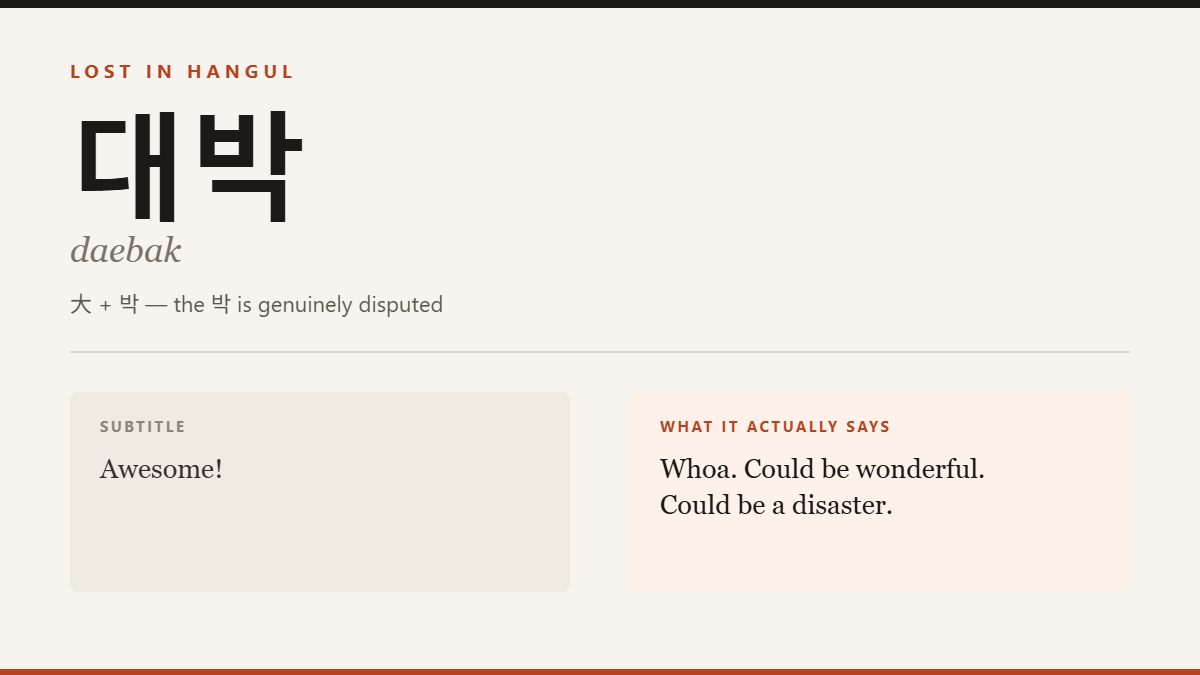
Short version: 대박 (daebak) is the word for a hit, a jackpot, a windfall. As an exclamation it has drifted into an all-purpose “whoa” that can be delighted, appalled or merely startled, and the direction is carried entirely by tone.
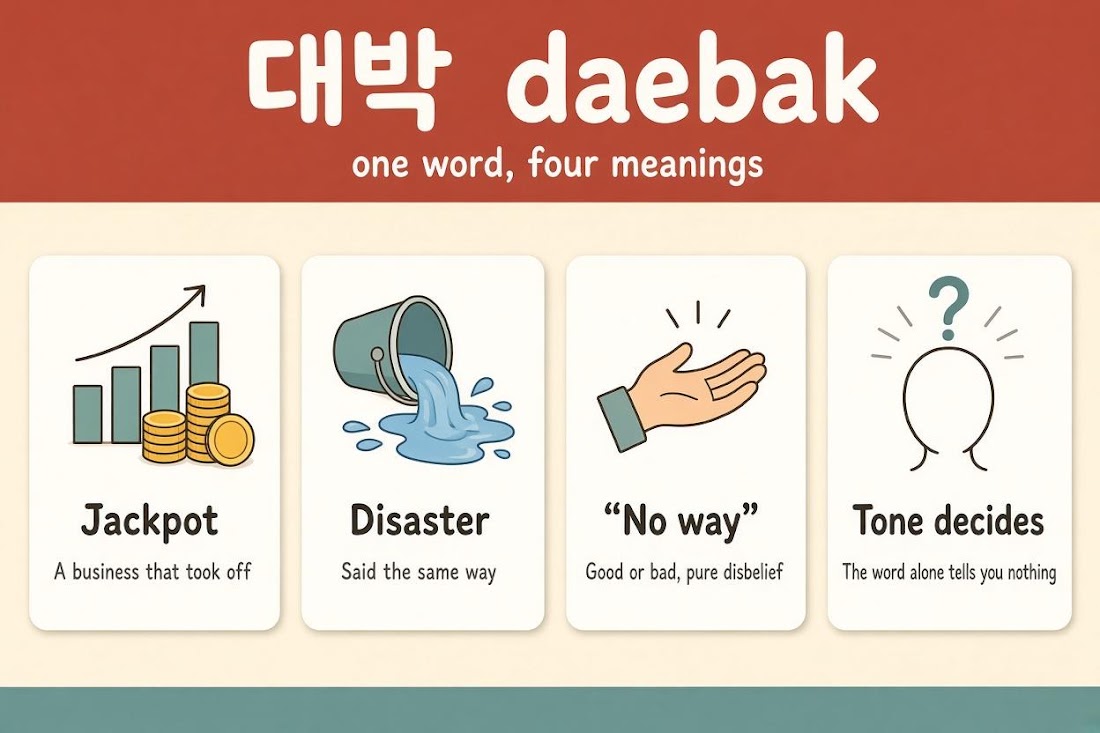
Where the word comes from, honestly
This is one where the polite answer is that nobody is certain, and anyone telling you otherwise online is picking a favourite. The 대 is almost certainly 大, big. The argument is about 박.
The most popular account ties it to 박, the gourd. In the folk tale of Heungbu, the poor brother’s gourds are cut open and pour out treasure, so a “big gourd” becomes a sudden windfall. It is a satisfying story, it fits the meaning, and it has the shape of a folk etymology constructed after the fact.
A competing account points to 大舶, a large trading ship, with the windfall being the cargo. There are others. Korean dictionaries tend to be cautious about all of them.
The reason the gourd version is hard to dismiss entirely is 쪽박, “small gourd”, which means going bust — 쪽박 차다, to carry the small gourd, is to be reduced to begging. The pair looks like a system. It is also exactly what you would expect if speakers built the opposite term later by analogy, which is why it settles nothing.
If you see a blog stating flatly that 대박 comes from Heungbu’s gourds, that is one theory presented as a fact. The useful thing to know is that the word means windfall, and that its origin is genuinely open.
The three jobs it does
1. A noun: a hit
대박 나다 is to become a huge success. Used about films, albums, restaurants, businesses, dramas. 대박 났어 about a shop means it is packed every day. This is the oldest and least slangy use, and it is the one that shows up in newspaper headlines without anyone blinking.
It also survives in the standard New Year greeting 새해 대박 나세요 — may you have a huge year — which is cheerfully mercenary in a way English new-year wishes usually are not.
2. An exclamation
On its own, 대박 is a complete sentence. Someone shows you a photo, you say 대박. Someone tells you their rent went up forty percent, you also say 대박.
This is the use that trips up subtitles, because English splits those two reactions into different words. “Awesome” cannot do the second one. “No way” cannot do the first. Korean uses the same two syllables and lets delivery sort it out, which is why the same caption gets printed in a variety show over a beautiful sunset and over someone dropping a tray.
3. An intensifier
More recently it has slid into adverb territory: 대박 맛있어, insanely tasty. 대박 웃겨, hilarious. This is casual to the point of sloppy, plenty of older speakers dislike it, and it is completely standard among younger ones. If you are learning, it is worth understanding and not worth producing.
Where it sits on the register scale
Firmly casual. It is fine among friends, fine in a group chat, fine shouted at a television. It is not fine in a business email, a formal presentation or a first meeting with someone senior, where it will read as juvenile rather than rude.
Variety captions use it constantly, which skews the impression learners get. On-screen Korean captions are written in the most casual register available on purpose, so the word appears far more often in subtitled content than it does in careful speech.
What subtitlers do with it
| Context | Common subtitle | What it misses |
|---|---|---|
| Reacting to something impressive | Awesome! / Amazing! | Fine. Little lost. |
| Reacting to bad news | No way! / Oh my god! | Fine, but now it looks like a different word |
| 대박 났어 about a business | It was a huge hit | Nothing much |
| Deadpan, flat delivery | Wow. | The dryness, which was the joke |
The fourth row is the interesting failure. A flat, unimpressed 대박 is a standard comic beat, and “Wow.” with a full stop is about the best English can manage.
If you want to use it
As a reaction, it is nearly impossible to misuse among friends. 대박 with rising intonation reads as delighted, with falling intonation as stunned. Both are correct.
The thing to avoid is using it upward or in formal settings. If you want the same reaction with the register raised, 정말요? or 와, 대단하네요 will do the job without making anyone wince.
The opposite word, and the vocabulary it sits in
쪽박 — small gourd — is the mirror of 대박. 쪽박 차다, to carry the small gourd, means to be ruined, and the image behind it is a beggar holding a bowl. 쪽박 났어 about a business is the exact inverse of 대박 났어.
Both sit in a wider vocabulary of sudden fortune that Korean has a lot of, much of it from gambling and lottery talk. 한방 — one shot — is the single decisive win. 인생역전 is “life reversal”, the windfall that changes everything. None of this is unusual in a language, and it does tell you what kind of concept 대박 is: not achievement, luck.
Hearing which one you got
Since the same word covers delight and horror, the delivery is the whole message, and it is fairly consistent.
- Rising, stretched, loud. 대바아악. Delighted. Usually with the hands somewhere near the face.
- Falling, short, quiet. Appalled, or sympathetic. Often followed by a pause.
- Flat, no inflection at all. Unimpressed. This is a joke, and it is a joke because the word is supposed to be loud.
Subtitles get the first one right, approximate the second and lose the third entirely.
It is also completely respectable
Worth noting because the slang uses can make it look newer than it is. 대박 appears in newspaper headlines about box office numbers, in business writing about product launches, and in the standard New Year wish. Only the exclamation and the adverb uses are casual. The noun is just a word.
Read next
- “Injeong” (인정) — the one-word agreement that took over Korean variety
- “Gukrul” (국룰) — the national rule nobody voted on
- “Kkuljaem” and “Nojaem” (꿀잼·노잼) — how Koreans rate whether it was fun
Last reviewed: September 20, 2026