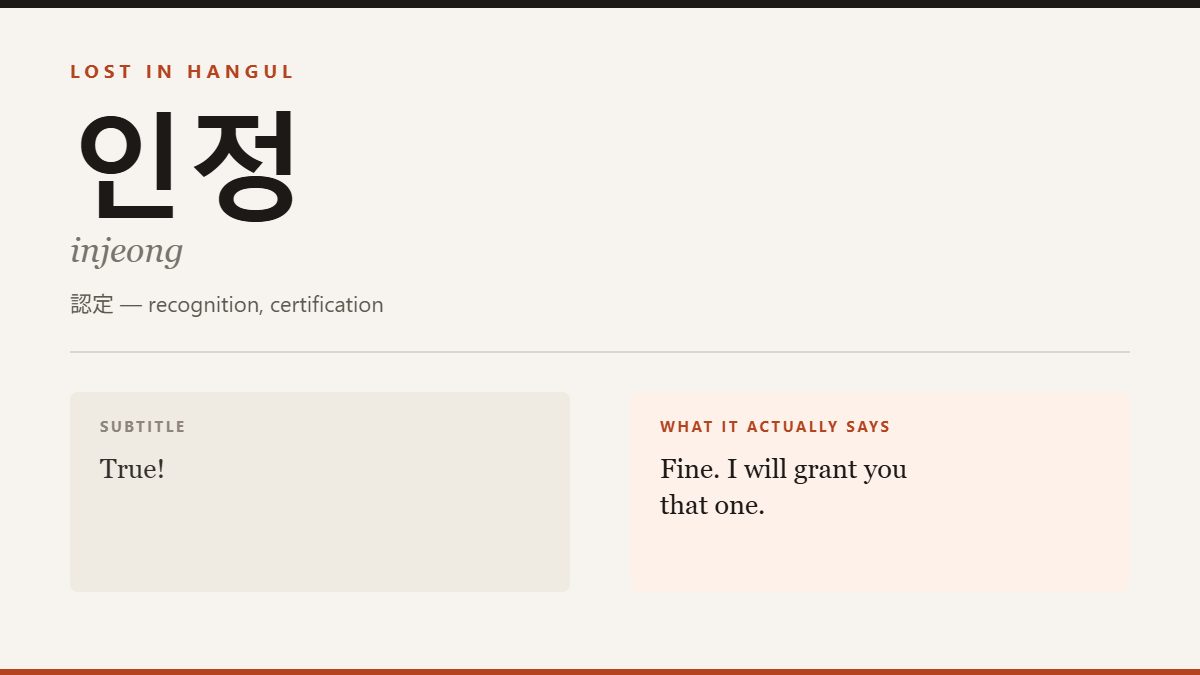
Short version: 인정 (injeong) is a formal word for recognition that got clipped into a one-word “fair enough”. It is not quite agreement. It is conceding, and the difference is the whole point.
Where the word comes from
The root is 認定, Sino-Korean, meaning recognition or certification. 인정하다 is an ordinary, slightly formal verb: to acknowledge, to admit, to accept as valid. It turns up in legal and administrative Korean constantly — a claim is 인정ed, a qualification is 인정ed.
The slang did something simple and effective to it. It stripped the verb ending off and left the bare noun standing alone as an interjection. So a word that belongs on a form now gets shouted across a table, and part of the humour of it is exactly that mismatch of register.
In writing it contracts further to ㅇㅈ, the initial consonants only, which is the standard Korean shorthand pattern — the same move that turns ㄱㅅ into thanks and ㅇㅋ into okay.
It is a call and response
The characteristic use is a two-part exchange, and it is worth learning as a unit rather than as a word.
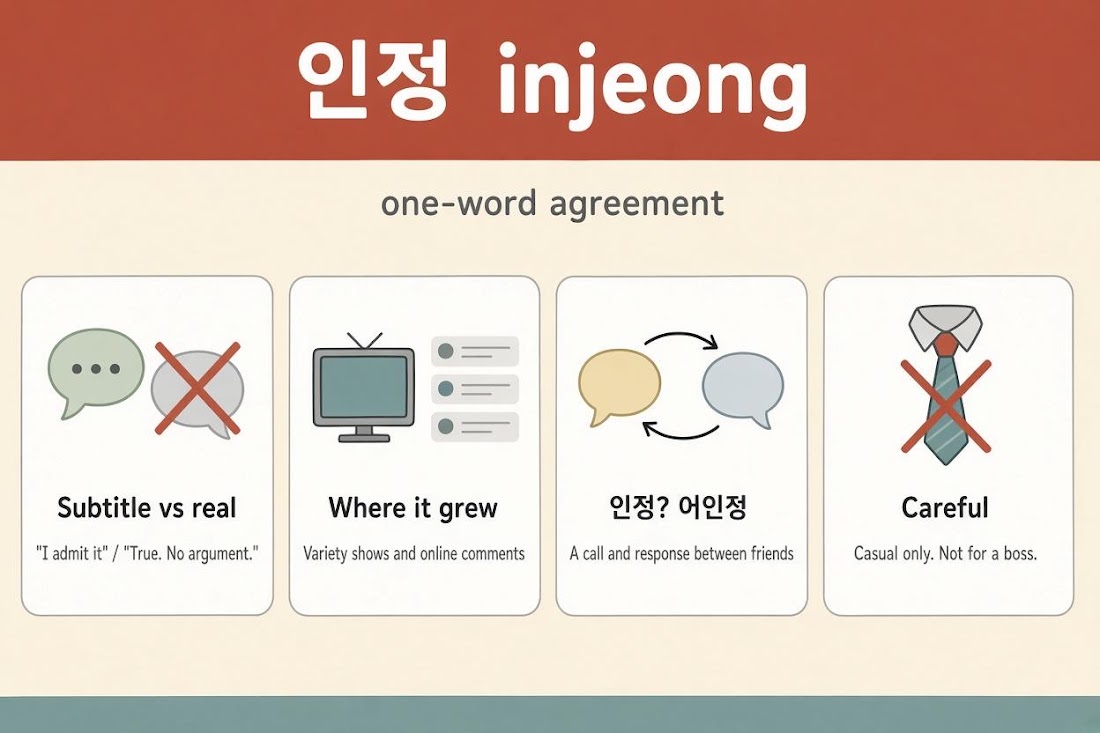
One person makes a claim and appends 인정? — will you grant this? The other answers 어 인정 — yes, granted. Or refuses: 비인정, 노인정, or simply 아니.
It is close to the English “right?” / “right.” exchange, except that English “right?” invites agreement and 인정? demands a ruling. The asker is not checking whether you feel the same way. They are asking you to certify a claim, and the mock-formality of the word is doing the joke.
Why it is not 맞아
맞아 means “that’s right” and is neutral. You say it when someone states something you also believe.
인정 carries a faint concession. It is what you say when the point being made is not necessarily in your favour, or when you have been holding out and are now giving in. Someone mocks your terrible taste in films, correctly, and you say 인정. Someone says the weather is nice and you do not.
Which is why the closest English is “fair” or “fair enough” rather than “true”. Both admit something at slight cost to the speaker.
The extended family
- 인정할 건 인정하자 — “let’s admit what needs admitting”. Older, fully standard, and the phrase the slang grew out of.
- 인정각 — roughly “this is heading for an admission”. 각 as a suffix meaning an angle or an incoming situation is its own productive slang pattern.
- 국룰 인정 — granting that something is 국룰, a “national rule”, meaning universally agreed practice.
Who actually says it
This is young slang. Teenagers and people in their twenties use it freely; plenty of people over forty know it and would not produce it. Used by someone visibly too old for it, the word becomes a joke about itself, which Korean variety exploits constantly by putting it in the mouth of the oldest cast member.
It is also firmly casual. 인정 in a work email would be bizarre. The full verb, 인정합니다, is the formal version and means something genuinely different in tone: that is a real admission, made seriously.
What subtitles do
Usually “True!” or “Agreed!”, occasionally “Admit it!” for the question form. The loss is the concession and the joke-formality, both of which are the reason anyone picked this word over 맞아 in the first place.
“Fair.” is the better subtitle and rarely gets used, probably because it looks too short to be a translation.
The written forms
In text, 인정 contracts to ㅇㅈ — just the two leading consonants. Korean does this with a whole set of high-frequency words, and the pattern is worth learning even if you never produce it, because comment sections are full of it.
| Short form | Full form | Meaning |
|---|---|---|
| ㅇㅈ | 인정 | fair / granted |
| ㅇㅋ | 오케이 | okay |
| ㄱㅅ | 감사 | thanks |
| ㄴㄴ | 노노 | no no |
There is also 레알 인정, where 레알 is the English word “real” transcribed through a Spanish-looking spelling, for reasons nobody can adequately explain. It intensifies: really, genuinely granted.
Its formal twin still exists
Do not let the slang overwrite the ordinary verb. 인정합니다 is a serious sentence. A person admitting fault in a workplace, a witness accepting a fact, an official recognising a qualification — all 인정, none of them casual.
So the same root covers a teenager conceding an argument about a film and a company acknowledging liability. When variety captions put 인정 on screen in a giant font, part of the humour is that borrowed gravity.
What to listen for
Watch for it as a question with rising intonation at the end of somebody’s claim. That is the setup, and whatever comes back is the punchline — agreement, refusal, or a long silence, which is funnier than either.
Read next
- “Gukrul” (국룰) — the national rule nobody voted on
- “Daebak” (대박) — one word, four completely different meanings
- “Kkuljaem” and “Nojaem” (꿀잼·노잼) — how Koreans rate whether it was fun
Last reviewed: September 20, 2026