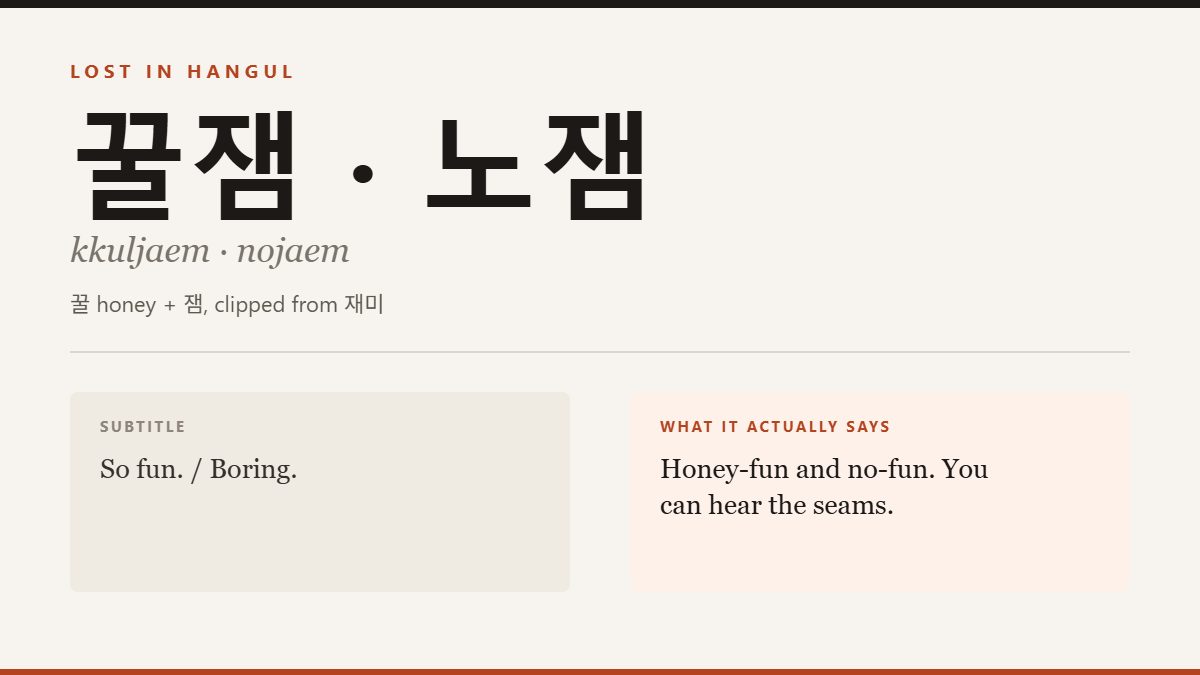
Short version: 꿀잼 is honey-fun, 노잼 is no-fun, and both are built out of parts you can take apart. Once you see how they are assembled you can read a whole shelf of Korean internet vocabulary you have never met before.
Where the words come from
Start with 재미, fun or interest, and the adjective 재미있다, to be fun. Young Korean clipped 재미 down to a single syllable, 잼. That clipped form cannot stand alone; it needs something attached to the front.
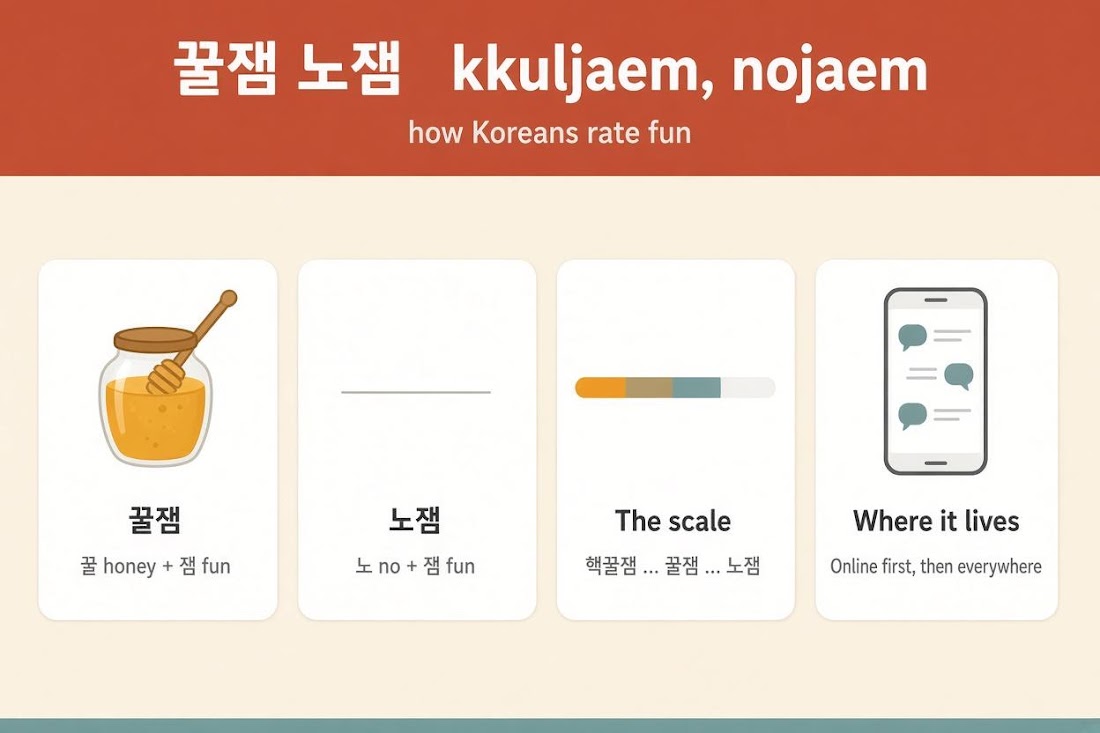
Two things get attached. 꿀 is honey, used as an intensifier prefix meaning excellent or sweet. 노 is the English word “no”, borrowed wholesale as a negating prefix. So:
- 꿀잼 = honey + fun = seriously entertaining
- 노잼 = no + fun = flat, boring, a waste of time
- 핵잼 = nuclear + fun = even stronger than 꿀잼
- 마이 없는 잼 does not exist — the prefix is not optional
Both prefixes are productive, which is the useful part. 꿀 gives you 꿀팁 (a great tip), 꿀템 (a great item, 템 being clipped from “item”), 꿀알바 (an easy part-time job). 노 gives you 노답 — no answer — meaning hopeless, beyond fixing.
Learn the pieces and the compounds decode themselves, including ones that were coined last week.
What they are used on
Anything with entertainment value, judged bluntly. An episode, a film, a game, a night out, a person, a period of your life.
노잼 applied to a person is harsher than “boring” in English, because it frames them as failing to deliver something. 노잼 시기 — a no-fun period — is a real expression for a stretch of life where nothing interesting is happening, and it is used semi-seriously about one’s own twenties.
The intensifier ladder
| Prefix | Literally | Strength | Safe to use? |
|---|---|---|---|
| 노 | no | negative | Yes |
| 꿀 | honey | strong positive | Yes |
| 핵 | nuclear | very strong | Yes, casual |
| 개 | dog | very strong | Careful — coarse |
| 존 | (vulgar root) | very strong | No |
The bottom two rows matter. 개 as an intensifier is extremely common among young speakers and still reads as crude to a lot of people; 개꿀 and 개웃겨 are everywhere and neither belongs in front of your partner’s parents. The last row is a vulgar root that produces words you will hear constantly online and should not produce yourself until you can hear exactly how they land.
Why the subtitle loses something
“So fun” and “boring” are accurate and colourless. What they cannot carry is that the Korean words are constructed, visibly and recently, out of a honey and an English “no” and a clipped noun. Korean speakers hear the seams. That playfulness is most of the reason the words are fun to say.
It is the same problem English would have explaining “hangry” to a Korean audience in three seconds. You can give the meaning or you can give the joke.
Register and shelf life
These are internet-born and young. They are completely normal in speech among friends, in captions, in comments. They would be odd from a news anchor and strange in a job interview.
Slang of this kind dates fast. 꿀잼 and 노잼 have lasted long enough to be safe, but the surrounding vocabulary turns over every couple of years, and a learner who loads up on the newest coinages tends to end up sounding like someone trying slightly too hard. The structural knowledge — clip the noun, bolt on an intensifier — is what keeps its value.
The neighbouring game: words that are jokes about spelling
Once you are comfortable with clipping and prefixes, there is a second layer of Korean internet vocabulary built on a completely different principle: writing a word wrong on purpose, so that it looks similar.
- 띵작 for 명작 (masterpiece). ㅁ plus ㅕ squashed together looks like 띵. Used slightly ironically, for something genuinely good.
- 커엽다 for 귀엽다 (cute), by the same visual logic.
- 머전, 댕댕이 for 멍멍이 (doggo) — the same trick again.
The whole family is called 야민정음, a joke on 훈민정음, the original fifteenth-century document that introduced the Korean alphabet. Naming a set of deliberate misspellings after the founding text of the writing system is about as Korean-internet as it gets.
None of this can be subtitled. 띵작 is “masterpiece” with a wink that only exists on the page.
Which ones to actually use
꿀잼, 노잼, 꿀팁 and 노답 are safe in casual speech and writing with friends. 핵 is fine and energetic. 개 is extremely common and still coarse enough that you should hear a native speaker use it in a given setting before you do. The vulgar-root intensifiers are for recognising, not producing.
As a rule: if you cannot yet hear the difference between a word that is playful and a word that is crude, stay on the top half of the ladder. Korean has a lot of registers and very little tolerance for getting them wrong in the upward direction.
Read next
- “Daebak” (대박) — one word, four completely different meanings
- “Hyeonta” (현타) — the moment the frame widens and it is bleak
- “Injeong” (인정) — the one-word agreement that took over Korean variety
Last reviewed: September 20, 2026