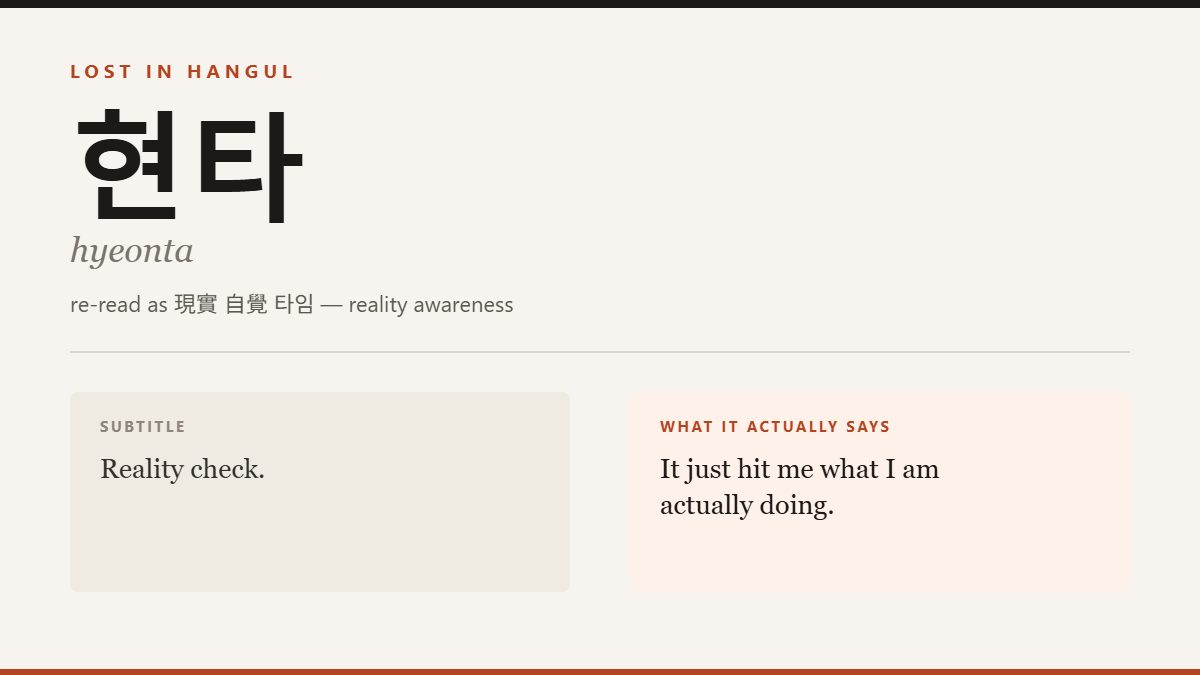
Short version: 현타 (hyeonta) is the moment you suddenly see your own situation from outside, and it is bleak. The crash after the excitement. The silence after the concert. Looking at your bank balance at 2am.
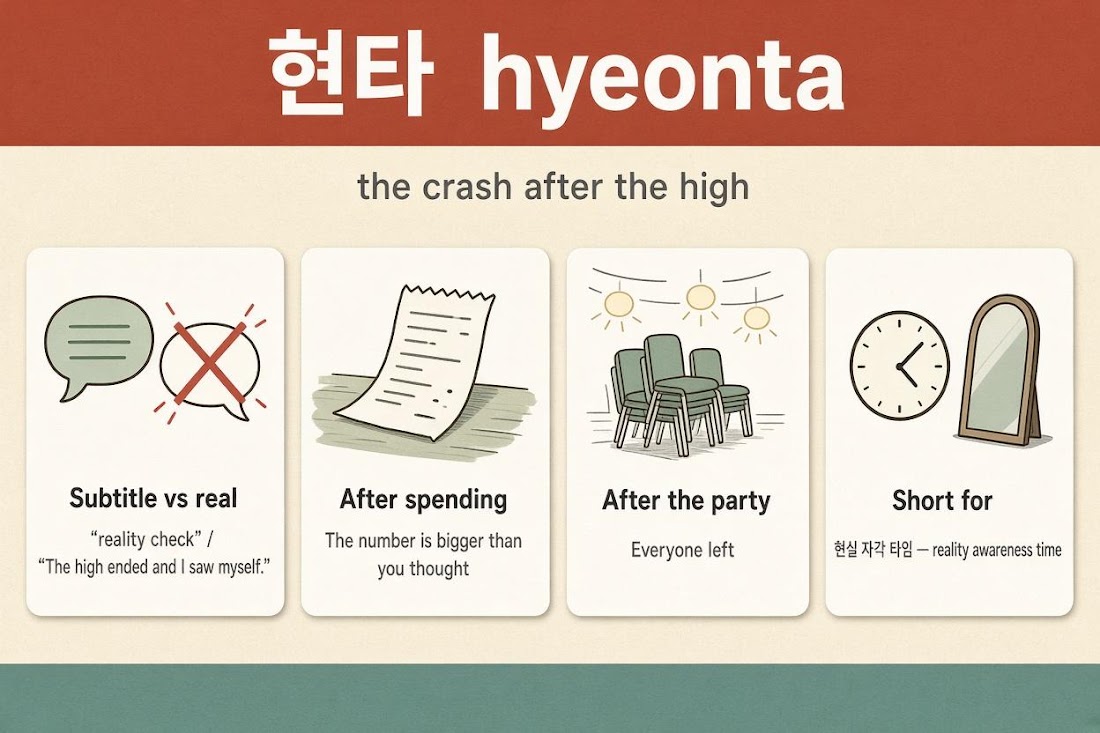
Where the word comes from, and the part people skip
It is an abbreviation, and there are two competing accounts of what it abbreviates. Both are real and the honest answer is that the second one displaced the first.
The earlier form was 현자타임 — “sage time”, 賢者 — an internet term borrowed from Japanese slang describing the flat, clear-headed emptiness that follows sexual release. Crude, and that is the origin.
The abbreviation 현타 then got re-analysed as standing for 현실 자각 타임 — “reality-awareness time”, 現實 + 自覺 + the English word “time”. That reading is now completely dominant, most younger speakers know only that one, and the word has lost its vulgar edge in ordinary use.
This is a good example of a word outrunning its own etymology. You can use 현타 freely; almost nobody hears the older sense any more. But if you see a blog confidently stating it “comes from 현실 자각 타임”, that is the back-formation, not the original.
What it actually describes
Not regret, and not sadness. The specific feeling is sudden perspective — the frame widening, and what you were doing a second ago looking absurd from the new angle.
- The lights come up after a concert and you are standing in an empty hall.
- The delivery arrives and you look at what you spent.
- You finish a game session at 4am and see the sun.
- A group chat about a comeback goes quiet and you remember you have work tomorrow.
- You catch sight of yourself in a shop window mid-enthusiasm.
The word is nearly always used about oneself, and nearly always with a rueful tone rather than a devastated one.
How it is used
현타 온다 — hyeonta is coming. 현타 왔어 — it arrived. 현타 씨게 왔다 — it hit hard. It behaves like weather: something that arrives rather than something you do.
That framing is worth noticing, because it matches 정 and 눈치 in treating an inner state as a thing that shows up on its own. Korean does this a lot.
In fandom, it is a shared experience
Post-concert 현타 is a recognised thing, discussed openly. The months of anticipation, the two hours, the train home. Fans post about it and other fans agree, which is most of the point.
There is also the 현타 that follows a big spend on albums or photocards, which fandoms joke about constantly and which is the same feeling with a receipt attached.
What it is not
| Word | What it covers |
|---|---|
| 현타 | Sudden outside view of your own situation |
| 후회 | Regret. You wish you had chosen differently. |
| 자괴감 | Self-disgust. Much heavier, genuinely bad. |
| 허무하다 | Emptiness, futility. Closer, and more philosophical. |
허무하다 is the nearest serious relative. The difference is that 현타 is sudden and specific, and 허무 is a settled condition. You get 현타 in a moment. You sit in 허무.
What subtitles do
“Reality check”, “it hit me”, “coming down”. The first is the usual pick and is not quite right, because a reality check in English implies a correction you needed. 현타 does not claim the new perspective is healthier. It just says it arrived, uninvited.
Register
Young, casual, internet-native and extremely common in speech among people under about forty. Fine among friends, wrong in any formal setting, and it would be strange from a news anchor.
Read next
- “Gukrul” (국룰) — the national rule nobody voted on
- “Kkuljaem” and “Nojaem” (꿀잼·노잼) — how Koreans rate whether it was fun
- “Injeong” (인정) — the one-word agreement that took over Korean variety
Last reviewed: September 21, 2026