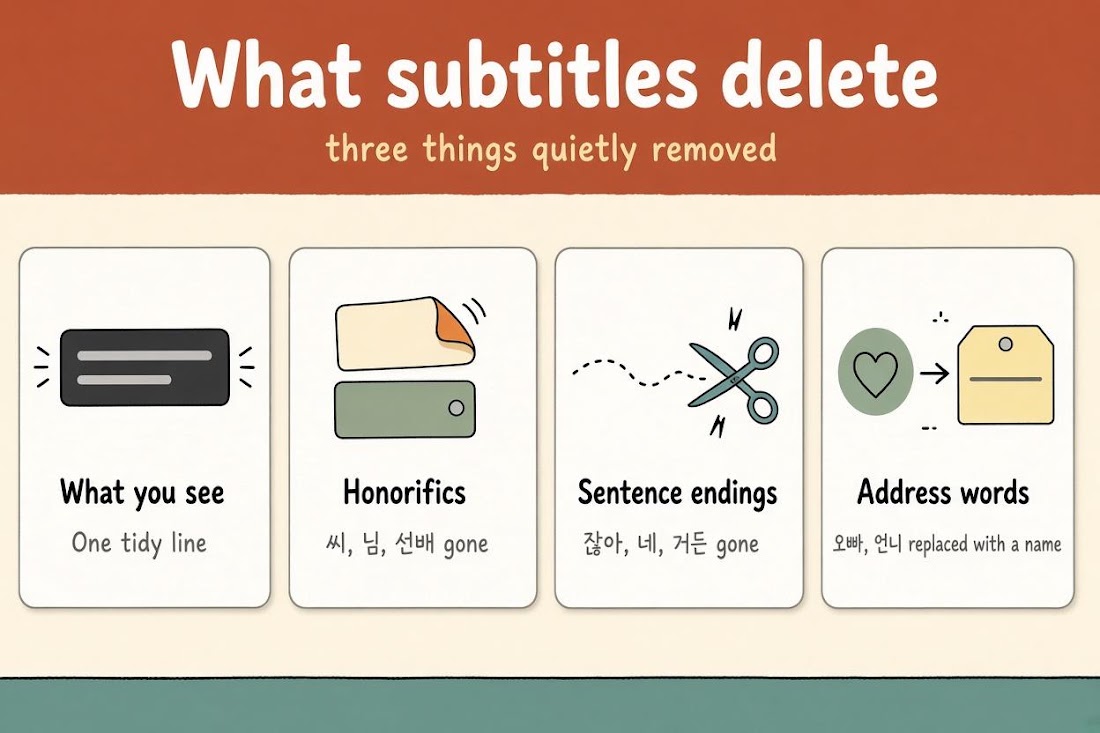
Short version: a handful of very short Korean words and verb endings do nearly all the work of tone, and almost none of them survive into English subtitles. They are not skipped through carelessness. They are skipped because they carry no facts, and subtitles are rationed by the character.
The softener: 좀
좀 is contracted from 조금, “a little”, and in about half its uses it has nothing to do with quantity.
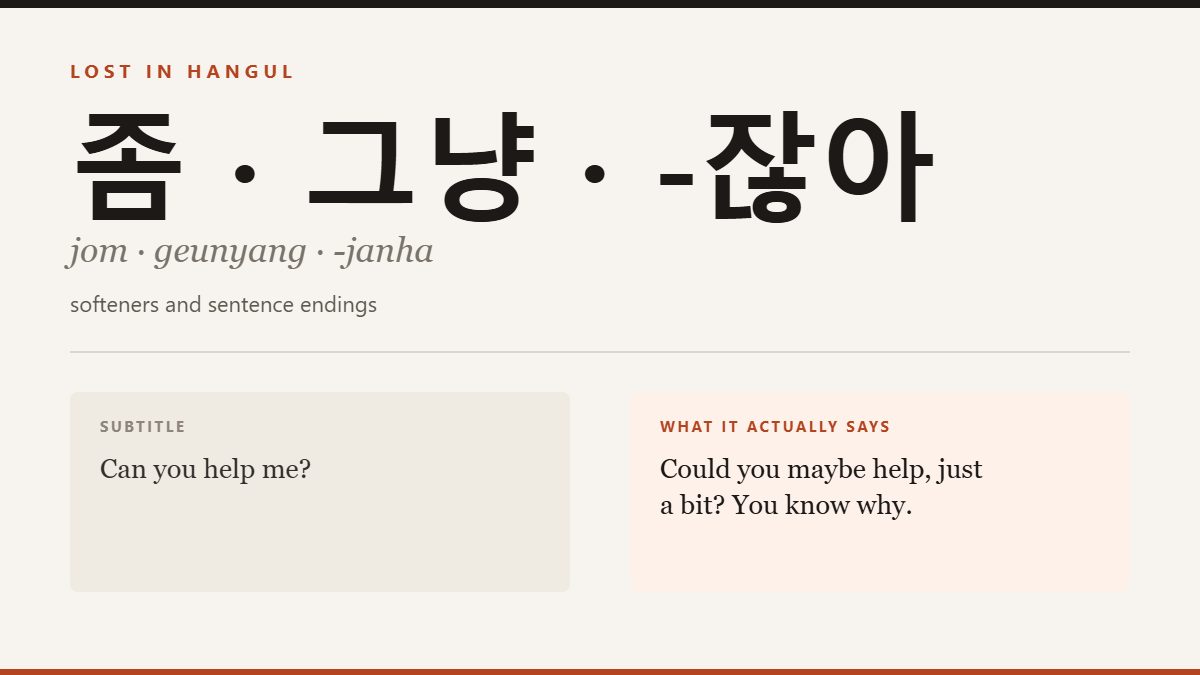
도와줘 is “help me”. 좀 도와줘 is also “help me”, and it is markedly softer. The 좀 is not requesting a small amount of help. It is lowering the pressure of the request, the way English does with “if you could” or “just”.
Korean speakers put it in front of almost every request. Leaving it out sounds curt. An English subtitle has no room for it and no natural slot to put it in, so it disappears and the character sounds more demanding than they were.
The shrug: 그냥
그냥 means “just” in the sense of “for no particular reason”. It is one of the most common words in casual Korean and it is almost always cut.
Asked why they did something, a person answers 그냥. That is a complete and socially acceptable answer, and it means something specific: there is no reason, or there is one and I am declining to give it. English “just because” is the nearest thing and is heard as evasive in a way the Korean is not.
The scatter: 막
막 means something like “wildly”, “all over the place”, “just kept”. It is a storytelling word. 막 울었어 is not “I cried”; it is “I was just crying and crying”.
It also marks that the speaker is narrating rather than reporting, which is why it comes in clusters when someone is telling a story with their hands.
The endings, which are worse
The particles are droppable. The verb endings are where English genuinely has no equipment, because they encode the speaker’s relationship to the information as grammar rather than as tone.
| Ending | Example | What it adds |
|---|---|---|
| -네 | 예쁘네 | I am noticing this right now, first-hand |
| -잖아 | 했잖아 | You already know this — I am reminding you |
| -더라 | 맛있더라 | I witnessed this myself, earlier |
| -겠- | 힘들겠다 | I infer this about your situation |
| -지 | 그렇지 | Confirming something we both hold |
-잖아 deserves its own paragraph
This is the ending that does the most invisible damage when it goes missing. -잖아 asserts that the listener already knows what is being said.
So 내가 말했잖아 is not “I told you”. It is “I told you, and you know I told you”, which is why it appears in every Korean argument ever filmed. It can be affectionate — a reminder between people who share a history — or it can be a weapon. Either way it presupposes a shared past, and the English subtitle “I told you” presupposes nothing.
-네 and the moment of noticing
예뻐 is “it’s pretty”. 예쁘네 is “oh, it’s pretty” — the speaker has just registered it. English can only do this with an interjection or with intonation, neither of which a subtitle can carry reliably.
It is small and it is everywhere. A character walks into a room and says 넓네. The subtitle reads “It’s big.” What was said is closer to “huh, it’s big.”
Why cutting them is usually correct
A subtitle is not a transcript. It has to be read in the time the line is on screen, and every word spent on tone is a word not spent on the information the viewer needs to follow the plot.
Given “I told you” versus “I told you and you know full well that I told you”, a subtitler with fourteen characters of room takes the first one every time, and they are right to. The cost is that English-language viewers systematically receive Korean dialogue as blunter, flatter and more abrupt than it is.
If Korean dialogue has ever struck you as oddly curt in subtitles while the actors on screen look perfectly warm, this is why. The warmth was in the endings, and the endings were the first thing cut.
The intensifier ladder, which does survive
Not everything gets cut. Intensifiers usually make it through, because English has slots for them and because they change the strength of a claim rather than its texture.
| Korean | Strength | Typical subtitle |
|---|---|---|
| 약간 | slightly | a bit |
| 되게 | quite | really |
| 진짜 | genuinely | really / so |
| 엄청 | enormously | so / hugely |
| 완전 | completely | totally |
진짜 is worth watching, because it has partly detached from its meaning. It literally means “true”, and in speech it functions as a general amplifier the way English “literally” now does — including for things that are not true and were never claimed to be.
The vocative particle nobody translates
Korean attaches 아 or 야 to a name when calling someone casually: 민수야, 지훈아. It marks the address as informal and close, and it is not optional between friends — using a bare name where the particle belongs sounds cold.
English subtitles print the name. There is nothing else to do. But this means that a Korean line containing warmth, informality and a name arrives in English as just a name, which is the smallest and most frequent version of the problem this whole site is about.
The stakes are visible when it disappears in Korean too. A character who has said 민수야 for ten episodes and suddenly says 민수 씨 has done something violent to the relationship, and the subtitle reads “Minsoo” both times.
So how do you hear what was cut
You mostly cannot, without the language. What you can do is stop trusting the flatness. If a scene plays warmer on the faces than it reads in the text, the text is what is wrong, and the missing material is almost always one of the items on this page.
Read next
- “Ani” (아니) — the word that usually is not “no”
- Two lines, forty characters: the rules subtitlers actually work under
- “Gwaenchanayo” (괜찮아요) — it also means “no thank you”
Last reviewed: September 20, 2026