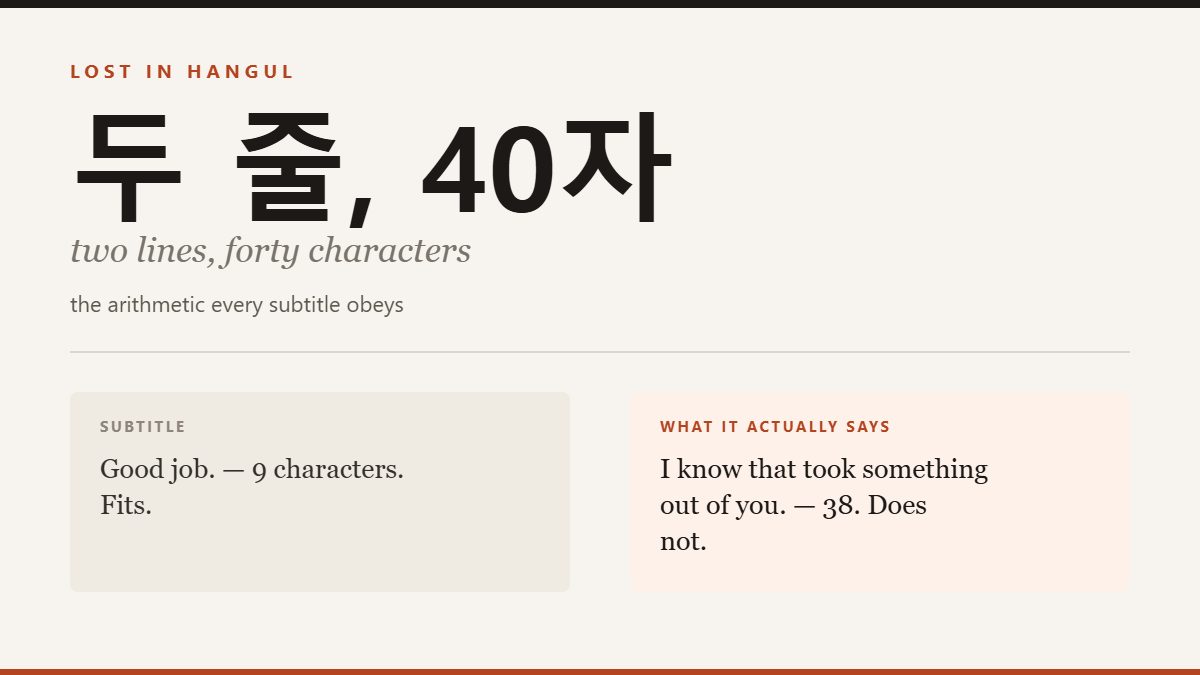
Short version: subtitlers are not choosing between a good translation and a lazy one. They are choosing between a translation that fits and one that does not. Almost everything this site describes as “lost” was lost to arithmetic.
The arithmetic
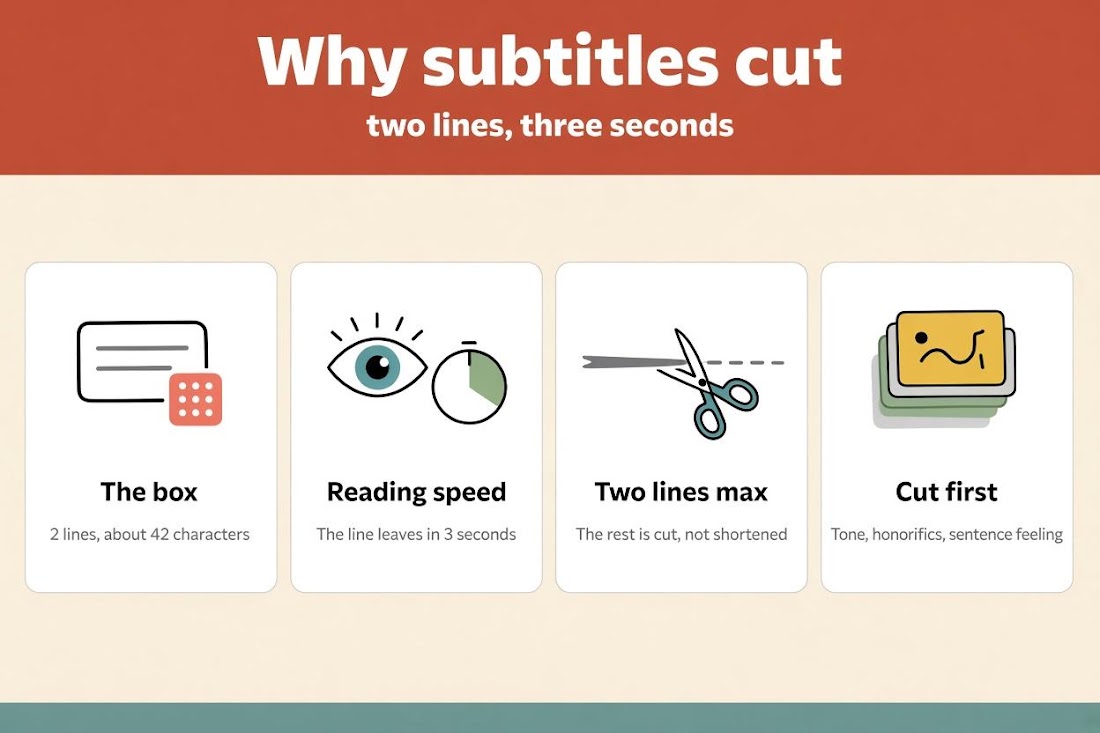
Subtitle guidelines vary by platform and language, but the shape of them is consistent, and for English the common numbers land somewhere close to this:
- Two lines maximum. Three lines exist in some specifications and are avoided because they cover too much of the frame.
- Around forty characters per line. Spaces and punctuation count.
- Roughly seventeen to twenty characters per second of screen time, because that is about what an audience can read while also watching a film.
- A minimum duration, usually around five sixths of a second, so a subtitle does not flash.
- No spanning a hard cut where it can be avoided, because a subtitle that survives a shot change makes the eye re-read it.
Put those together and a two-second line gives you about thirty-five characters. Not words. Characters.
What that does to Korean
Korean is compact in exactly the places English is not. Honorifics, evidentiality, the speaker’s relationship to the listener and the speaker’s relationship to the information are all carried by one or two syllables welded onto the end of a verb. English expresses the same things with extra clauses, or not at all.
Take a line covered elsewhere on this site: 고생했어. Four syllables, about half a second of speech.
| English option | Characters | Fits a half-second line? |
|---|---|---|
| Good job. | 9 | Yes |
| You worked hard. | 16 | Yes |
| Thank you for your hard work. | 29 | Barely |
| I know that took something out of you. | 38 | No |
| I know what that cost you, and I was there. | 43 | No |
The two accurate renderings are the two that will not fit. That is the entire problem, restated as a table.
The three moves available
- Compress. Keep the information the plot needs, drop the information the plot can survive without. Tone goes first, because tone is also visible on the actor’s face.
- Relocate. Put the lost nuance somewhere else. If -잖아 cannot be rendered in this line, the next line gets a slightly sharper word to carry the same friction.
- Borrow. Leave the Korean word in. 오빠, 화이팅, 대박 increasingly survive untranslated, which was unthinkable in official subtitles fifteen years ago.
The third option has only become viable because the audience changed. A subtitler in 2010 could not assume a viewer knew what 오빠 meant. In 2026 they largely can, and the practice has shifted accordingly. This is worth sitting with: subtitling standards are downstream of how much the audience already knows.
What cannot be done at all
Some things have no move available, and it is worth being clear about which.
Speech level. English has no grammatical politeness. A subtitler can make one character use contractions and another use full forms, which helps a little, and cannot show you the moment 했어요 becomes 했어.
Vocatives. Korean dialogue is full of address terms, several per exchange. English drops most of them because repeated names in English dialogue read as strange and slightly menacing. So a constant stream of relationship marking becomes silence.
Pronoun avoidance. Korean routinely omits subjects. English requires them. Every restored “I” and “you” is an addition the original did not make, and occasionally it forces the subtitler to decide who a sentence is about before the script has said.
Dubs have the opposite problem
Worth mentioning because it reverses everything. A dub is not constrained by reading speed; it is constrained by lip flaps and by the length of the original delivery. That gives more room for tone and less room for restructuring, and it is why dubbed Korean drama sometimes carries warmth that the subtitles lost while mangling something else entirely.
So why write any of this down
Because the loss being unavoidable does not make it invisible, and viewers notice the gap without being able to name it. The usual symptom is the feeling that a scene is landing harder for other people than it is for you.
The subtitler did their job. Forty characters, two lines, seventeen per second, and the actor is already halfway through the next sentence. What they could not do is hand you the footnote.
That footnote is the only thing this site is for. Nothing here is a complaint about subtitles. It is the material that would not fit.
What fansubs could do that official subs cannot
Anyone who watched Korean or Japanese content in the 2000s remembers translator notes: a second line of text at the top of the frame explaining an untranslatable term, sometimes in a different colour, occasionally running for three lines.
Official subtitling does not permit this, and the reasons are good ones. Notes cover the image, they force the viewer to read two things at once, they do not work on a phone, and they age badly. But the trade was real. Fansubs could hand you the footnote. Professional subtitles cannot, and everything they gained in polish they paid for in explanation.
The current compromise is to leave certain Korean words untranslated and let the audience absorb them over time. That is slower than a note and it does not interrupt the frame, and it only works for words common enough to be learned by exposure.
How to spot a good subtitle
- Line breaks fall at sense units. A line that breaks between an adjective and its noun makes the eye stumble even when the reader cannot say why.
- Register varies between characters. If everyone in a Korean drama speaks identical neutral English, nobody was thinking about speech levels.
- Short lines stay short. A subtitler padding a two-syllable Korean line into a full English sentence is adding material that was not spoken.
- Untranslated words are used consistently. If 오빠 survives in one scene and becomes a name in the next, nobody made a decision.
One thing worth remembering
The subtitler usually knew. They knew 고생했어 was not “good job” and that 아니 was not “no”. They had two lines and about a second and a half, and they made the call that keeps the viewer with the story.
Read next
- The Korean words subtitles always delete (and why translators do it)
- Why she calls him “Oppa” (오빠) — and why the subtitle just uses his name
- “Gosaenghaesseo” (고생했어) — why “good job” isn’t what he said
Last reviewed: September 20, 2026