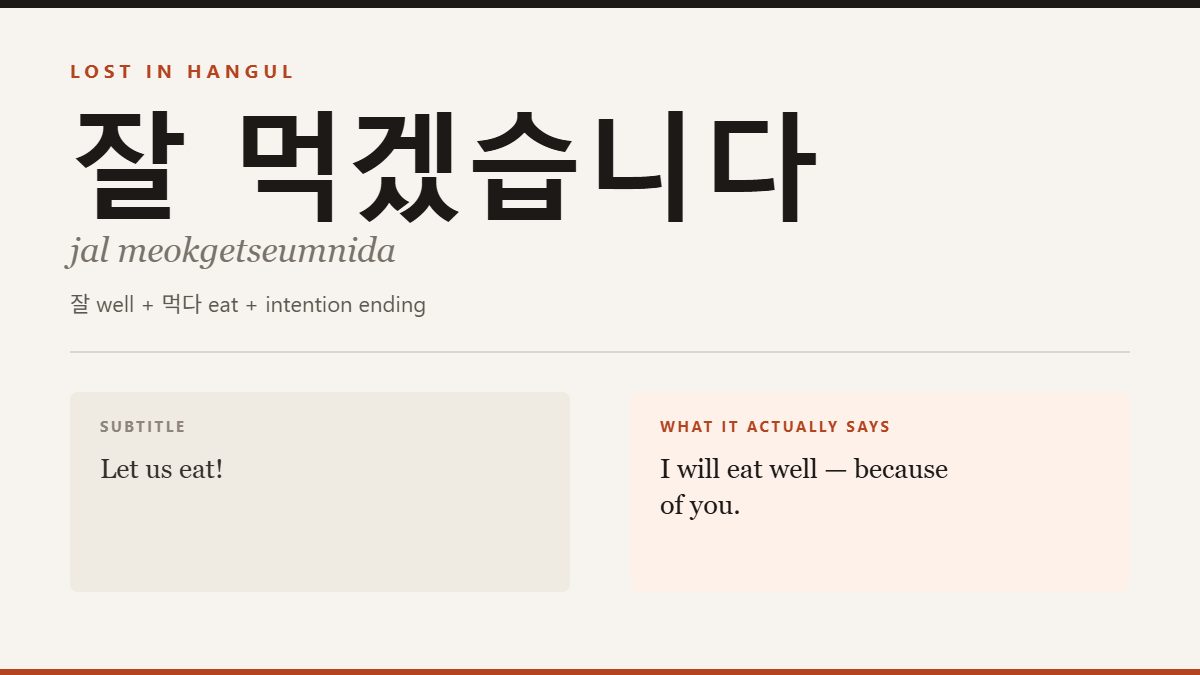
Short version: 잘 먹겠습니다 is not “bon appétit” and not a grace. It is addressed to the person who is feeding you, and if nobody is feeding you it has nothing to attach to.
Where the phrase comes from
It breaks down cleanly: 잘 well, 먹다 to eat, -겠- the marker of intention or near future, -습니다 the formal ending. Literally, “I will eat well.”
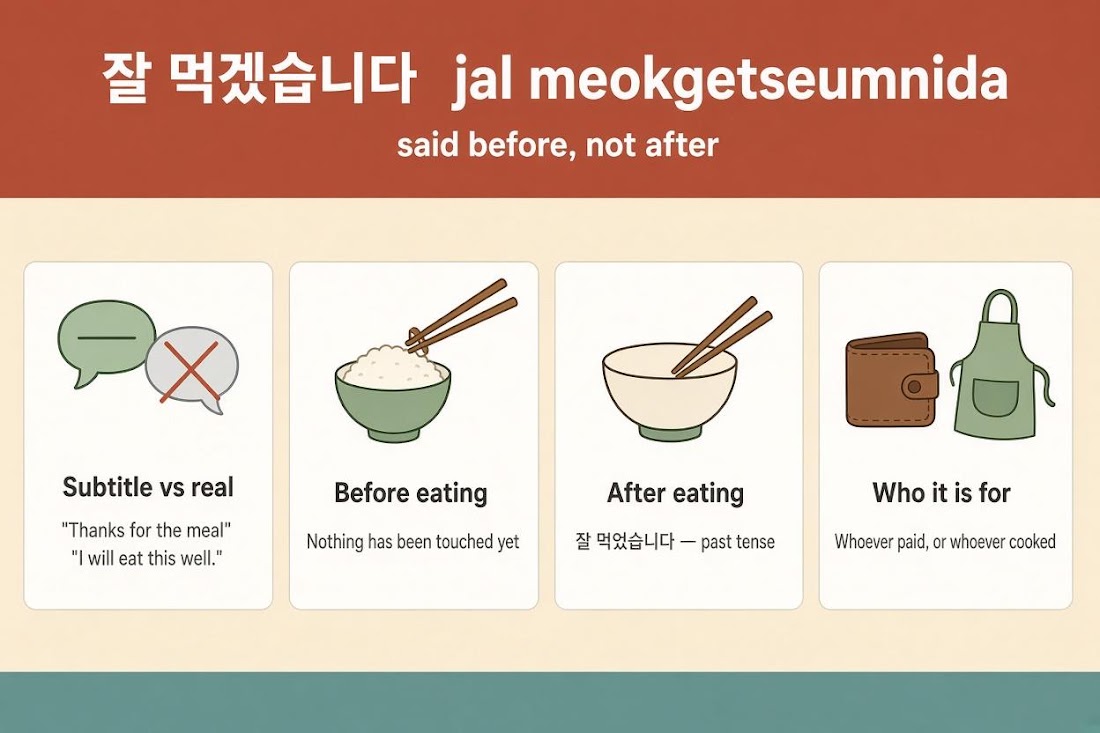
The counterpart afterwards is 잘 먹었습니다 — “I ate well” — same sentence in the past. Between them they bracket the meal.
What makes them work is the missing piece. Neither sentence names who made it possible, and both are pointed straight at that person. It is a thank-you built out of a statement about yourself.
Who you say it to
The host. The person cooking. The person paying. In a restaurant with colleagues, whoever is picking up the bill — which in Korea is very often the most senior person at the table, so the phrase quietly closes a status exchange as well as a culinary one.
Eating alone, it is optional and slightly playful. Mukbang and food YouTubers say it to the camera, which works because the viewer is being treated as present.
It is often compared to 잘 먹겠습니다’s Japanese cousin
You will see it equated with itadakimasu, and the two do occupy the same slot in a meal. Korean speakers generally describe theirs as directed at the person providing the food, where the Japanese phrase is more often explained as acknowledging what was given up to make the meal.
How much weight to put on that difference is contested and probably varies by who you ask. The practical point holds either way: in Korean, if someone bought your lunch, this sentence is aimed at them and they will notice if it is missing.
The politeness ladder
| Form | When |
|---|---|
| 잘 먹겠습니다 | Default. Formal, safe, always correct. |
| 잘 먹을게요 | Polite but lighter. Friends, casual meals. |
| 잘 먹을게 | Casual. Close friends, family. |
| 잘 먹겠습니다! (loud) | Variety shows, groups, said in unison |
The loud group version is a small ritual in itself. Watch any Korean food programme and the cast will say it together before the first bite, often with a bow of the head, and the subtitle will read “Let’s dig in!”
What subtitles do
“Let’s eat”, “Thanks for the meal”, “I’ll enjoy it”. The first is the most common and the least accurate, because it makes a thank-you into an invitation.
“Thanks for the food” is closer and reads oddly when said before eating in English, which is exactly the problem. English has no pre-meal thank-you directed at a host, so translators borrow the French one or invent an invitation.
If you want to use it
Say it whenever someone else is providing the food, every time, and say 잘 먹었습니다 when you are done. These are two of the highest-return phrases a learner can have, because skipping them is noticed and saying them costs nothing.
One thing to avoid: do not say it to a waiter. The phrase goes to whoever is feeding you in the social sense, not to staff. To a server you say 감사합니다.
Read next
- “Gwaenchanayo” (괜찮아요) — it also means “no thank you”
- “Gosaenghaesseo” (고생했어) — why “good job” isn’t what he said
- “Aigoo” (아이고) — one sound doing six different jobs
Last reviewed: September 21, 2026