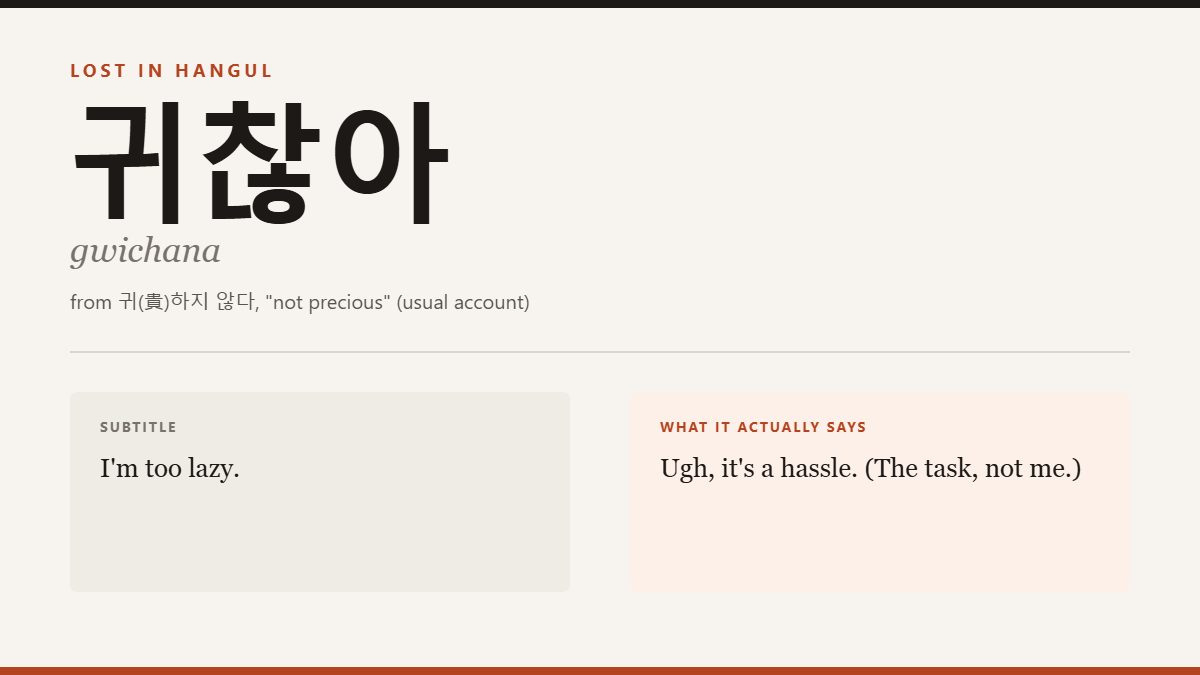
Short version: 귀찮다 means something is a hassle — too much effort for what it’s worth, right now. 귀찮아 is “Ugh, can’t be bothered.” It describes a reaction to a task, not your character. Aimed at a person, though — 너 귀찮아 — it means “you’re a nuisance,” and that one hurts.
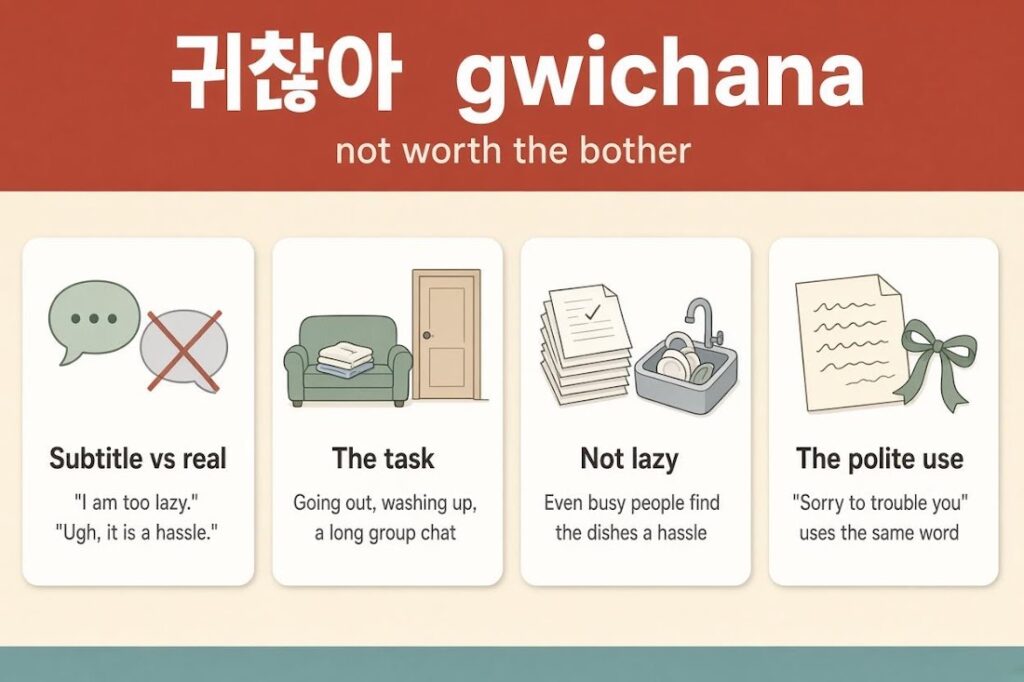
Things that are 귀찮다
- Taking your make-up off after a long night: 화장 지우기 귀찮아.
- Going out to the shop when you’re already in pyjamas: 나가기 귀찮아.
- Replying to a group chat with forty unread messages.
- Cooking for one, which is how a lot of delivery food gets ordered.
The pattern is verb + –기 귀찮아: 씻기 귀찮아, 일어나기 귀찮아. And 다 귀찮아 — “everything is a hassle” — is a mood people slip into when they’re worn out or low.
Not the same as lazy
English subtitles often reach for “lazy,” but Korean has a separate word for that: 게으르다. Calling someone 게으르다 is a judgement about who they are. Saying 귀찮아 about yourself is a passing reaction to one particular job. A very hard-working person can find the washing-up 귀찮다.
| Word | What it is | Feel |
|---|---|---|
| 귀찮다 | This task is a hassle | A reaction |
| 게으르다 | Lazy | A trait, a judgement |
| 피곤하다 | Tired | The body |
| 번거롭다 | Cumbersome, inconvenient | Formal, polite |
| 귀차니즘 | “Can’t-be-bothered-ism” | Jokey slang |
귀차니즘 adds the English “-ism” to make a philosophy of not bothering. Someone who orders delivery rather than walk to a restaurant downstairs might call it their 귀차니즘, half proudly.
Aimed at a person
- 귀찮게 하지 마 — “Stop bothering me.” Sharp.
- A parent, to a child who keeps pestering: 좀 귀찮게 하지 마!
- 귀찮게 해서 미안해 — “Sorry to bother you.”
That last one turns the word into something useful. 귀찮게 해 드려서 죄송합니다 — “I’m sorry to have troubled you” — is a standard polite apology. In formal settings people often prefer 번거롭게 해 드려서 죄송합니다, which says the same with a more businesslike word.
Where the word comes from
The usual account is that 귀찮다 comes from 귀하지 아니하다 — 귀 being 貴, “precious” — contracted through 귀치 않다 into the modern form. So it began as “not precious, not worth much,” drifted to “not to my liking,” and ended up at “bothersome.” Today’s dictionaries treat it as a single native word. The contraction story is the standard explanation, and like the similar one for 괜찮다, it fits the forms well.
You’ll also hear 귀찮아 in romance dramas as the first stage of affection: one character finds the other 귀찮다 — always turning up, always talking — until, about eight episodes later, they notice they miss it.
What subtitles do
“I’m too lazy,” “I don’t feel like it,” “It’s annoying,” “Leave me alone.” “Too lazy” turns a shrug into a confession about character. “Annoying” makes it sound irritated rather than tired. The Korean is lighter than both: it is a sigh at the size of a task, and everyone has one.
Read next
- “Dapdaphae” (답답해) — not frustrated. Something tighter than that.
- "Simsimhae" (심심해) — bored, bland, and the apology that went viral
- “Gatsaeng” (갓생) — the “god life”, meant sincerely and as a joke
Last reviewed: October 4, 2026