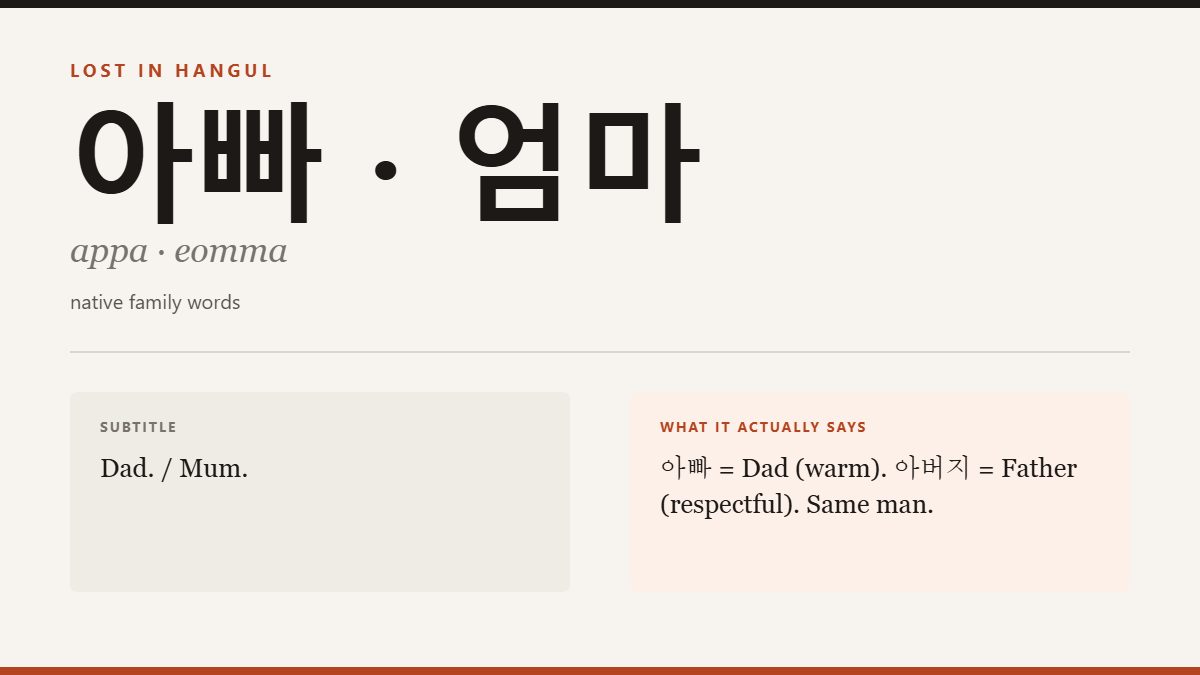
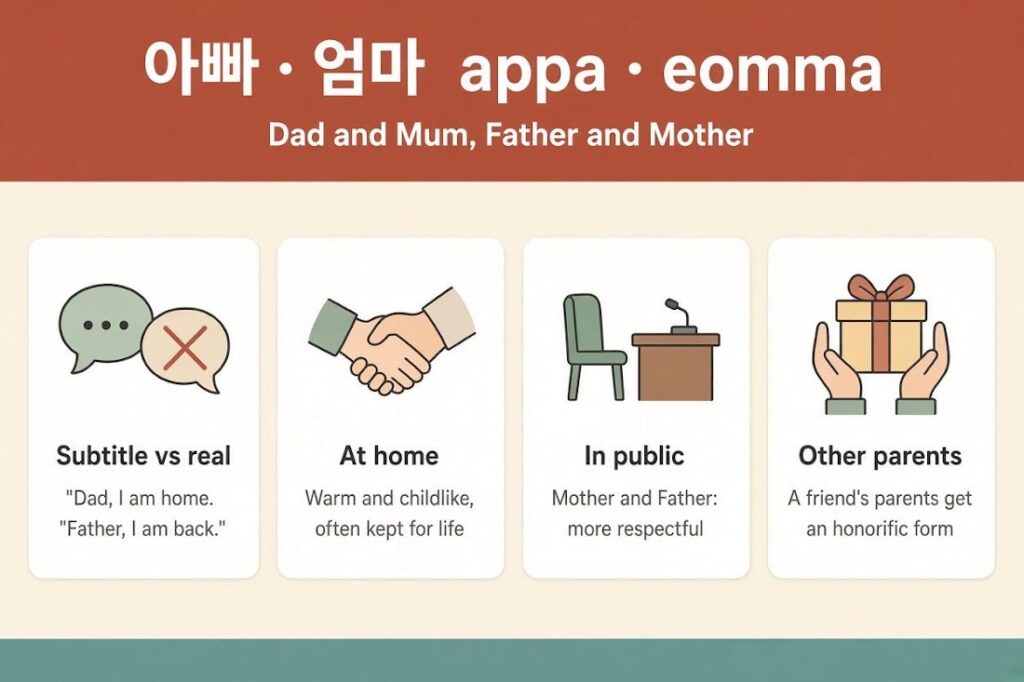
Short version: 엄마 and 아빠 are “Mum” and “Dad.” 어머니 and 아버지 are the more respectful “Mother” and “Father.” English speakers say Mum and Dad all their lives. Many Korean adults shift toward 어머니 and 아버지, at least in front of others; plenty keep 엄마 and 아빠 forever. And other people’s parents get a third set of words. Fans often spell them “omma” and “appa.”
The ladder
| Mum | Dad | Feel |
|---|---|---|
| 엄마 | 아빠 | Warm, childlike, everyday |
| 어머니 | 아버지 | Respectful, adult |
| 어머님 | 아버님 | Honorific: someone else’s parents, your partner’s parents |
Who switches, and when
Children say 엄마 and 아빠. After that, families differ. A common pattern — far from a rule — is that sons drift toward 어머니 and 아버지 as adults, at least in public, while many daughters keep 엄마 and 아빠. The etymologist Cho Hang-beom noted the same tendency in 2002: past childhood, women favour 아빠 more than men do. Plenty of grown men still say 엄마 at home, and nobody finds it odd.
The setting matters more than age. Talking about your parents in a job interview, to a boss or in a speech, 어머니 and 아버지 — or 부모님 — are expected. 우리 엄마가 in an interview sounds childish. At home, the same person may say 엄마, 밥 줘 an hour later.
Other people’s parents
Your friend’s mother is 어머님, her father 아버님. A wife traditionally calls her husband’s parents 어머님 and 아버님 too. Salespeople and school staff also use 어머님 and 아버님 for middle-aged customers and parents. It’s polite and warm, though some customers dislike being assumed to be somebody’s mother or father.
Don’t call someone else’s parents 엄마 or 아빠 — those are for your own. Small children call a friend’s dad 아저씨 without anyone minding, but as an adult, calling a friend’s parent 아줌마 or 아저씨 would be rude.
Where the words come from
All of them are native Korean, and their history is less tidy than it looks. According to Cho Hang-beom’s study of the words, 아빠 goes back to 아바, which turns up meaning “father” in a letter from 1586, and only took its present spelling in the 1930s. 아버지 is in some ways the newer word: its earlier form 아바지 is established in the central dialect’s records only by the late nineteenth century, and it pushed out a rival, 아버니, in the early twentieth. 어머니 went through a similar vowel change, from 어마니.
Where 아바 itself came from is not settled. Many languages have mama- and papa-like words, often linked to the easy sounds babies make, and that is a popular explanation here too. Cho finds it unconvincing for 아바, and says its origin can’t yet be pinned down.
The verbs change too
Once you say 아버지 or 어머니, the rest of the sentence usually follows. 아빠, 자? (“Dad, you asleep?”) becomes 아버지, 주무세요? with the honorific verb for sleep. 엄마, 밥 먹었어? becomes 어머니, 식사하셨어요? A son speaking that way to his father is being properly respectful, and it can sound a little distant too. That distance is part of the meaning.
If you meet a Korean friend’s parents, 어머님 and 아버님 are the safe, warm choice. Pair them with polite speech and you’ll be fine. You may well get 반말 back. From a friend’s parent, that’s normal and friendly, not rude. And when you talk about “parents” in general, the polite word is 부모님.
What subtitles do
A grown son has called his father 아버지 for twenty episodes. At the hospital bed, he suddenly cries 아빠. Every Korean viewer hears him become a child again. If the subtitle says “Dad” both times, nothing happened; if it moves from “Father” to “Dad,” the moment survives, but “Father” will have sounded stiff and old-fashioned in English for the nineteen episodes before.
Read next
- “Uri” (우리) — why she says “our mom” about her own mother
- The verbs that change for your grandmother — and why subtitles can’t show it
- Why she calls him “Oppa” (오빠) — and why the subtitle just uses his name
Last reviewed: October 4, 2026