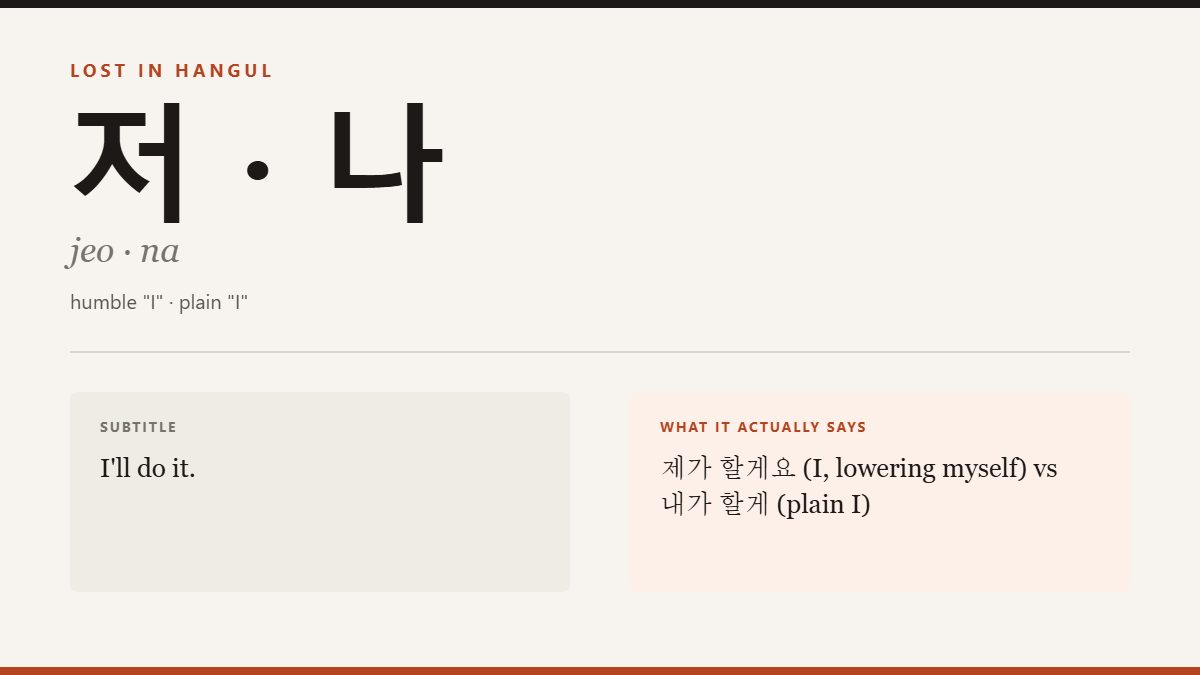
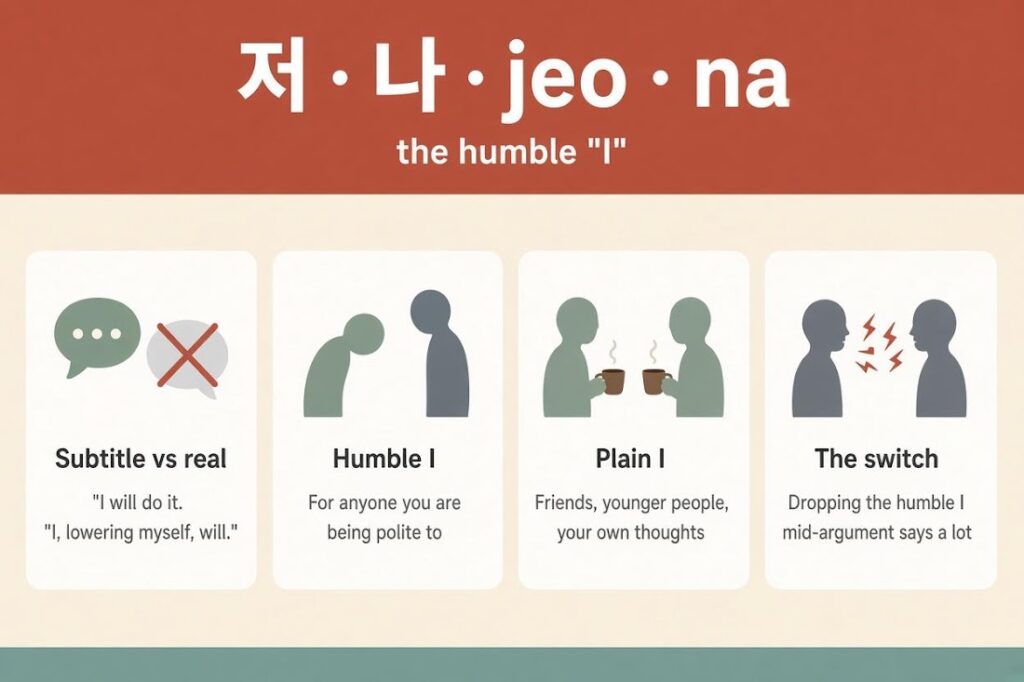
Short version: Korean has two common words for “I.” 나 is plain — used with friends, with people younger than you, and in your own thoughts. 저 is humble — used with anyone you’re being polite to. Politeness here works by lowering yourself rather than raising the other person. English has one “I,” so a subtitle can never show which one was said.
The forms
| Plain | Humble | |
|---|---|---|
| I (topic) | 나는 / 난 | 저는 / 전 |
| I (subject) | 내가 | 제가 |
| my | 내 | 제 |
| me | 나를 / 날 | 저를 / 절 |
| we / our | 우리 | 저희 |
Two of these trip learners up. With the subject particle, standard Korean says 내가 and 제가 rather than 나가 or 저가. And 내 and 제 are “my” — so 제 이름은 is “my name is,” said politely.
Lowering yourself
Korean politeness runs in two directions. Honorific verbs and the –시– ending raise the person you’re talking about. Humble forms lower you. 저 is the most common humble form, alongside 저희 (humble “we”) and humble verbs such as 드리다 (“give”) and 여쭙다 (“ask”). So 제가 말씀드릴게요 is “I (humble) will tell (humble) you.”
For a learner, the working rule is about who is lower. If you’re the younger or junior person and you’re using –요 or –습니다, use 저. If it’s 반말, it’s 나. The rule doesn’t run the other way: older speakers being courteous to younger people often keep 나 with polite endings — a manager saying 내가 확인해 볼게요 to a new hire, or a professor saying 내가 지난주에 말했죠 in a lecture — and that sounds perfectly natural. From a junior, though, 나는 학생이에요 sounds like a learner, or a small child talking to an adult.
저희 — the humble “we”
저희 lowers your group, and in doing so it leaves the listener outside it. 저희 회사 is “our company,” said to a client. You wouldn’t say it to a colleague from the same company, because they’re inside the “we”; there, it’s 우리 회사.
That’s also behind an argument many Koreans learned at school: you’re told to say 우리나라, never 저희 나라, because when Koreans talk among themselves there’s no one to lower the country in front of. Speaking to a foreigner is the debated case: the National Institute of Korean Language still recommends 우리나라 even then, but stops short of calling 저희 나라 wrong.
Where the words come from
Both are native Korean, with no hanja. Learners should know 저 has a look-alike: the 저 in 저 사람 (“that person”) and 저기 (“over there”) is a different word meaning “that.” Context keeps them apart; the humble “I” is almost always followed by a particle or comes at the front of a polite sentence.
Historical dramas add one more. Joseon kings refer to themselves as 과인, from 寡人, “a person of little virtue” — a humble “I” so formal that only a king could use it.
What a switch tells you
- A junior who has always said 제가 suddenly says 내가 to a senior: they’ve either grown close, or they’re furious.
- In an argument, someone moving from 제가 to 내가 has dropped the politeness: “I’m the one who…”
- A character who uses 나 with someone they should address with 저 is signalling contempt, or that they think they outrank them.
- A couple moving from 저 to 나, along with 반말, have just become closer.
If you’re learning, default to 저 with anyone you’d use –요 with. It is never wrong to be humble, and getting it wrong in the other direction is noticed immediately.
What subtitles do
Nothing — there is nothing to do. “I” is “I.” Occasionally a translator adds “sir” to hint at the humble form, or rewrites the line to sound more formal. But the shift from 제가 to 내가 in the middle of a confrontation is one of the clearest signals in Korean drama, and in English it simply doesn’t exist.
Read next
- 합니다 vs 해요 — the two polite Koreans, and why subtitles merge them
- The verbs that change for your grandmother — and why subtitles can’t show it
- The pronouns Korean never said, and English put in anyway
Last reviewed: October 4, 2026