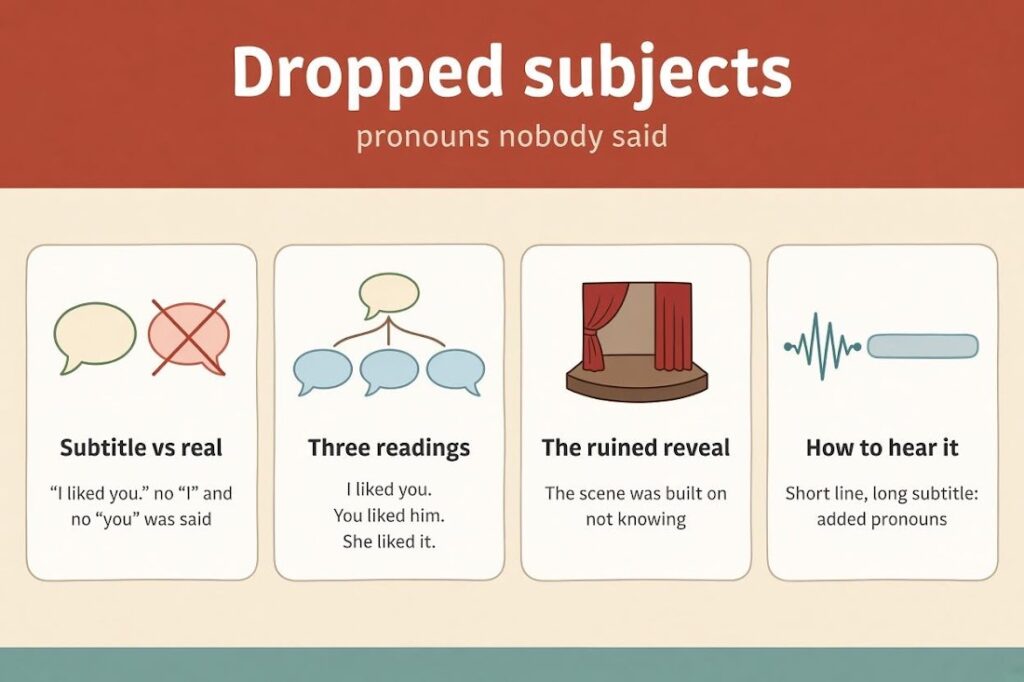
Short version: Korean drops subjects constantly. English cannot. So every English subtitle contains pronouns the speaker never said, and the subtitler had to decide who the sentence was about before the script made it clear.
Korean sentences often have no subject
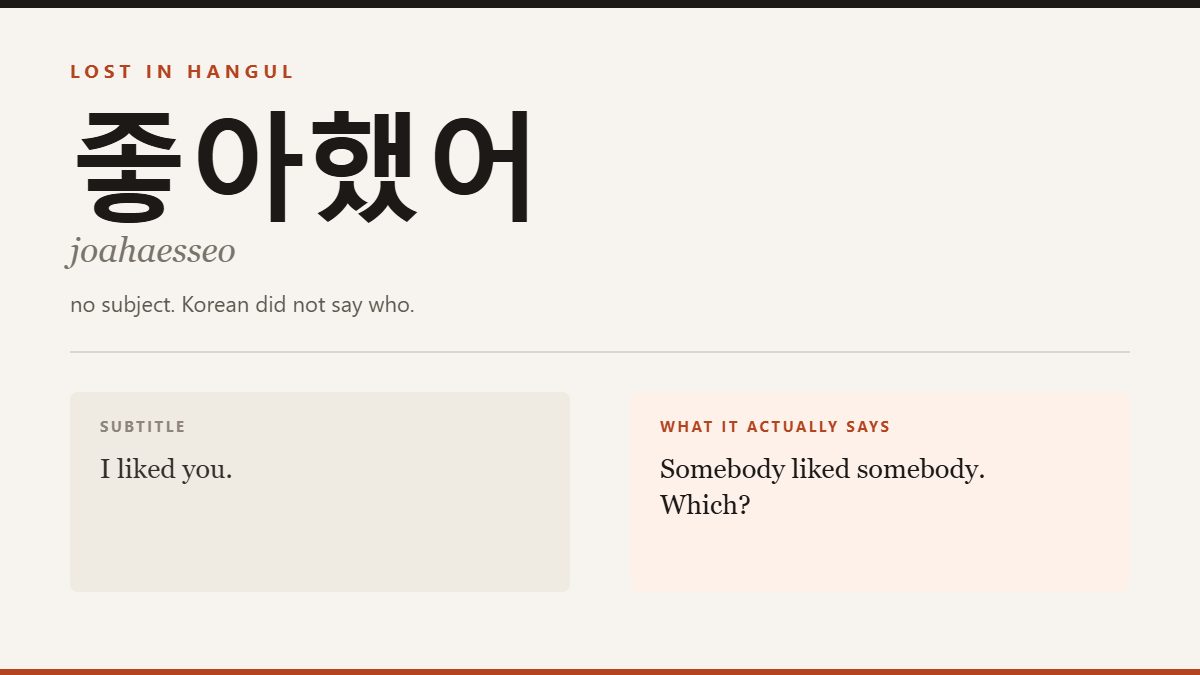
밥 먹었어? has no “you” in it. 갈게 has no “I”. 좋아했어 has no subject at all and could mean “I liked it”, “you liked it”, “he liked her”, depending entirely on what came before.
This is not slang or shorthand. It is how the grammar works. When the subject is recoverable from context, Korean leaves it out, and leaving it in can sound heavy or pointed.
English forces the choice
An English sentence needs a subject. So the subtitler must supply one, and supplying one is an interpretation.
| Korean | Possible English | Note |
|---|---|---|
| 좋아했어 | I liked you. | Confession |
| 좋아했어 | You liked him. | Accusation |
| 좋아했어 | She liked it. | Report |
| 보고 싶었어 | I missed you. | The usual reading |
| 보고 싶었어 | You wanted to see it. | Also grammatical |
Usually context settles it and the subtitler gets it right. Sometimes the ambiguity was the point, and English destroys it by choosing.
The scene this ruins
Korean drama uses subject-dropping to delay a reveal. A character says something that could be about themselves or about someone else, the other character freezes, and the audience does not know yet either.
The English subtitle has to pick, so it picks, and the ambiguity that the writer built the scene on disappears. A good subtitler will sometimes restructure the English to keep it vague — “it was you” instead of a clean sentence — but the options are limited.
The other direction: added emphasis
Because Korean can drop the subject, including it is marked. 내가 할게 — “I’ll do it” with the “I” spelled out — carries emphasis that plain 할게 does not.
English has no way to show this except italics or word choice, so it usually goes. A character volunteering pointedly and a character volunteering casually read identically in translation.
How to hear it
Listen for the length of the line. If a Korean sentence sounds much shorter than its English subtitle, the difference is usually pronouns that were never there. If it sounds longer, there is emphasis or a sentence ending that the English has dropped.
It is a rough test and it works surprisingly often.
Read next
- The Korean words subtitles always delete (and why translators do it)
- “Ani” (아니) — the word that usually is not “no”
- Two lines, forty characters: the rules subtitlers actually work under
Last reviewed: September 21, 2026