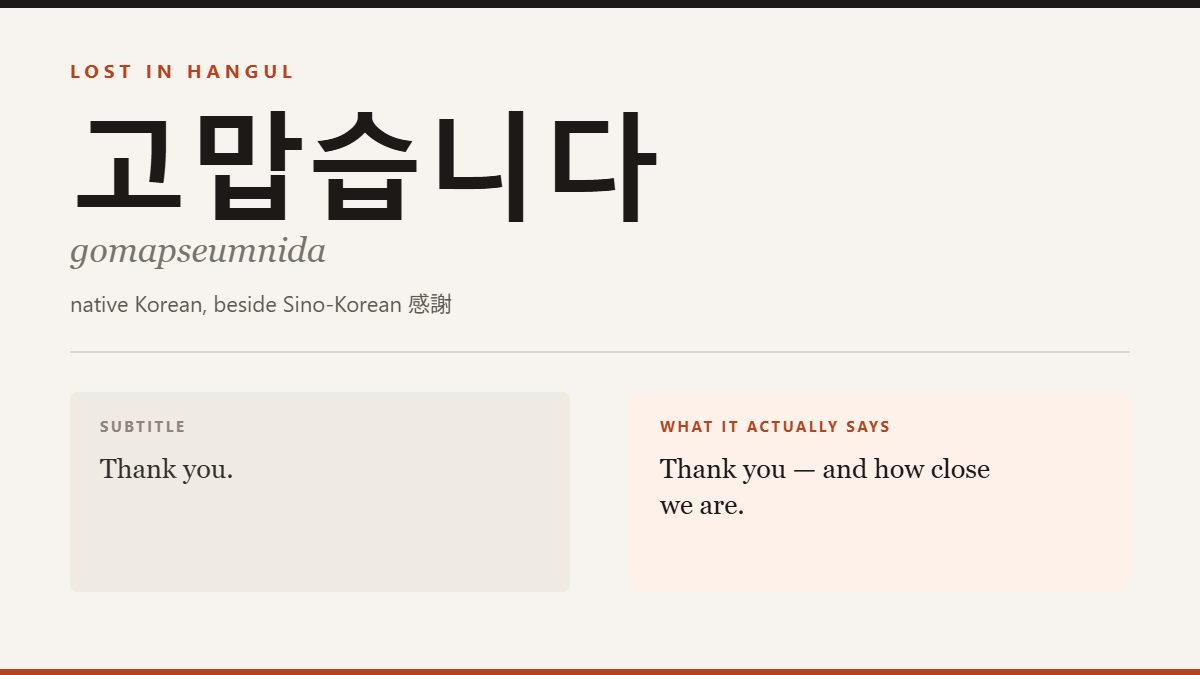
Short version: 고맙습니다 and 감사합니다 both mean thank you. One is native Korean and one is Sino-Korean, and the choice between them says something small but real.
Where they come from
감사 is 感謝 — 感 to feel, 謝 to thank. Sino-Korean, and it patterns like other imported abstract nouns: it takes 하다, it appears in formal compounds, and it carries a slight institutional weight.
고맙다 is native Korean, with no hanja behind it. It is the older layer of the language, the same layer as 아쉽다 and 서운하다.
This split runs through the whole vocabulary. Korean usually has both a native word and a Sino-Korean one for the same idea, and the Sino-Korean one is almost always the more formal of the pair.
So which do you use
| 감사합니다 | 고맙습니다 | |
|---|---|---|
| Register | Formal, official | Formal, but warmer |
| Safe with strangers | Yes | Yes |
| To a superior at work | The usual pick | Fine, slightly less stiff |
| In a speech or announcement | Standard | Less common |
| To someone who did you a personal kindness | Correct | Often better |
Both are polite. Neither is a mistake. If you only learn one, learn 감사합니다, because it is never wrong.
The difference people actually feel
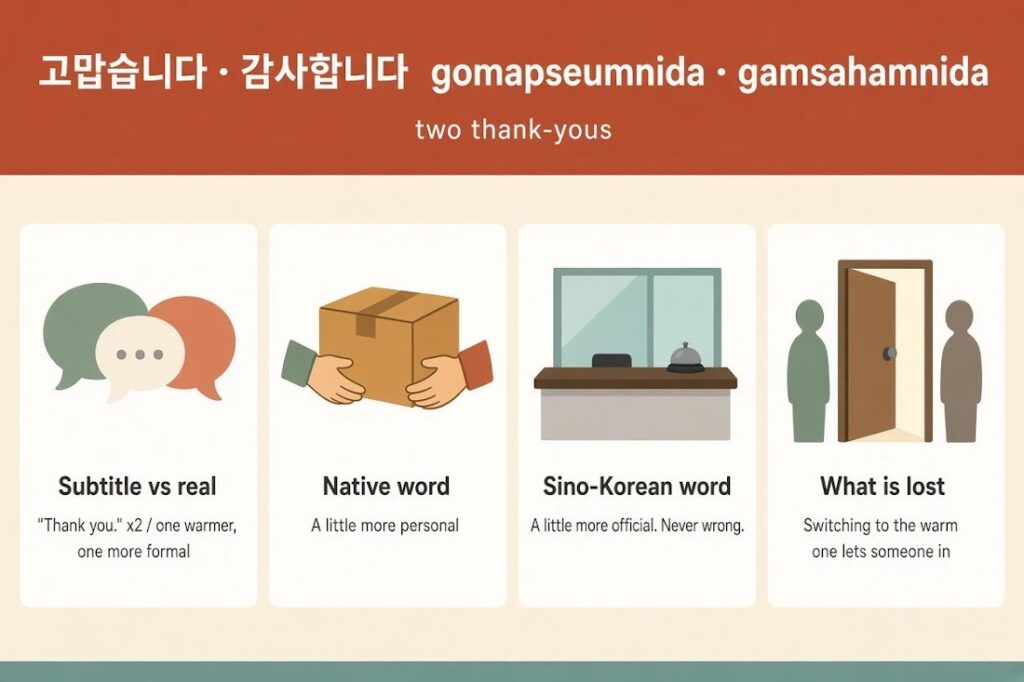
Ask Korean speakers and most will say 고맙습니다 feels a little more personal and 감사합니다 a little more official, and then add that they do not really think about it.
That is the honest answer. This is not a rule with a clean edge. It is a small preference that surfaces in specific moments: a neighbour who helped you carry something is more likely to get 고마워요, and a bank teller is more likely to get 감사합니다.
There is a minor current of opinion in Korea that 고맙습니다 should be preferred as the native word. You will see it argued occasionally in language columns. It is a preference, not a rule, and nobody will correct you either way.
The casual forms
- 고마워 — casual, to friends and juniors. This is the everyday one.
- 고마워요 — polite and warm.
- 감사해요 — exists, sounds slightly awkward to many speakers. Most people use 감사합니다 or switch to 고마워요.
- 감사드립니다 — elevated, for speeches and formal writing.
Note the gap: there is no comfortable casual form of 감사. The Sino-Korean word resists going informal, which tells you where it lives.
What subtitles do
“Thank you” for both, which is the only option English has. The lost information is small per instance and adds up: a character who always says 감사합니다 is holding people at a distance, and one who switches to 고마워 has let someone in.
Read next
- “Sugohaesseoyo” — the everyday phrase that can still get you in trouble
- “Gosaenghaesseo” (고생했어) — why “good job” isn’t what he said
- The moment they switch to 반말 — what just happened between them
Last reviewed: September 21, 2026