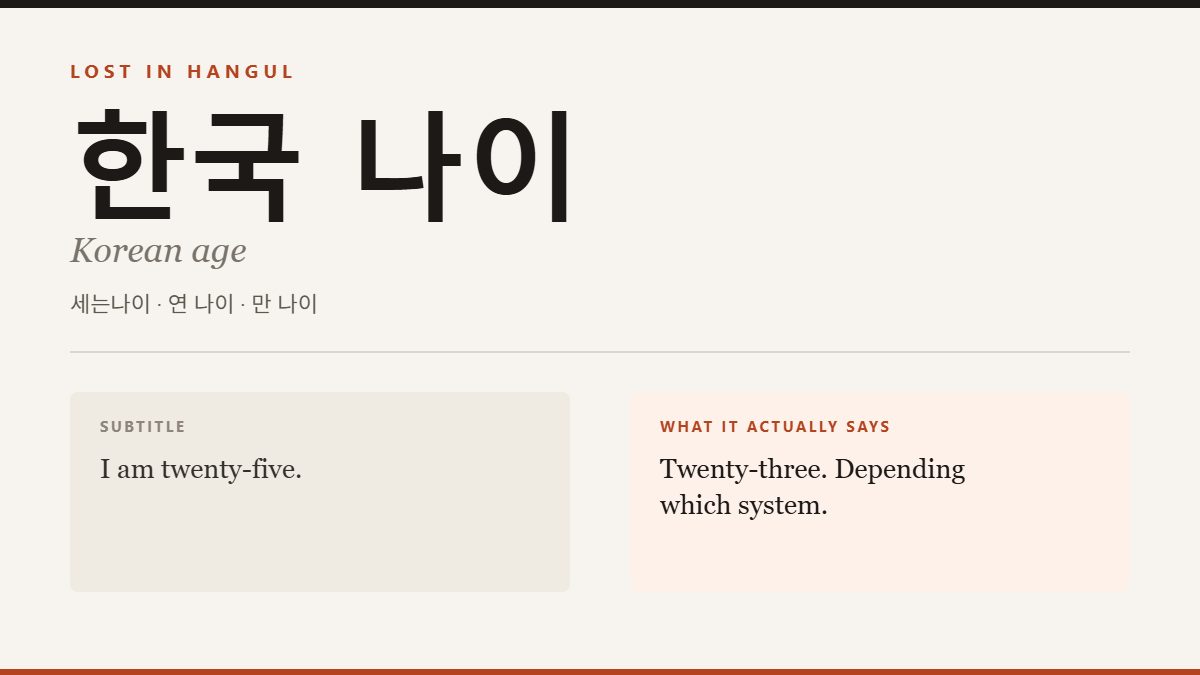
Short version: Korean age used to be counted differently, everyone had two or three ages at once, and the law changed in 2023. If you have watched Korean content from different years and been confused, this is why.
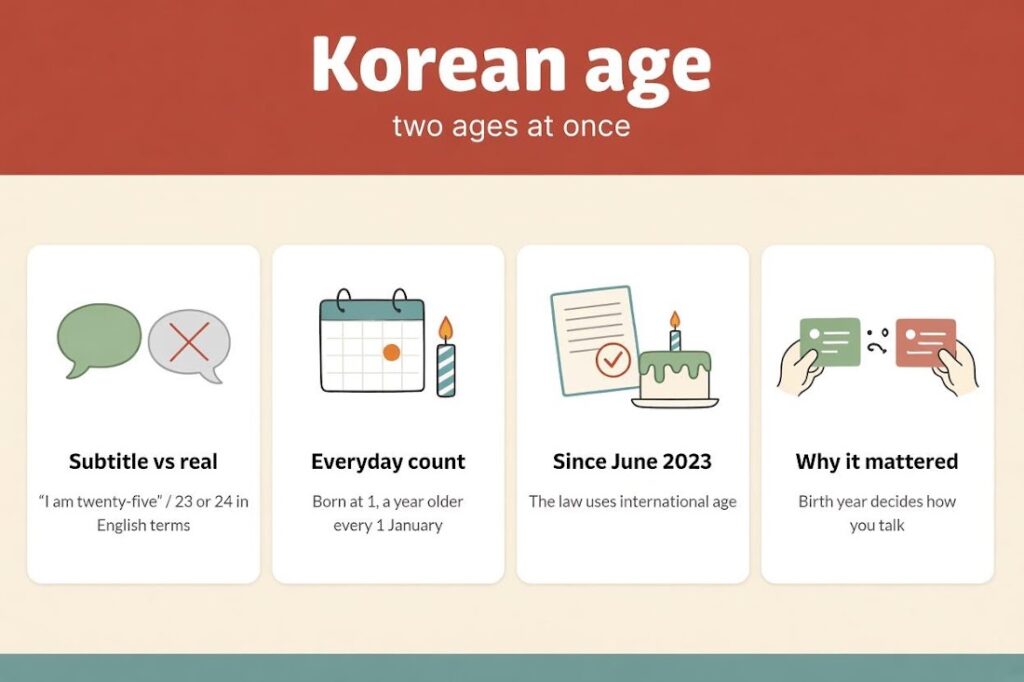
The three systems
| System | How it counted | Where it was used |
|---|---|---|
| 세는나이 | Born at 1, everyone gains a year on 1 January | Everyday conversation |
| 연 나이 | Current year minus birth year | Military service, school entry |
| 만 나이 | International reckoning, gains a year on your birthday | Law, medicine, contracts |
So a person born in December could be 1 under international counting and 2 in conversation a few weeks later. Two Koreans meeting had to establish which number they were using before they could establish anything else.
What changed in 2023
From 28 June 2023, Korea standardised on 만 나이 — international age — for legal and administrative purposes. The stated goal was to end the confusion in contracts, medical dosing and public services.
Everyday speech is slower to follow. Plenty of people still give their 세는나이 in casual conversation, and content made before the change uses the old numbers throughout. Expect a decade of overlap.
Why age mattered so much in the first place
Because age assigns the relationship. Whether someone is your 형 or your 동생, whether you use 반말 or 존댓말, whether you are 친구 at all — all of it follows from birth year.
Which is why two Koreans meeting for the first time establish age almost immediately, and why that exchange feels abrupt to outsiders. It is not curiosity. It is working out which grammar to use.
The complication nobody misses
There was a further wrinkle called 빠른 년생: children born in January or February used to be able to start school a year early, which put them in a class with people born the previous year. The result was a person whose age and school cohort disagreed, and endless negotiation about who was 형 to whom.
The practice was phased out, and Koreans who lived through it still describe it as a headache.
What subtitles do
Usually nothing — the number is spoken and translated literally, so a character in an older drama says “I’m twenty-five” while being what an English viewer would call twenty-three or twenty-four.
The scene that breaks is the one where two characters compare birth years and one immediately switches speech level. In English it reads as two people exchanging trivia and then randomly becoming more casual.
Read next
- Hyung, Nuna, Sunbae — three words your subtitle turned into “you”
- The moment they switch to 반말 — what just happened between them
- “Maknae” (막내) — the youngest is a job, not a fact
Last reviewed: September 21, 2026