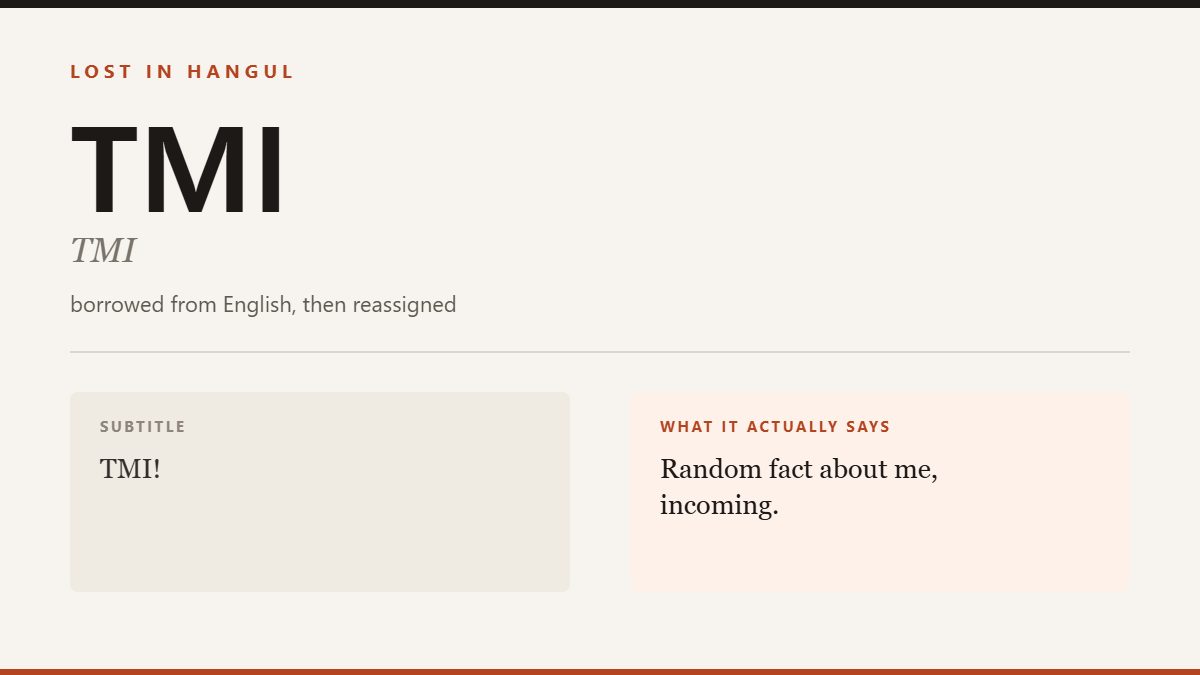
Short version: Koreans use the English initialism TMI, and it has drifted. In Korean it usually means “a small pointless fact about myself that I am about to share”, often affectionately. It is not the reproach it is in English.
Where it comes from and what changed
Borrowed straight from English internet slang — “too much information” — where it is what you say when someone has overshared and you wish they had not. It arrived in Korean in the 2010s and shifted use within a few years.
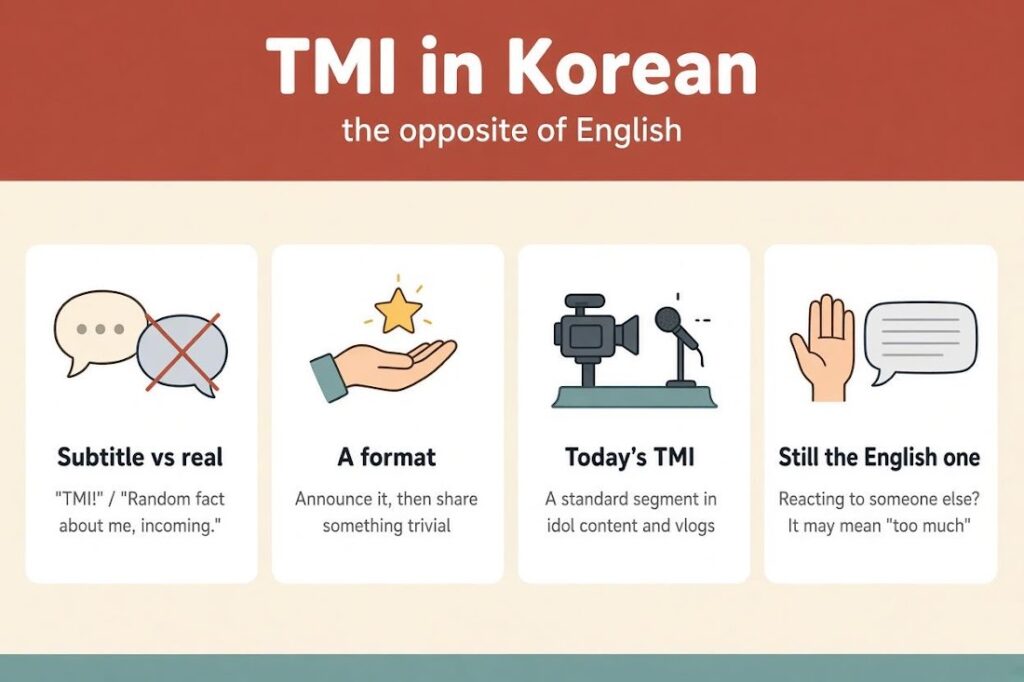
In Korean it became a format rather than a complaint. A person announces TMI and then volunteers something trivial about themselves. The word licenses the sharing instead of objecting to it.
How it appears
- 오늘의 TMI — “today’s TMI”, a standard segment framing in idol content and vlogs.
- TMI 하나 말하자면 — “to give you one TMI”, introducing a small personal detail.
- As a caption on screen when someone says something irrelevant and charming.
Idol fan content runs on this. A member is asked for a TMI and says what they ate, and the fandom treats it as meaningful, which it is, because the point was never the information.
It can still mean the English thing
The original reproach survives, especially among older or more online-bilingual speakers. Context separates them cleanly: if the speaker is announcing their own TMI, it is the Korean sense. If they are reacting to someone else’s, it may be the English one.
Why this happens to borrowed words
Korean has a long history of taking English words and reassigning them. A few you will meet:
| Korean usage | From | Now means |
|---|---|---|
| 화이팅 | fighting | A cheer of encouragement |
| TMI | too much information | A trivial personal fact, shared willingly |
| 서비스 | service | Something given free |
| 원샷 | one shot | Drink it all at once |
| 스킨십 | skinship | Physical affection generally |
None of these are mistakes. They are loanwords doing what loanwords do, and knowing the Korean meaning rather than the English one is the difference between following a conversation and guessing at it.
What subtitles do
They leave it as “TMI” — and English viewers read the English meaning, which is the opposite of what was said. This is one of the few cases where leaving a word untranslated makes the subtitle less accurate.
Read next
- “Hwaiting” (화이팅) — not “fighting”, and not quite “you got this”
- “Gukrul” (국룰) — the national rule nobody voted on
- “Kkuljaem” and “Nojaem” (꿀잼·노잼) — how Koreans rate whether it was fun
Last reviewed: September 21, 2026