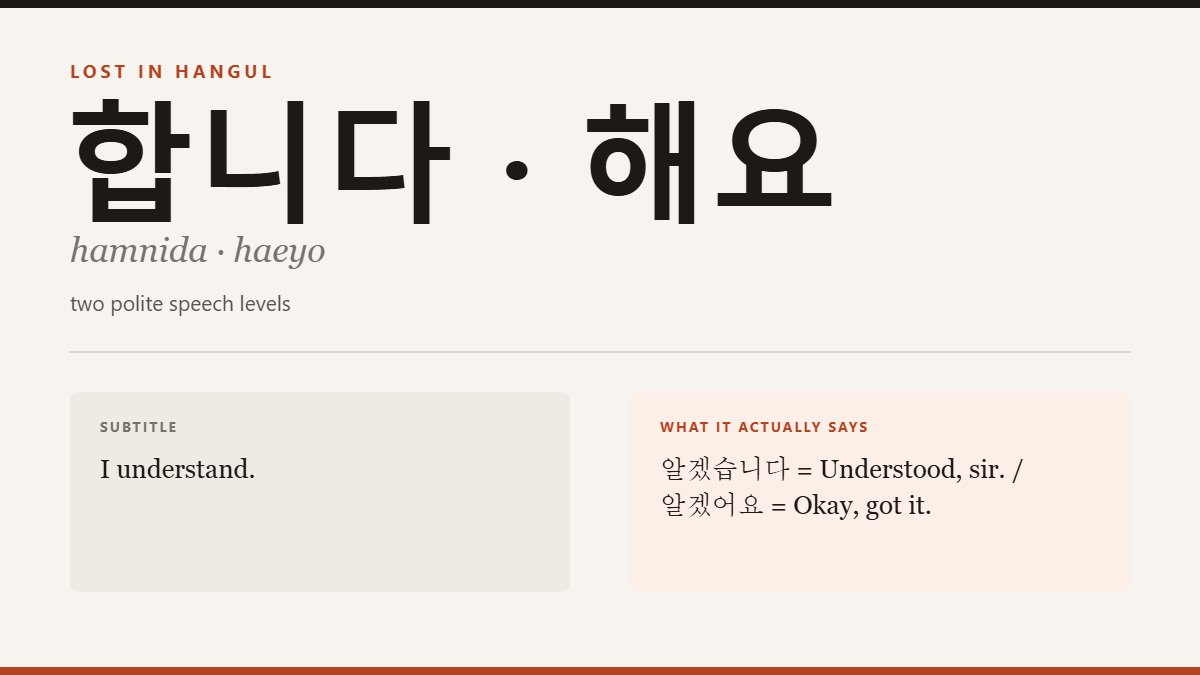
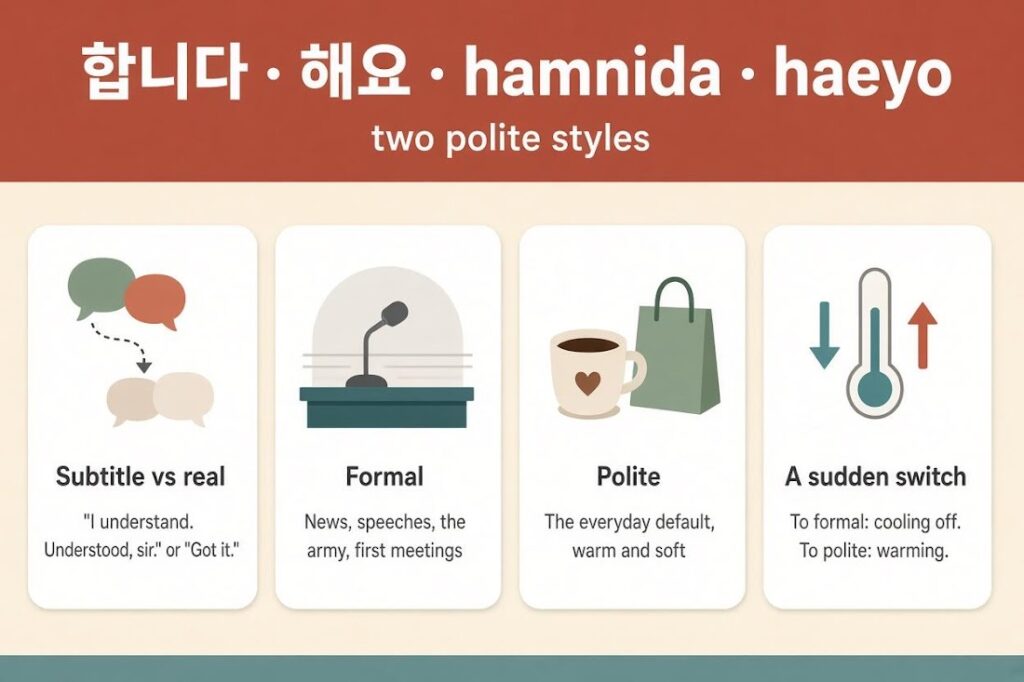
Short version: polite Korean has two main styles. The formal one ends in –ㅂ니다 / –습니다 and sounds crisp, official, a little stiff. The everyday polite one ends in –요 and sounds warm and respectful. Both are polite. Characters move between them constantly, and English has no way to show it.
The two styles
| Formal (합쇼체) | Polite (해요체) | |
|---|---|---|
| It’s okay | 괜찮습니다 | 괜찮아요 |
| I understand | 알겠습니다 | 알겠어요 |
| Thank you | 감사합니다 | 고마워요 |
| Where is it? | 어디입니까? | 어디예요? |
| Feel | Official, public, crisp | Friendly, respectful, soft |
Where you hear the formal style
- News anchors and announcements
- Presentations, speeches, meetings
- Military service — so strongly that it has a nickname, 다나까, after the endings –다, –나, –까
- Staff greeting customers: 어서 오십시오, 감사합니다
- First meetings, especially in business
- Newer employees speaking to senior managers
The polite –요 style is everything else: most shopping, most conversations with people older than you, most of daily life. A reasonable rule is that –요 is the default and –습니다 is for when the situation is official or you want to show extra deference.
Where this comes from
Korean grammar marks the relationship between speaker and listener in the verb ending, a system known as speech levels. Traditional grammars list more than two polite levels, some of which now sound archaic or appear mainly in historical dramas. In modern everyday speech, the two polite ones above do most of the work, alongside 반말, the casual style.
What a switch tells you
Most people mix both styles, even within one conversation — formal to open and close, –요 in the middle. That is normal. But a sudden switch means something:
- From –요 to –습니다: cooling off, getting formal, “let’s keep this professional.”
- From –습니다 to –요: warming up, relaxing, becoming more personal.
- A young man speaking in 다나까 style: he’s probably just finished military service, and his friends will tease him for it.
Men and women both use both styles. Older descriptions sometimes claimed men prefer –습니다 and women prefer –요. Any such tendency is weak and depends far more on job and situation than on gender.
What subtitles do
They can’t do much. 알겠습니다 and 알겠어요 both become “I understand” or “Got it.” Occasionally a translator adds “sir” or “ma’am” to hint at the formal style, but that adds a word that wasn’t there. The result is that a character’s whole shift in tone — a subordinate dropping into stiff formality because they are angry, or a couple’s first softening into –요 — goes past unseen.
Read next
- The moment they switch to 반말 — what just happened between them
- “Sugohaesseoyo” — the everyday phrase that can still get you in trouble
- Two lines, forty characters: the rules subtitlers actually work under
Last reviewed: September 26, 2026