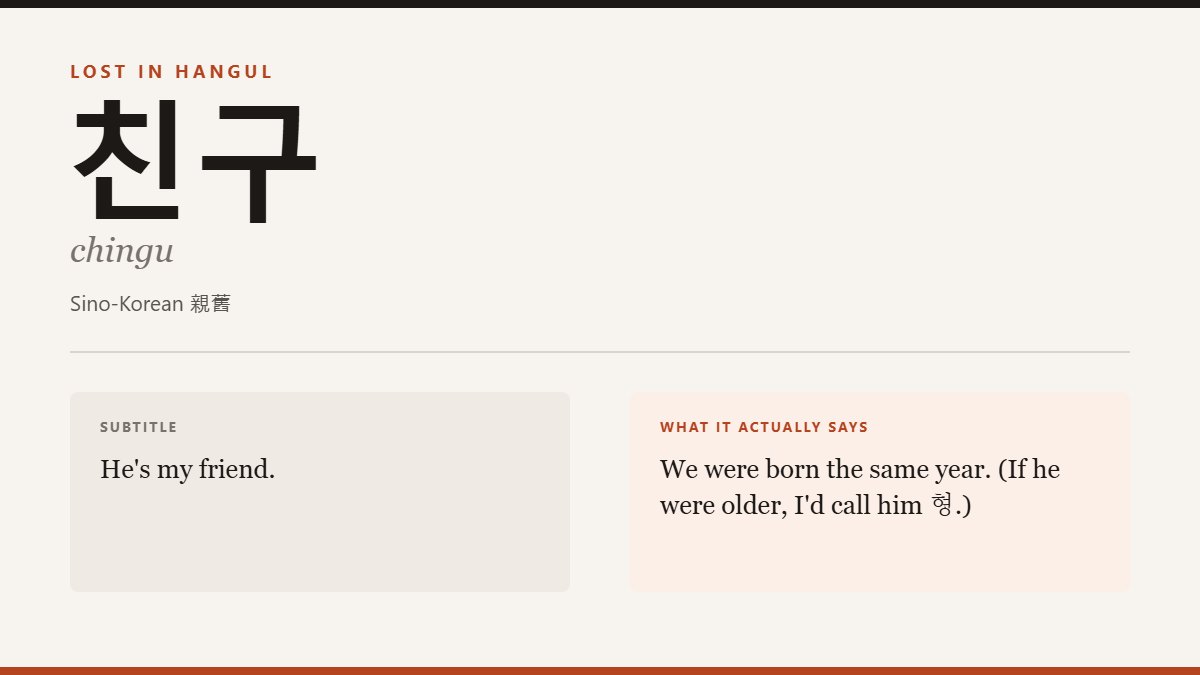
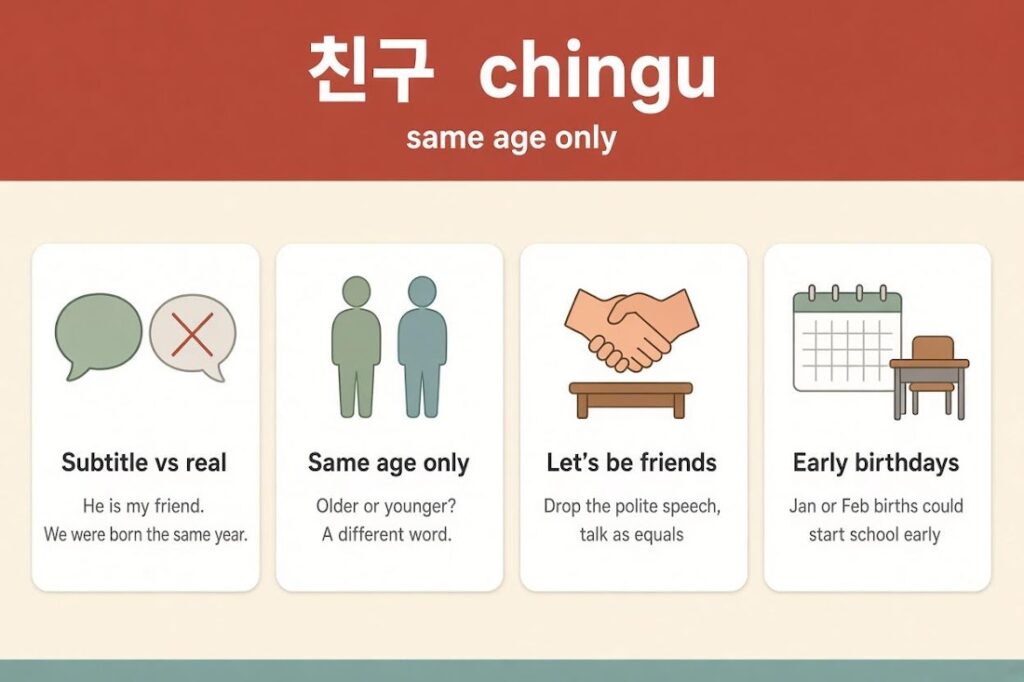
Short version: 친구 means friend, but in everyday Korean it usually means a friend of the same age — born the same year, or in the same school year. A close friend who is two years older is not called your 친구; they are your 형, 누나, 오빠 or 언니. A younger one is your 동생.
Why age decides the word
Korean speech is built on relative age. The first thing two new acquaintances often work out is who is older, because it decides how they will talk: who uses polite speech, who uses a title, who gets called by first name. 친구 is the word for the one relationship where none of that applies. Same age means equal footing.
| Their age | What they are to you | How you talk |
|---|---|---|
| Older | 형 / 누나 / 오빠 / 언니, or 선배 | They may use 반말; you often start polite |
| Same | 친구 | Both use 반말 once close |
| Younger | 동생, or 후배 | You may use 반말; they often use polite speech |
“Let’s be friends”
우리 친구 하자, “let’s be friends,” has a specific meaning. It is often said when two people discover they are the same age: it means “let’s drop the polite speech and talk as equals.” Sometimes it is said across a small age gap as a generous offer from the older person — “forget the age difference, let’s just be friends.”
Where the word comes from
친구 is Sino-Korean, 親舊: 親 “close, intimate” and 舊 “old, of long standing.” Literally “an old intimate.” The native Korean word 동무 also meant friend, but it fell out of use in the South after it became associated with North Korean usage, where it came to mean “comrade.”
The early-birthday problem
This gets complicated in real life. For decades, children born in January and February could start school a year early, alongside the previous year’s births. They became known as 빠른 년생 — “early” births. A person born in February 1995 might have gone through school with the 1994 class.
So is she a 친구 to people born in 1994 or in 1995? It depends who you ask, and it causes genuinely awkward moments at social gatherings. The school-entry rule changed in the late 2000s, and Korea’s 2023 move to international age in official use changed things further, so the problem is fading. But adults caught in the middle still joke about it.
Workplaces often ignore all of this. Two colleagues the same age may keep using polite speech for years, because job rank matters more than age at work. 친구 is a personal relationship, not a professional one.
What subtitles do
“Friend” — always. That’s fine in most scenes, but it hides the age information, which is often the point. When a character says 친구야? on learning someone’s birth year, they are really asking “so we’re equals?” And when an older character refuses to be called a 친구 by someone younger, they are asserting rank. “He’s not my friend” misses that entirely.
Read next
- Hyung, Nuna, Sunbae — three words your subtitle turned into “you”
- Korean age: why everyone had two of them, and what changed in 2023
- The moment they switch to 반말 — what just happened between them
Last reviewed: September 26, 2026