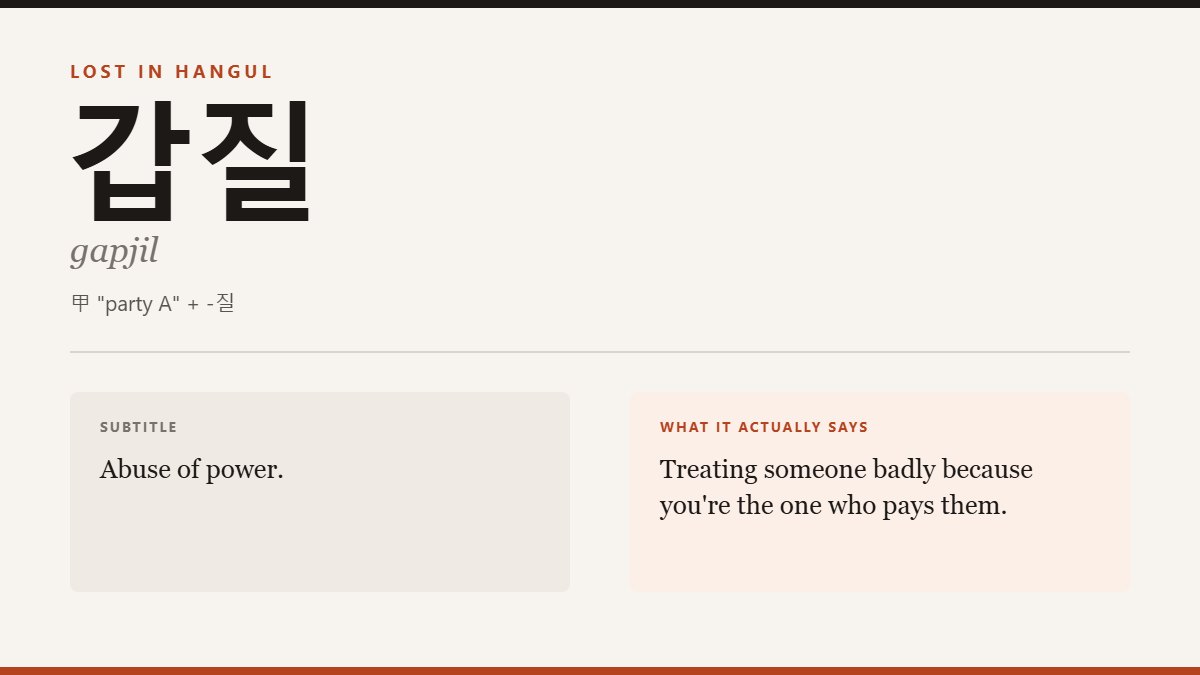
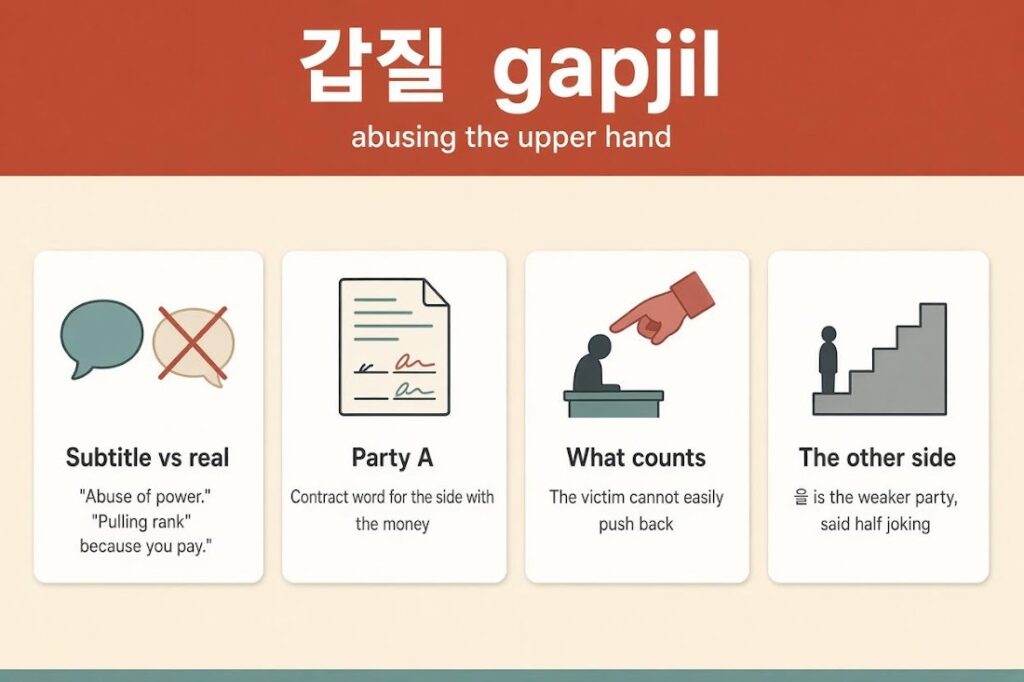
Short version: 갑질 is the abuse of a position of power — a boss humiliating staff, a client bullying a supplier, a customer screaming at a cashier. The word comes from contract language, where 갑 is “party A,” the side with the money and the upper hand.
Where the word comes from
Korean contracts traditionally name the two parties 갑 and 을, from 甲 and 乙, the first two of the ten “heavenly stems” used for ordering things. 갑 is usually the one paying (the client, the landlord, the employer) and 을 the one being paid. So 갑 came to mean “the party with power” and 을 “the party without.”
–질 is a native suffix that turns a noun into an activity, often a disapproving one. It appears in 도둑질 (thieving), 손가락질 (pointing fingers, blaming), and 삽질 (digging with a shovel — and, as slang, pointless work). 갑질 is “doing 갑“: behaving like the one in charge, in the ugliest way.
What counts as 갑질
- A manager making juniors run personal errands.
- A customer demanding a clerk kneel to apologise.
- A large company squeezing a small supplier with last-minute changes.
- An apartment resident verbally abusing the building’s security guard.
- A landlord entering a tenant’s home whenever they like.
The common thread is that the victim cannot easily fight back. That is what separates 갑질 from ordinary rudeness.
How it became a national word
The term existed before, but it spread explosively in the mid-2010s after a series of widely reported incidents involving executives and powerful families — including a 2014 airline incident that made international news. Each case became a public argument about hierarchy and how people with money treat people without it.
The word was so central to those debates that Korea’s English-language press began using “gapjil” untranslated, with a short gloss, rather than searching for an English equivalent.
The 을 side
| Word | Meaning |
|---|---|
| 을 | The weaker party |
| 을의 설움 | The sorrows of being 을 |
| 을질 | Joking reversal: the weaker side pushing back |
| 병 | 丙, “party C” — someone even lower down the chain |
People describe themselves as 을 at work with a mix of resignation and humour. “I’m 을 in this relationship” can even be said about dating, meaning “I’m the one who cares more.”
Korea passed a workplace harassment law in 2019 that covers much of what people mean by 갑질 at work. The word still covers much more than the law does — customers, landlords, families.
What subtitles do
“Abuse of power,” “bullying,” “throwing his weight around.” These are right in meaning. What is lost is the contract frame: the idea that some people are 갑 simply because of where they sit, and that everyone in the scene knows their own position. When a character mutters 갑질 하네, they are describing a whole social structure in two syllables.
Read next
- “Eogulhada” (억울하다) — wronged, and unable to prove it
- “Hyeonta” (현타) — the moment the frame widens and it is bleak
- "Kkondae" (꼰대) — the person who starts with "back in my day"
Last reviewed: September 26, 2026