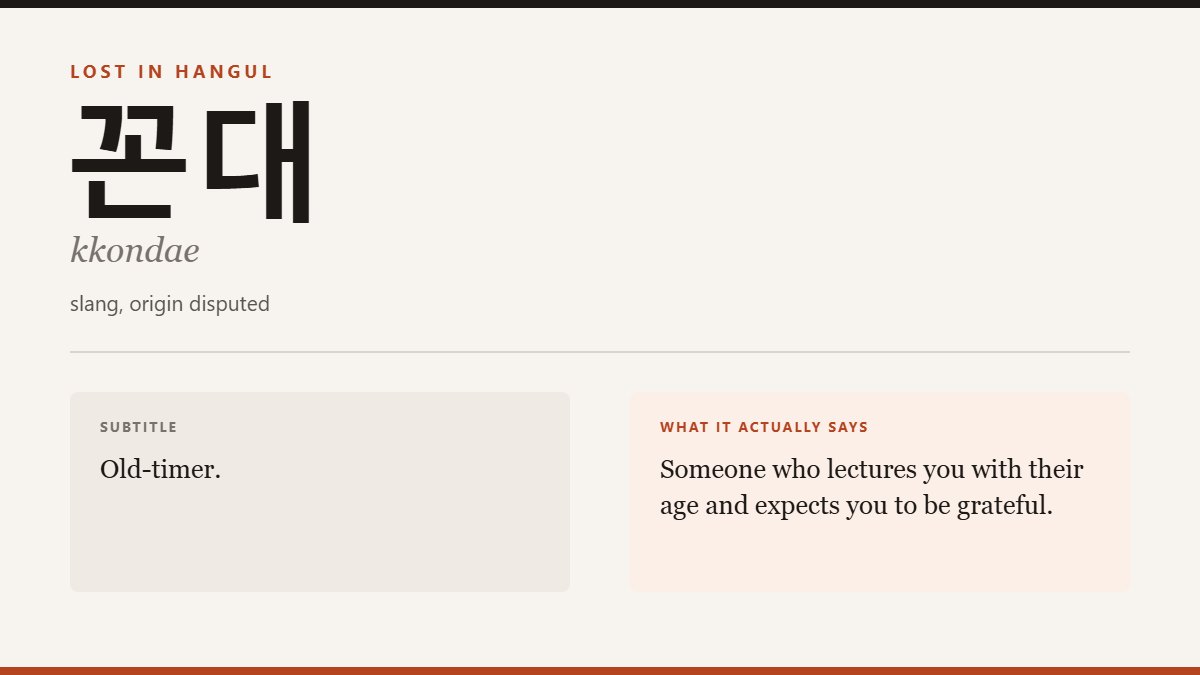
Short version: a 꼰대 is someone who uses age or seniority as a reason to lecture you, insists their way is the only way, and expects you to be grateful for the advice. It started as teenage slang for fathers and teachers. It now describes an attitude, and young people can have it too.
What makes someone a 꼰대
Age alone does not. A seventy-year-old can be warm and open and nobody will call them a 꼰대. The word is about behaviour:
- Giving advice nobody asked for, at length.
- Starting sentences with 나 때는 말이야 — “back in my day.”
- Treating hierarchy as proof of being right.
- Commenting on other people’s clothes, marriage plans, or career choices.
- Making juniors stay late because “that’s how we learned.”
The core of it is certainty plus rank. A 꼰대 is not just old-fashioned; they expect you to agree because of who they are.
The latte joke
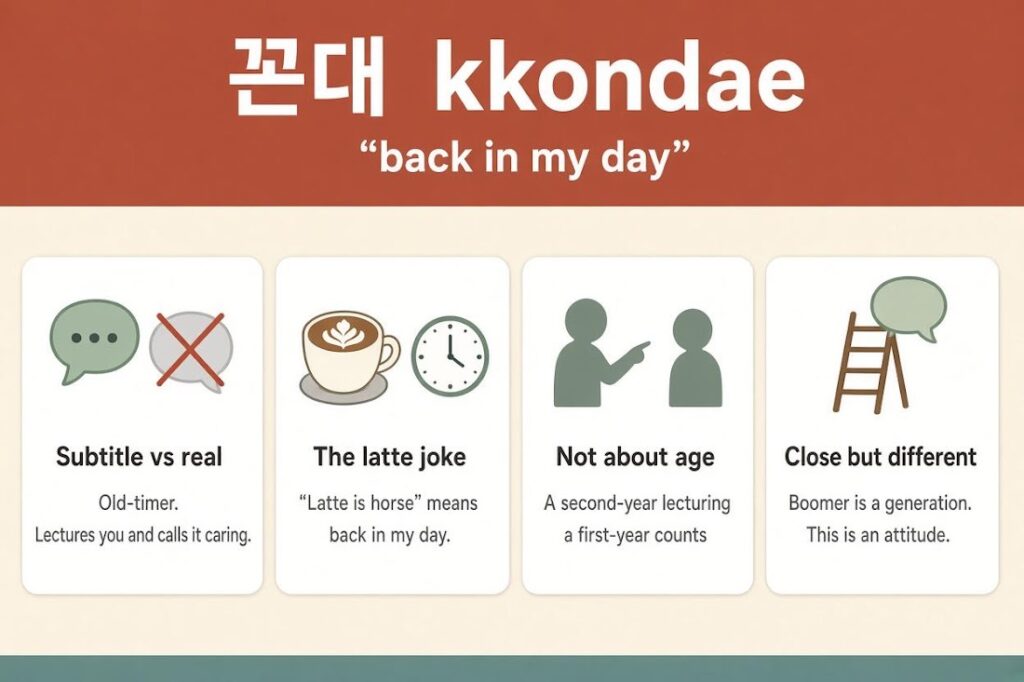
You will see “Latte is horse” on Korean social media and even on café signs. It is a pun: 나 때는 말이야 (“back in my day”) sounds like 라떼는 말이야, and 말 means both “speech” and “horse.” So “latte is horse” is a word-for-word joke translation of the most 꼰대 sentence in the language. It became so common that simply saying 라떼 now means “here comes a back-in-my-day story.”
Where the word comes from
This is disputed, and I will not pretend otherwise. One popular explanation links it to a regional word for a silkworm pupa, supposedly because of wrinkled skin. Another claims a route through the French word comte. Neither is well documented. What is clear is that it was student slang for fathers and teachers by the late twentieth century, and that its meaning widened in the 2010s into the attitude it names today.
Young 꼰대
젊은 꼰대, “young kkondae,” is a real phrase. It describes someone in their twenties or thirties who has picked up exactly the behaviour they used to complain about — the second-year employee lecturing the first-year, or the university senior who insists freshmen follow the old rules. The phrase is useful because it makes clear the word was never really about age.
How it is used, and how rude it is
It is an insult, but a common and fairly mild one. People use it about others more than to their faces. You will also hear it used on oneself as a pre-emptive apology: 꼰대 같은 소리 하나 해도 돼? — “Can I say something a bit kkondae?” That is someone asking permission to give advice, knowing how it might land.
The word travelled beyond Korea in the late 2010s, and English-language outlets have explained it as Korea’s version of “boomer.” That comparison is close but not exact. “OK boomer” is about a generation. 꼰대 is about an attitude inside a hierarchy, which is why it is so often about workplaces.
What subtitles do
“Old-timer,” “old fogey,” “dinosaur,” “boomer,” or simply “jerk.” Each catches part of it. What gets lost is the hierarchy — that the person being called a 꼰대 is almost always someone the speaker is supposed to respect. The word is funny and a little daring precisely because of that, and “boomer” does not carry the same risk.
Read next
- Hyung, Nuna, Sunbae — three words your subtitle turned into “you”
- “Gatsaeng” (갓생) — the “god life”, meant sincerely and as a joke
- “Gukrul” (국룰) — the national rule nobody voted on
Last reviewed: September 26, 2026