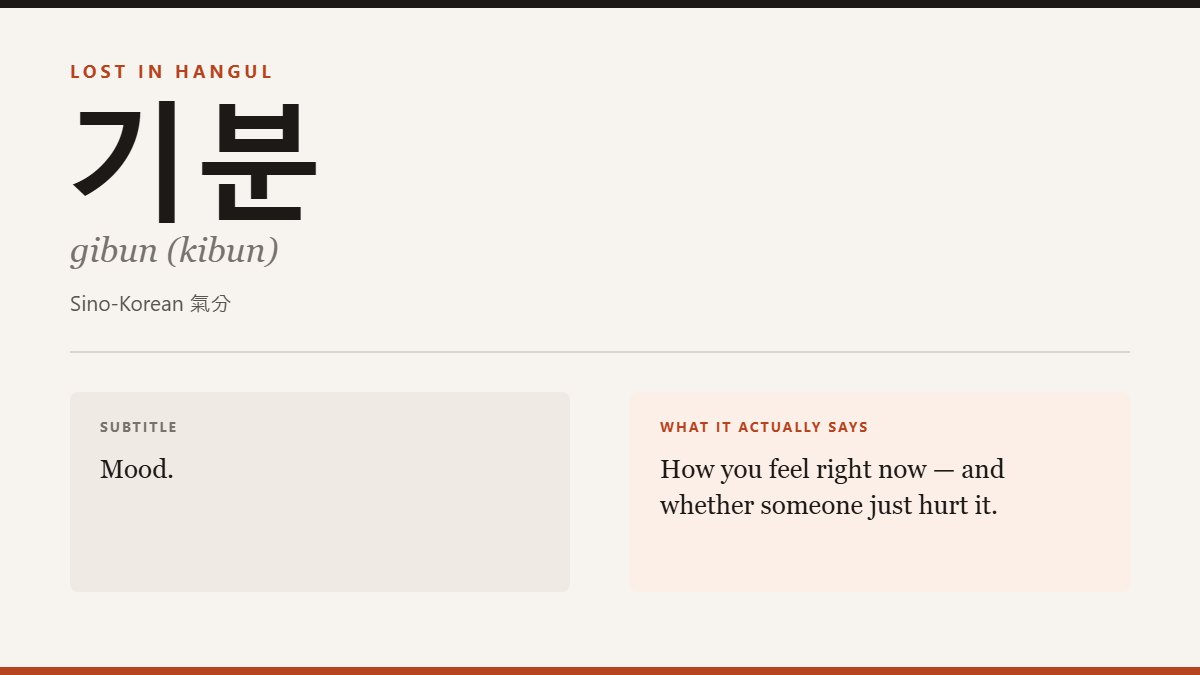
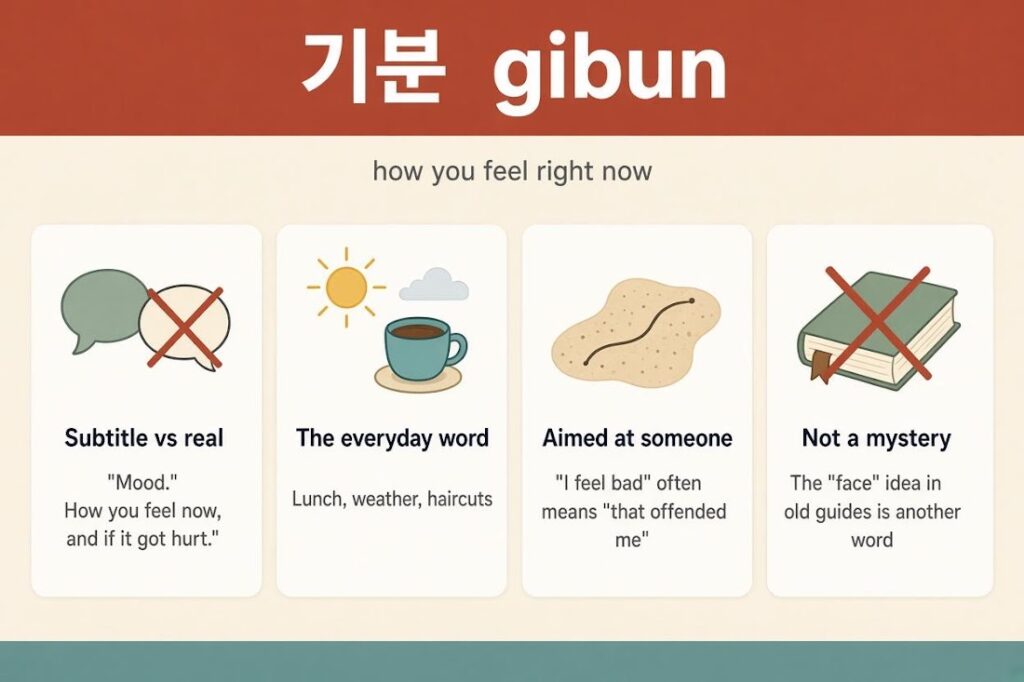
Short version: 기분 means your mood, or how you feel at this moment. 기분 좋다 is “I feel good,” 기분 나쁘다 is “I feel bad” — often meaning “that offended me.” It is one of the most common words in the language, and it is much less mysterious than some Western books make it sound.
The everyday word
- 기분 좋아 — I feel great / I’m in a good mood
- 기분 나빠 — that annoyed me / I’m offended
- 기분이 이상해 — I feel strange / something feels off
- 기분 전환 — a change of mood (a walk, a haircut, a trip)
- 기분 탓이야 — it’s just your imagination (literally, “blame the mood”)
Two of these deserve attention. 기분 나빠 looks like “I’m in a bad mood,” but it is often aimed at someone: “that was offensive.” And 기분 탓 is a lovely phrase for dismissing a suspicion — “is the coffee weaker today?” “기분 탓이야” — “you’re imagining it.”
Where the word comes from
기분 is Sino-Korean, 氣分. 氣 is the “energy” or “air” that appears in many East Asian words for health and emotion, and 分 is a portion or share. Together they describe the state of your inner energy at a given time. The same characters exist in Japanese as kibun, with a very similar everyday meaning.
The business-book version
If you have read an older guide to doing business in Korea, you may have met “kibun” presented as a key cultural concept: a sort of inner harmony and dignity that must never be disturbed, closely tied to face. The advice usually followed: never deliver bad news directly, never embarrass anyone, always protect their kibun.
There is something real underneath. Korean speakers do care about not hurting each other’s feelings in public, and blunt criticism in front of others can go badly. But the word itself does not carry that special weight. Korean speakers use 기분 about lunch, weather and haircuts. The deeper idea those guides were reaching for is closer to 체면 (face) and to 눈치 (reading the room).
If you want to learn from those guides, keep the advice and drop the mystique. “Don’t criticise people publicly” is good advice anywhere. You do not need a special Korean word to follow it.
How it differs from nearby words
| Word | Meaning |
|---|---|
| 기분 | Mood right now; your feelings in the moment |
| 감정 | Emotions in general, more formal |
| 마음 | Heart, mind, what you really feel or intend |
| 체면 | Face, dignity in front of others |
A useful test: 기분 changes by the hour. 마음 is steadier and deeper. You can be in a bad 기분 all day and still have a good 마음 toward someone.
What subtitles do
“Mood” or “feel,” which is right most of the time. The spot where subtitles slip is 기분 나빠. It usually becomes “I’m upset” or “I’m annoyed,” which is close. But when a character says it quietly and directly to someone, it is a line in the sand — “You’ve offended me, and I’m telling you so.” In a culture where people often avoid saying that out loud, hearing it plainly is a bigger moment than the English suggests.
Read next
- “Seounhada” (서운하다) — the hurt you feel slightly embarrassed about
- “Nunchi” (눈치) — subtitles say “reading the room,” and still miss it
- “Dapdaphae” (답답해) — not frustrated. Something tighter than that.
Last reviewed: September 26, 2026