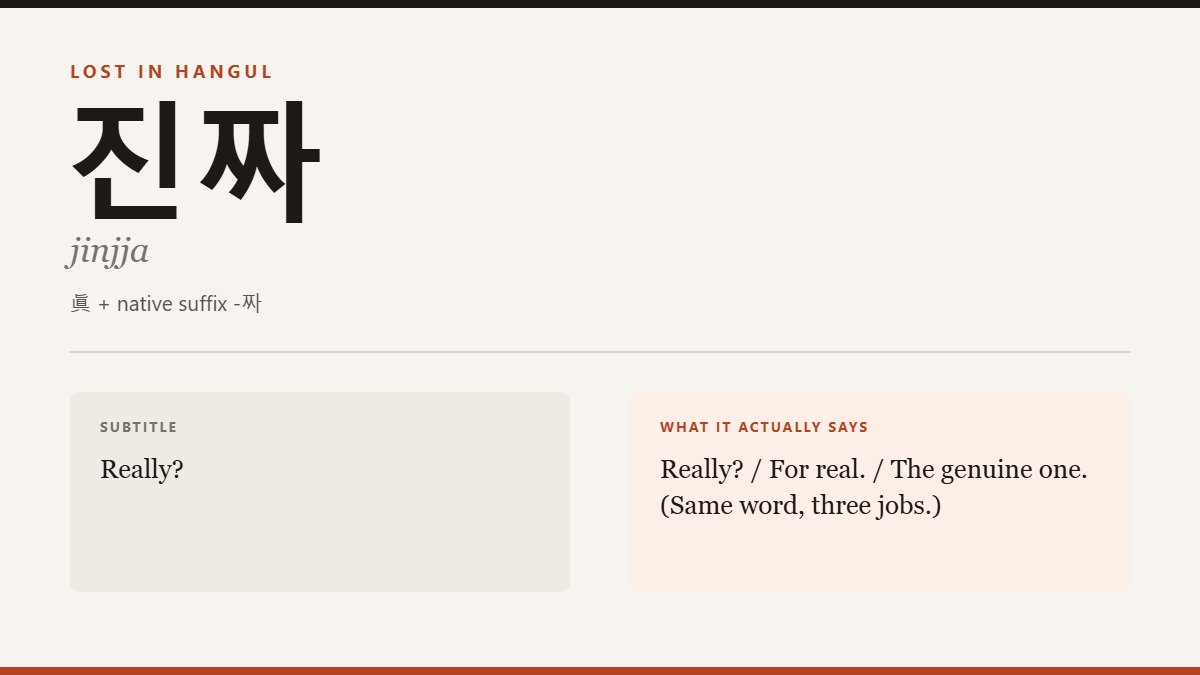
Short version: 진짜 means “real” as an adjective, “really” as an adverb, and “Really?” as a reaction. It is extremely common and casual. Its more neutral twin is 정말, and its internet cousin is 레알.
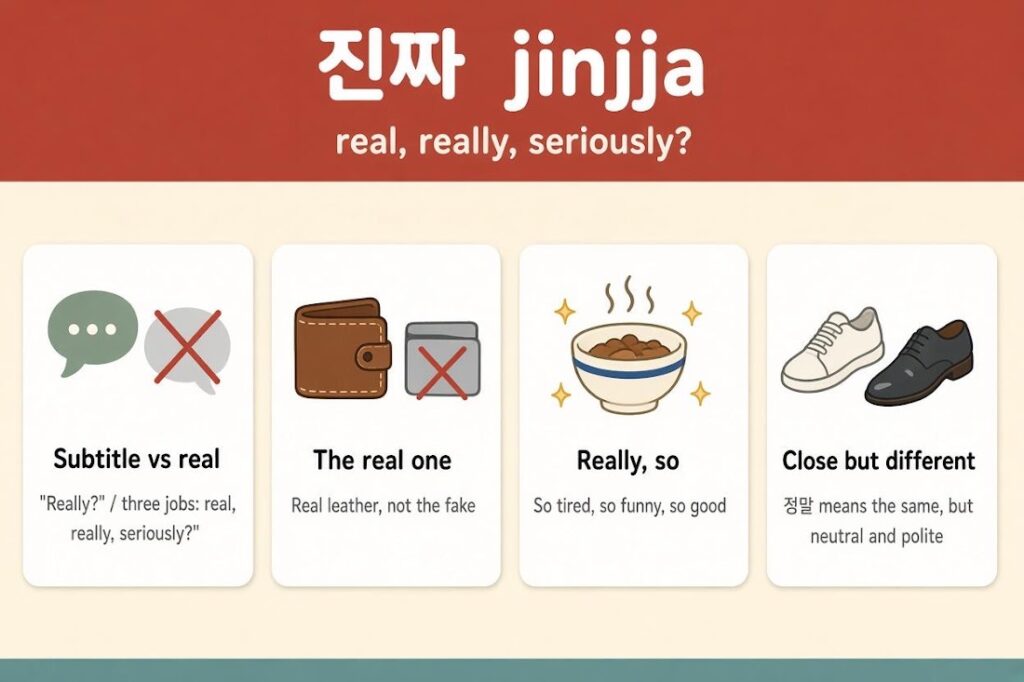
Three jobs
| Use | Example | Meaning |
|---|---|---|
| Noun / adjective | 이거 진짜야 | This one’s real / genuine |
| Adverb | 진짜 맛있다 | This is really good |
| Reaction | 진짜? | Really? / Seriously? |
As an adverb it is everywhere in casual speech. 진짜 피곤해, 진짜 웃겨, 진짜 싫어 — “so tired,” “so funny,” “I really hate it.” It is doing the same job as English “so” or “really,” and people use it just as often.
Where the word comes from
진짜 combines 진, from 眞 (“true”), with the native suffix –짜, which marks a thing as a certain kind. Its opposite is built the same way: 가짜, from 假 (“false”), means a fake. So 진짜 and 가짜 are a matched pair: the real one and the fake one.
That origin is still visible in how it is used. 진짜 as a noun means “the genuine article” — 진짜 가죽 is real leather, and 진짜를 보여 줄게 is “I’ll show you the real thing.”
진짜 vs 정말
정말 means the same thing and can replace 진짜 in almost every sentence. The difference is register:
- 진짜 — casual, spoken, a little emphatic
- 정말 — neutral, fine in writing and in polite speech
- 참 — gentler, a bit old-fashioned, common in writing (참 좋다)
- 레알 — slang, from English “real,” used jokingly online
In a job interview, 정말 감사합니다 is natural. 진짜 감사합니다 sounds sincere but a little too relaxed. Among friends, 정말? can sound slightly stiff, and 진짜? is what most people say.
The reaction, and its tones
진짜? on its own depends entirely on intonation. Bright and rising: genuine surprise. Flat: doubt. Drawn out with a frown: “you can’t be serious.” Doubled — 진짜 진짜? — it becomes “no, really, are you telling the truth?”, which children use a lot.
You will also hear 진짜로, “for real,” used to insist: 진짜로 안 했어 — “I really didn’t do it.” Adding 로 makes it more emphatic, like saying “honestly” in English.
What subtitles do
“Really,” “seriously,” “so,” “for real.” All correct. The loss is in frequency and register. A character who says 진짜 in every sentence is a certain kind of person — young, excitable, informal — and the subtitle, which uses “really” a normal amount, smooths that out. Likewise, when a stiff, formal character suddenly says 진짜? instead of 정말요?, the drop in register is a small crack in their composure that English can’t easily show.
Read next
- “Daebak” (대박) — one word, four completely different meanings
- “Ani” (아니) — the word that usually is not “no”
- “Injeong” (인정) — the one-word agreement that took over Korean variety
Last reviewed: September 26, 2026