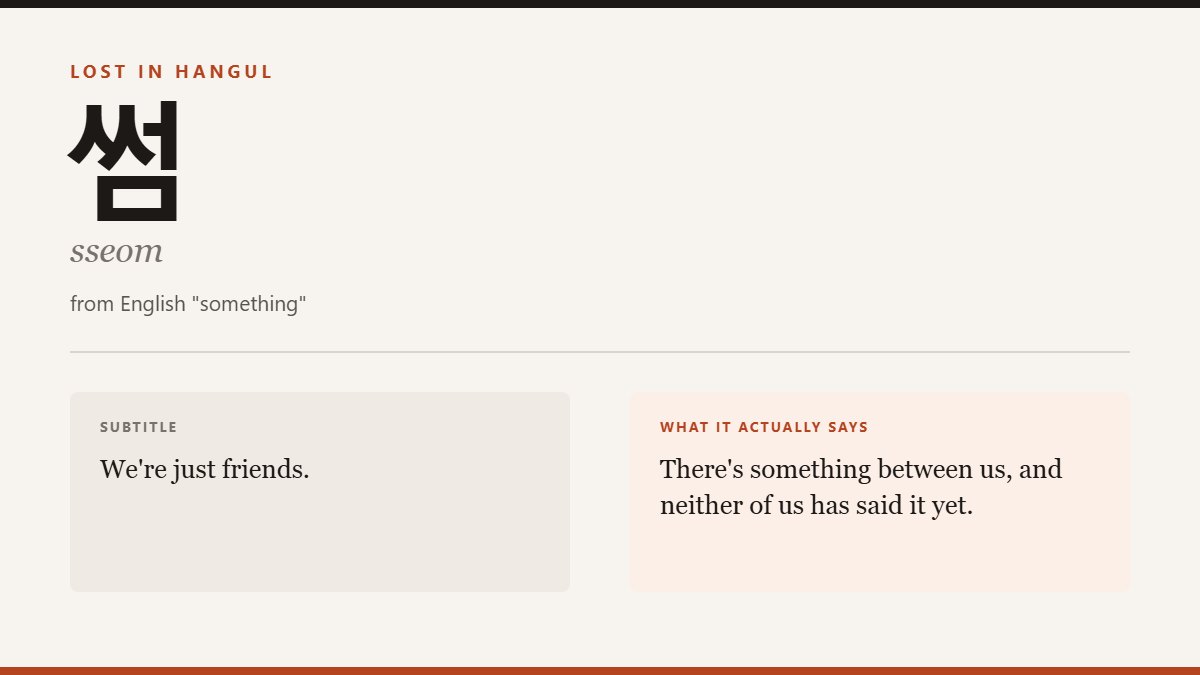
Short version: 썸 is the stage before a relationship. Two people are clearly interested in each other, they text a lot, they meet up, and neither has said “let’s date.” Korean calls that stage 썸, and being in it is 썸 타다.
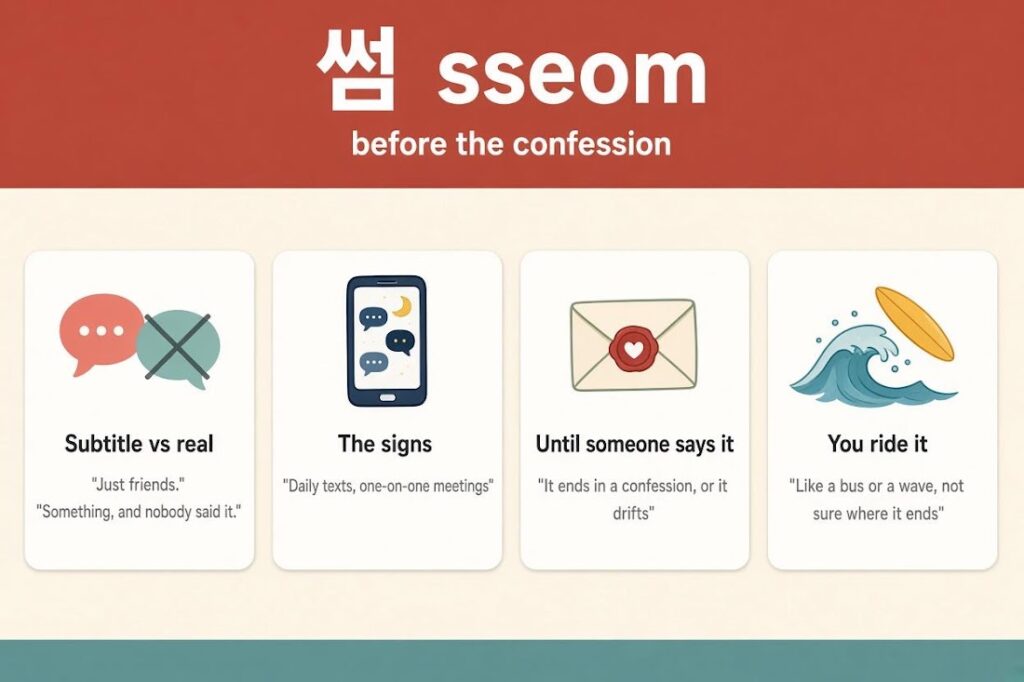
How it is used
- 우리 썸 타는 중이야 — we’re in the “something” stage
- 썸남 / 썸녀 — the man / woman you’re in a 썸 with
- 썸만 타다 끝났어 — it never got past the 썸 stage
- 썸 아니야? — isn’t that a 썸? (teasing a friend)
The verb 타다 means “to ride,” and it is used for things that carry you along, like a bus or a swing. You “ride” a 썸 the way you ride a wave: it moves, you are on it, and you are not sure where it ends.
Where the word comes from
썸 is clipped from English “something,” as in “there’s something between them.” It became common in the early 2010s and was pushed into everyday speech by a hit 2014 duet whose title was simply 썸. Korean speakers do not hear it as English any more; it is just the word.
What counts as 썸
There is no official line, which is part of the fun. But the markers people usually mention:
| Sign | Why it counts |
|---|---|
| Texting every day, including late at night | More than friends do |
| Meeting one-on-one, repeatedly | Not group hangouts |
| Small jealousies | “Who were you with?” |
| Nobody has confessed | The defining feature |
That last one matters. In Korean dating culture, a relationship traditionally starts with a clear confession, 고백, and often an agreed “first day” — couples count their anniversaries from it. 썸 is everything before the 고백. It ends either in a confession or in quietly drifting apart.
Because the confession is so important, the 썸 stage can feel long and anxious. A common complaint is being stuck in 썸 for months with someone who won’t confess. There is a phrase for the person who enjoys the attention without committing: 어장 관리, literally “fish-farm management.”
Compared to English
English has “talking stage,” “situationship,” “seeing each other,” and “it’s complicated.” None of them match exactly. “Situationship” usually implies something is already physical and undefined. 썸 is earlier and more hopeful — the flutter before anything is decided. It pairs naturally with 설레다, the excitement of anticipation.
What subtitles do
This is a hard one. When a character asks 너 썸 타? you may see “Are you seeing someone?” — which is wrong, because 썸 means you are not officially seeing them yet. “Is there something going on with you two?” is closer. The deeper loss is the confession structure: English viewers may not realise that everyone in the scene is waiting for someone to say the words.
Read next
- “Seolleda” (설레다) — the flutter that only happens beforehand
- “Simkung” (심쿵) — heart, thud
- Why she calls him “Oppa” (오빠) — and why the subtitle just uses his name
Last reviewed: September 26, 2026