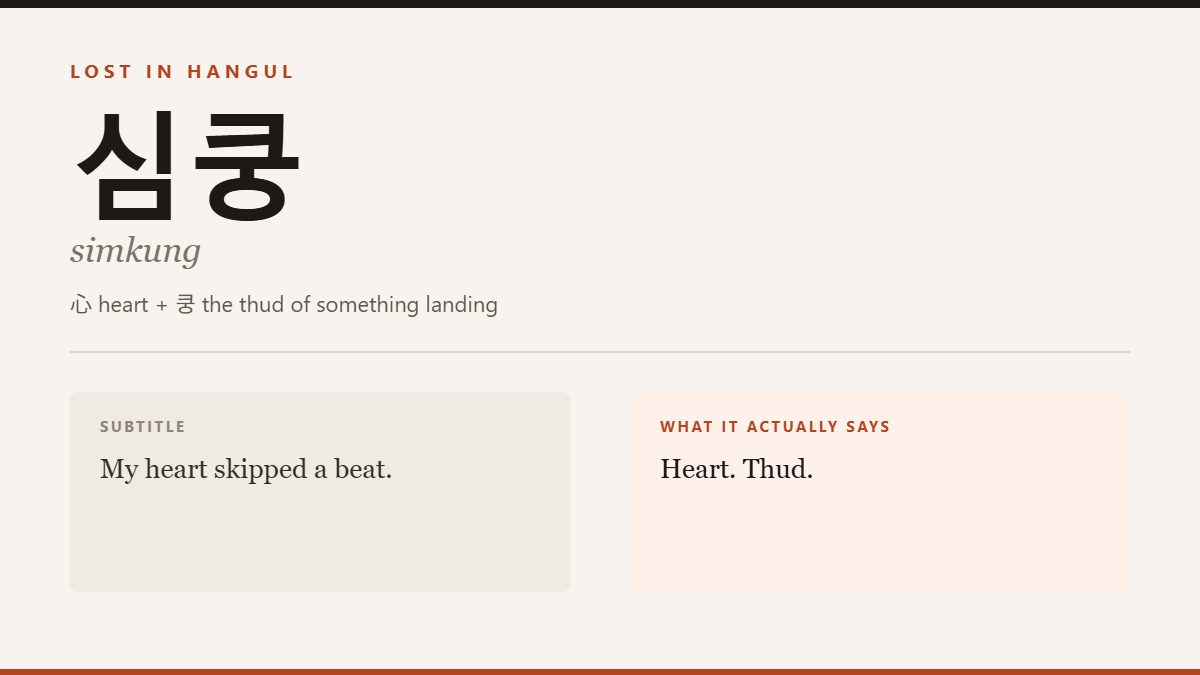
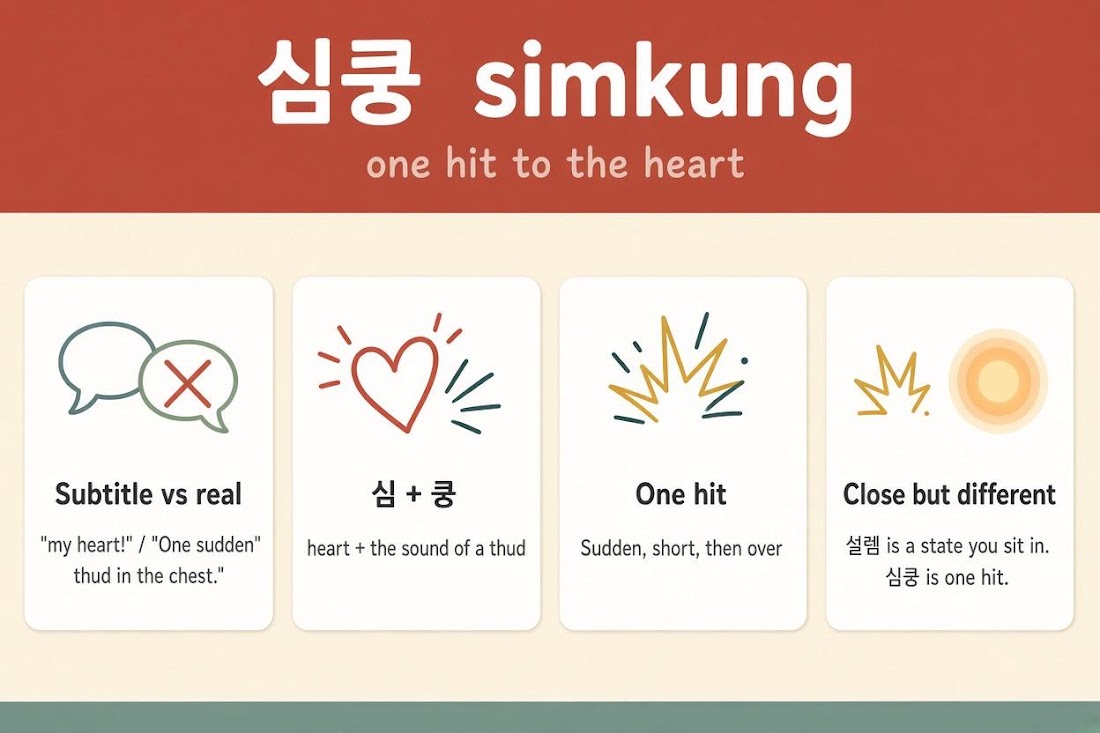
Short version: 심쿵 (simkung) is one hit to the heart. A single sudden flutter at something charming. It is shorter, younger and sharper than 설렘, and it is built out of two pieces you can take apart.
Where the word comes from
A compound, and a neat one. 심 is 心, heart. 쿵 is a native Korean sound word — the thud of something heavy landing. So the word is literally heart-thud.
That second half matters. 쿵 belongs to Korean’s enormous stock of sound-and-shape words, and pairing a Sino-Korean noun with one of them is a very modern move. The result reads as playful rather than poetic.
How it is used
- 심쿵했어 — I got heart-thudded. Past tense, because it is an event.
- 심쿵 주의 — “heart-thud warning”, used as a caption on a clip of something cute.
- 심쿵유발 — heart-thud-inducing, describing a person or moment.
It is almost always about someone else being charming, and it is almost always small: a glance, an unexpected kindness, an idol doing something ordinary well.
Against its neighbours
| Word | Shape |
|---|---|
| 심쿵 | A single hit. Sudden. |
| 설렘 | A state. Lasts, points forward. |
| 두근두근 | Repeated heartbeat. Nerves or anticipation. |
| 뭉클 | Thick and rising. Moved, not charmed. |
두근두근 is the closest sound relative and a different feeling: it is the heart beating fast over time, and it works for fear as well as attraction. 심쿵 is one beat and always positive.
What subtitles do
“My heart skipped a beat” is the standard and it is long. “That was so cute” gets the function and loses the body. Fansubs frequently leave it as “simkung”, which works for an audience that already has the word.
Register: young, casual, internet-born, extremely common in fandom captions. It would be odd from someone in their sixties and that oddity is sometimes the joke.
Read next
- “Kkuljaem” and “Nojaem” (꿀잼·노잼) — how Koreans rate whether it was fun
- “Daebak” (대박) — one word, four completely different meanings
- “Injeong” (인정) — the one-word agreement that took over Korean variety
Last reviewed: September 21, 2026