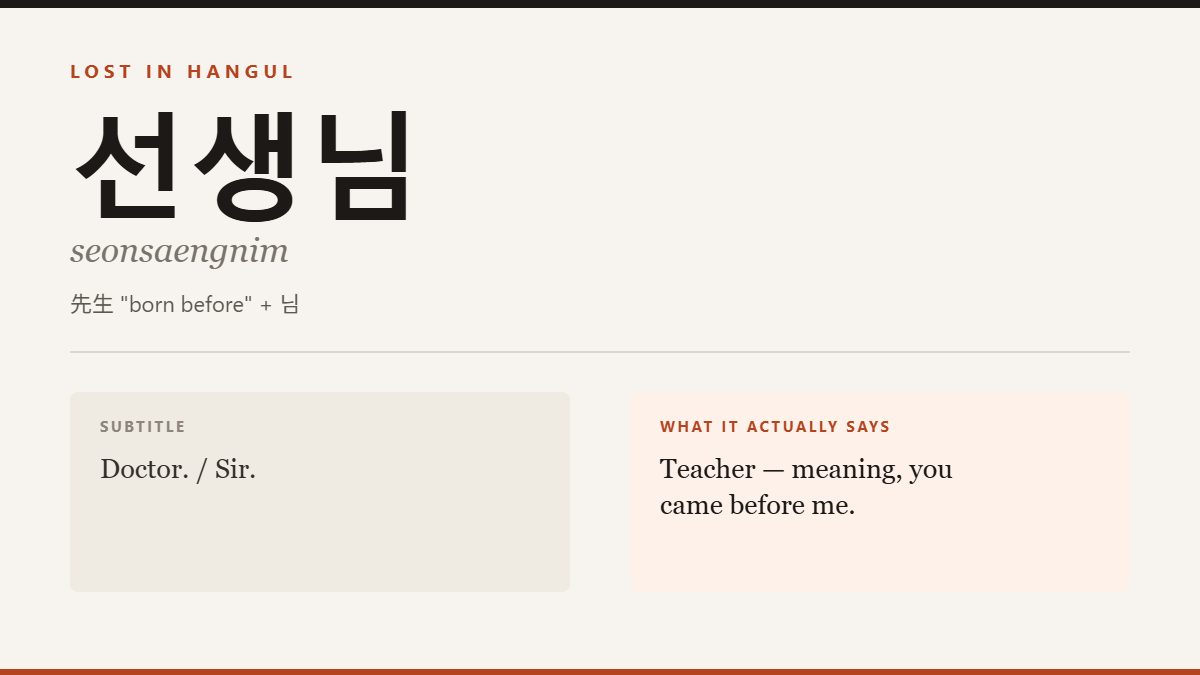
Short version: 선생님 literally means teacher, and Korean uses it for doctors, lawyers, pharmacists, older strangers and anyone whose title you do not know. It is the safest respectful address in the language.
Where the word comes from
先生 plus the native honorific 님. The hanja read as “born before” — the one who came earlier. So the respect built into the word is about precedence rather than about instruction, which is exactly why it travels so far beyond classrooms.
The same characters give Japanese sensei, which behaves similarly and is not identical: Korean 선생님 is used more freely with strangers.
Who gets called it
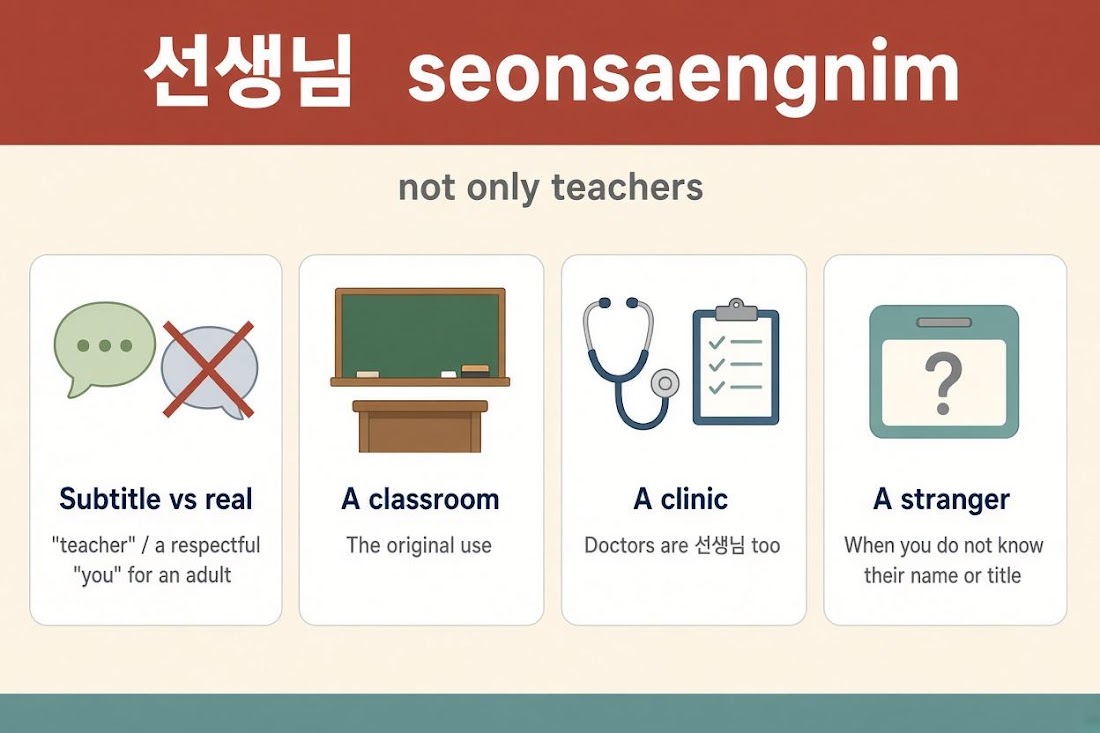
- Teachers and professors, obviously.
- Doctors. This is the standard address in a Korean hospital, not 의사님.
- Lawyers, pharmacists, and most licensed professionals.
- An older stranger you want to be polite to and whose job you do not know.
- Anyone in a position you are asking something of.
That fourth use is the practical one for a learner. If you do not know someone’s name or title and they are clearly older than you, 선생님 works and will never offend.
Why Korean needs it
Because there is no usable polite second-person pronoun. English has “you” and “sir”. Korean has neither in a neutral form, so the gap gets filled by a title, and 선생님 is the general-purpose one.
It is also why Korean conversations sound repetitive in subtitles: the title appears in almost every turn because it is doing the job of the pronoun.
The ones that are not interchangeable
| Address | For |
|---|---|
| 선생님 | Teachers, professionals, older strangers — the safe default |
| 사장님 | A business owner, and also any shop or restaurant proprietor |
| 고객님 | You, the customer, said by staff |
| 기사님 | A driver |
| 이모 | Literally “aunt”. A middle-aged woman running a restaurant. |
이모 is the warm one and it is a real thing, not a joke. Calling a restaurant owner “aunt” is friendly and completely normal.
What subtitles do
“Doctor”, “sir”, “ma’am”, or the person’s name. All reasonable. What vanishes is that Korean is reaching for the same word in a hospital, a courtroom and a bus stop, and that the word means “you came before me”.
Read next
- “-ssi” and “-nim” (씨 · 님) — the suffix that sets your rank
- Hyung, Nuna, Sunbae — three words your subtitle turned into “you”
- Why she calls him “Oppa” (오빠) — and why the subtitle just uses his name
Last reviewed: September 21, 2026