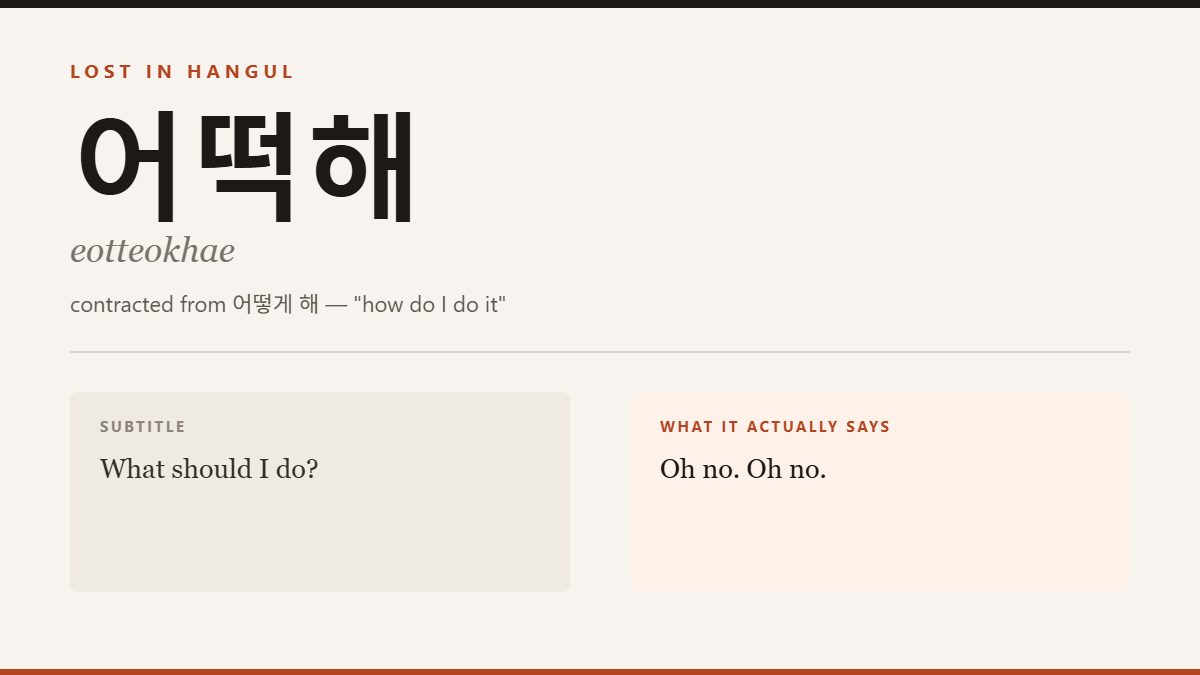
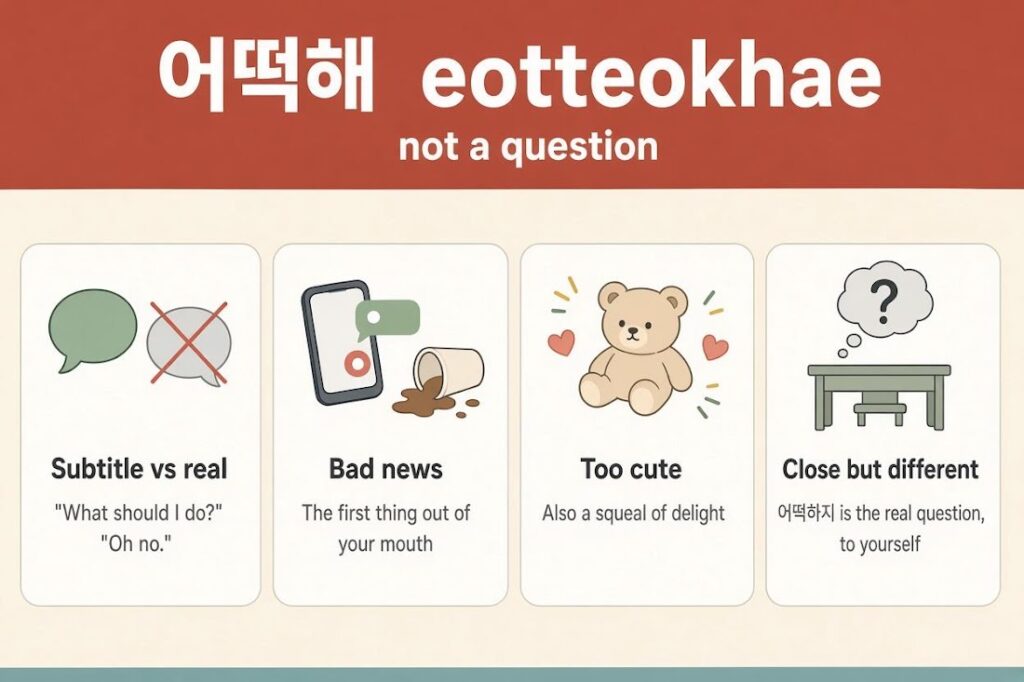
Short version: 어떡해 is not a question. It means roughly “oh no” — the sound of someone facing a situation with no obvious move. English subtitles write “what should I do?”, which turns a wail into a request for advice.
Where the word comes from
A contraction of 어떻게 해 — “how do I do it”. So the literal reading really is “what do I do”, and the question form is where it started.
What happened is that the phrase wore down into an exclamation. It stopped expecting an answer and became the noise you make when something has gone wrong. English “what do I do” can drift the same way; Korean has taken it much further.
Spelling confusion, briefly
어떡해 is the exclamation. 어떻게 is the word “how”. They sound nearly identical and Koreans mix them up in writing constantly, to the point that correcting it is a small internet genre. If you write 어떻해, that one is simply wrong and does not exist.
When it gets used
- A friend tells you bad news. 어떡해 is the first thing out of your mouth, and it means “oh no”, not “what should you do”.
- You realise you have forgotten something important.
- Something adorable happens. Yes, really — 어떡해 doubles as a squeal of delight when something is too cute to handle.
- Watching a drama character make a bad decision.
That third use surprises learners and is extremely common among younger speakers. The logic is the same either way: the situation has overwhelmed the speaker and there is no move available.
The variants
| Form | Feel |
|---|---|
| 어떡해 | Casual. Friends. |
| 어떡하죠 | Polite, genuinely worried |
| 어떡하지 | To oneself, thinking out loud |
| 어쩌지 | Same job, slightly more casual |
어떡하지 is the one that actually is a question, aimed at yourself, and it is the form most likely to want an answer.
What subtitles do
“What should I do?” almost every time. It is literal and it changes the scene: a character expressing helplessness becomes a character asking for instructions, and the person opposite them looks rude for not answering.
“Oh no” is shorter, less literal and much closer.
Read next
- “Aigoo” (아이고) — one sound doing six different jobs
- “Ani” (아니) — the word that usually is not “no”
- “Gwaenchanayo” (괜찮아요) — it also means “no thank you”
Last reviewed: September 21, 2026