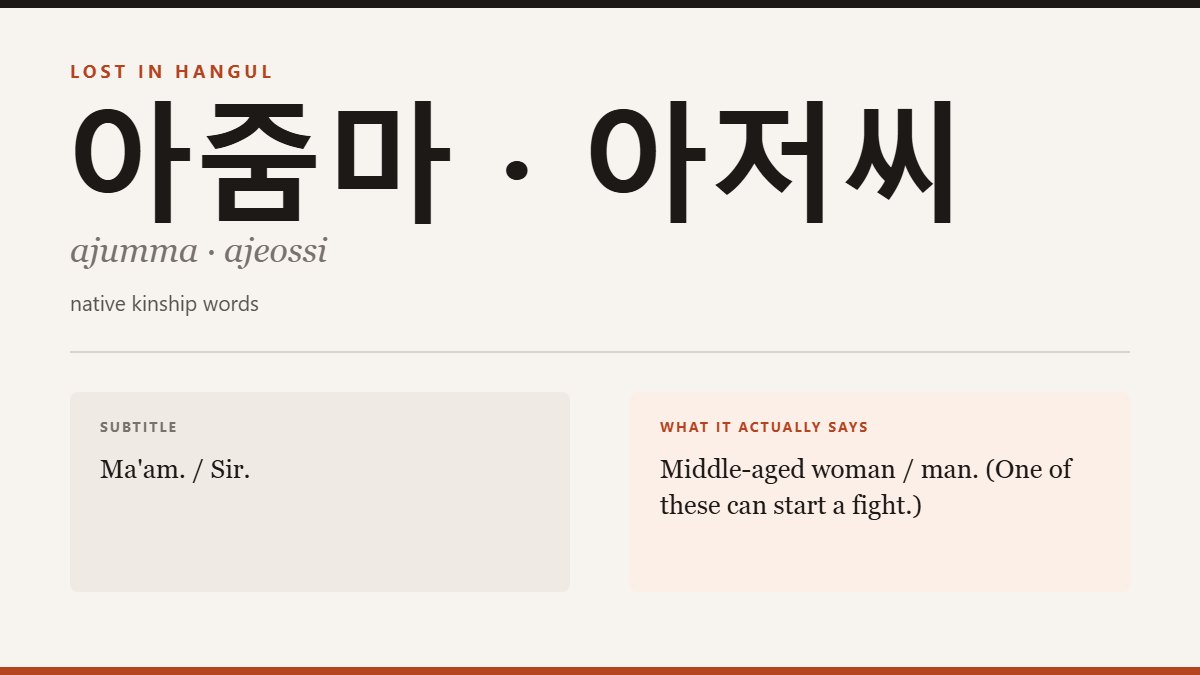
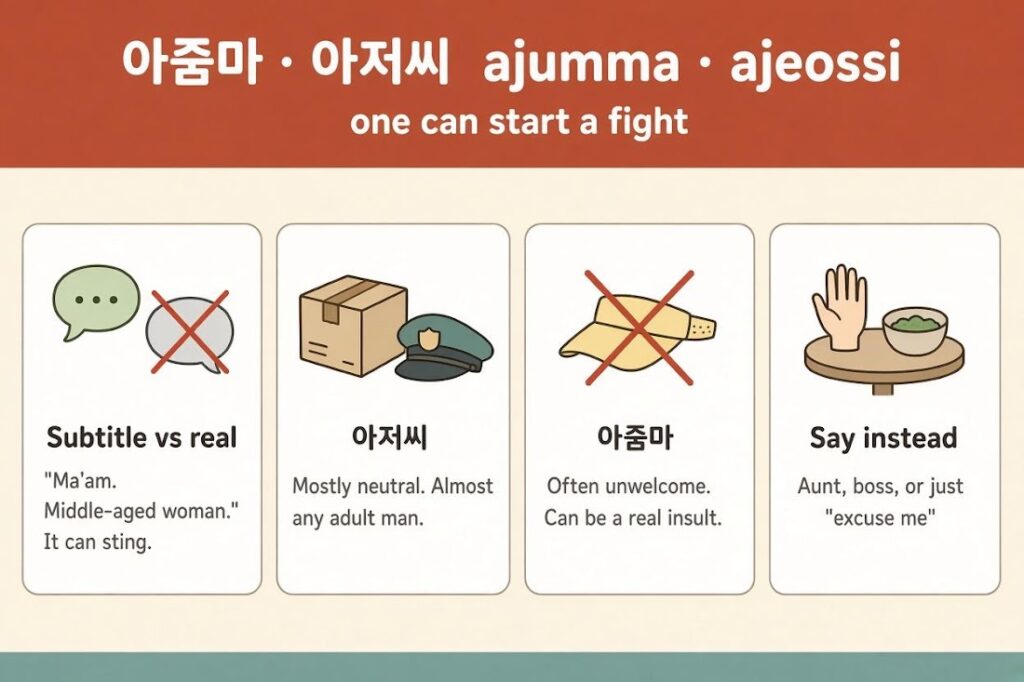
Short version: 아줌마 is a middle-aged woman and 아저씨 is a middle-aged man, used both to describe strangers and to address them. They grew out of words for aunts and uncles. 아저씨 is fairly neutral; 아줌마 can sound dismissive, and many women dislike being called it.
Who gets called what
| Word | Roughly | How it lands |
|---|---|---|
| 아저씨 | A man from about his thirties up | Mostly neutral |
| 아줌마 | A married or middle-aged woman | Often unwelcome |
| 아주머니 | The polite form of 아줌마 | Better, still age-marking |
| 아재 | Slang for 아저씨 | Jokey, self-deprecating |
A child will call almost any adult man 아저씨. A taxi driver, a delivery man, a neighbour — all 아저씨, and nobody minds. 아줌마 is different. It carries an image: permed hair, sun visor, pushing to the front of the queue. Calling a woman 아줌마 when she does not see herself that way can be a real insult.
Where the words come from
Both are native Korean and come from older words for aunts and uncles in the wider family. 아주머니 and 아저씨 were once kinship terms, and in some families they still are. 아줌마 is the casual, shortened form of 아주머니. The exact historical path of each word is discussed by linguists and I won’t try to settle it here; the kinship origin is the part that matters.
That origin explains the whole system. Korean addresses strangers as if they were family: the older man becomes an uncle, the woman at the restaurant becomes an aunt, the young woman becomes a big sister. 아줌마 and 아저씨 are simply the most generic uncle and aunt.
What people say instead
Because 아줌마 is risky, Korean speakers have a set of alternatives:
- 이모 — “aunt on the mother’s side.” The standard way to call a woman working at a restaurant. Warm and friendly.
- 사장님 — “boss.” For anyone who might own the shop. Flattering and safe.
- 어머님 — “mother,” polite. Used by salespeople and at schools for customers or parents.
- 언니 — “big sister.” Used by women to other women, including shop staff, and often by salespeople to younger customers.
- 저기요 — “excuse me.” Avoids the problem entirely.
Men have an easier time. 아저씨 is so neutral that the main workaround is to upgrade it — 사장님 again, or 선생님 for someone professional.
아재 and 아재개그
아재 is a dialect-flavoured, casual version of 아저씨, and it has become an affectionate joke. 아재개그 is a “dad joke” — a groan-worthy pun. Men in their thirties call themselves 아재 to laugh at their own age, and it softens the word considerably.
There is a well-known asymmetry here. Men often embrace 아재 as a joke about themselves. Women rarely do the same with 아줌마, because the word has a harder edge — it is tied to stereotypes about women after marriage that many find unfair.
What subtitles do
“Ma’am,” “sir,” “lady,” “mister,” or the line is rephrased. None of them carry the kinship frame or the sting. When a character snaps 아줌마! at a woman, Korean viewers hear a small insult. “Ma’am!” in English sounds polite. That is the direct opposite of what was said.
Read next
- “Seonsaengnim” (선생님) — teacher, doctor, lawyer, stranger
- “-ssi” and “-nim” (씨 · 님) — the suffix that sets your rank
- Hyung, Nuna, Sunbae — three words your subtitle turned into “you”
Last reviewed: September 26, 2026