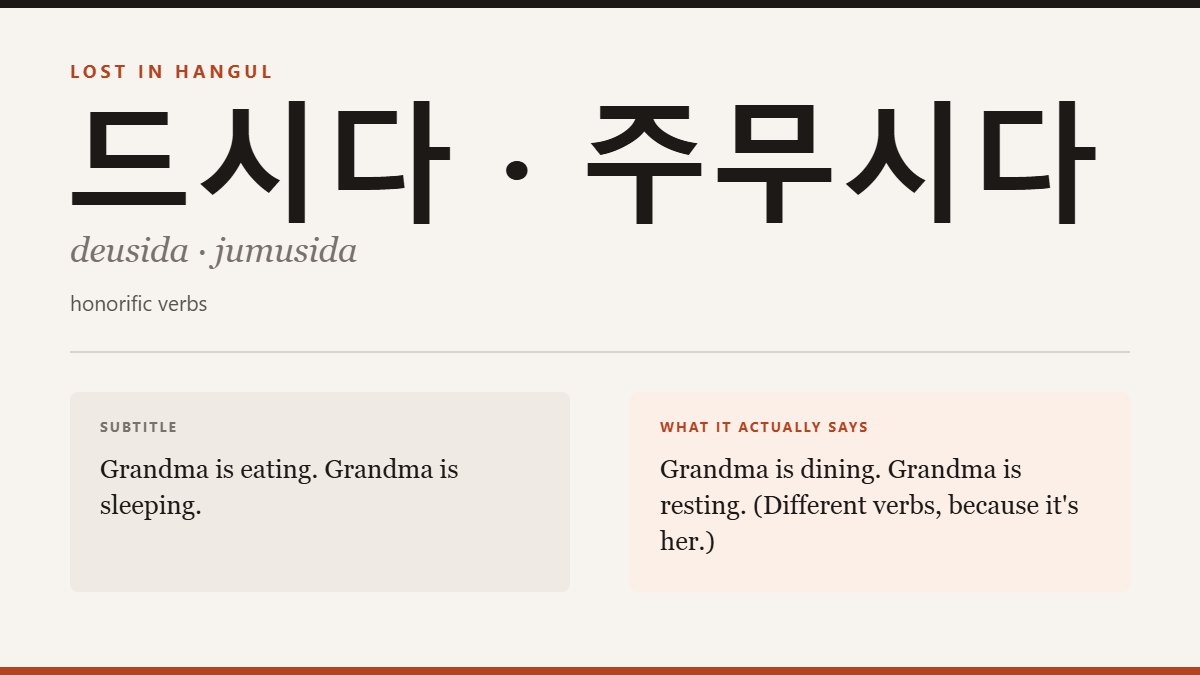
Short version: in Korean, some everyday verbs and nouns are replaced by entirely different words when you talk about someone who deserves respect. Your friend 먹어요, but your grandmother 드세요. Your friend 자요, your grandmother 주무세요. English uses the same verb for both, so the respect is invisible in subtitles.
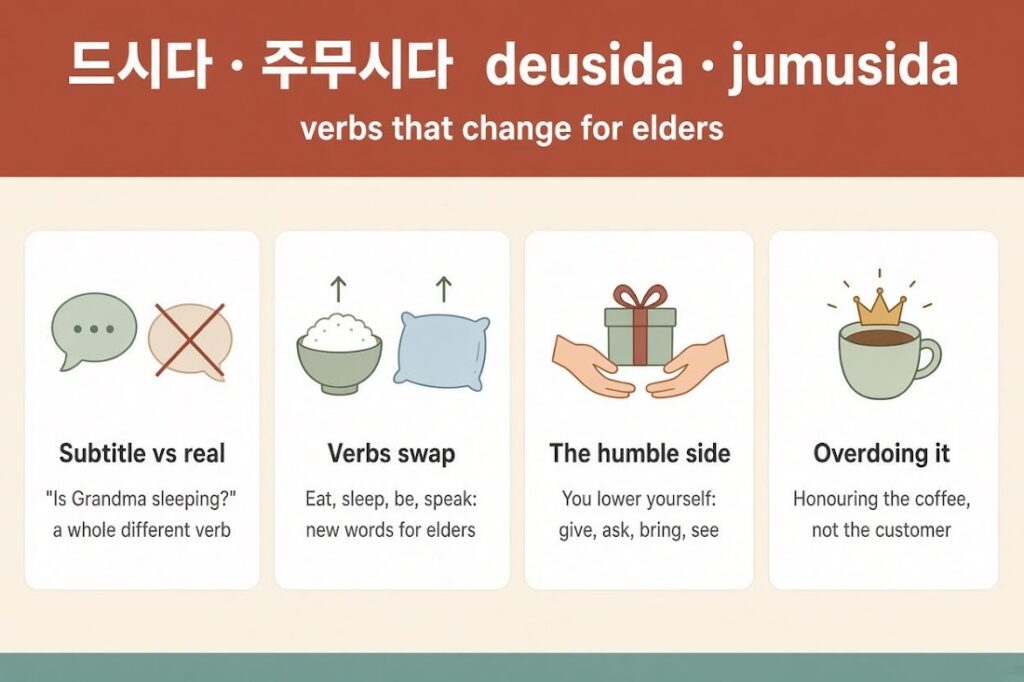
The main swaps
| Plain | Honorific | Meaning |
|---|---|---|
| 먹다 | 드시다 / 잡수시다 | to eat |
| 자다 | 주무시다 | to sleep |
| 있다 | 계시다 | to be (somewhere) |
| 말하다 | 말씀하시다 | to speak |
| 죽다 | 돌아가시다 | to die |
| 아프다 | 편찮으시다 | to be ill |
Nouns change too: 나이 (age) becomes 연세, 집 (home) becomes 댁, 이름 (name) becomes 성함, 생일 (birthday) becomes 생신, and 밥 (a meal) becomes 진지. Asking an older person 성함이 어떻게 되세요? instead of 이름이 뭐예요? is basic courtesy.
The humble side
There is a mirror set for your own actions toward someone respected. Instead of raising them, you lower yourself:
- 주다 (give) → 드리다 — 할머니께 드렸어요, “I gave it to Grandma”
- 묻다 (ask) → 여쭙다 — 선생님께 여쭤볼게요, “I’ll ask the teacher”
- 데리다 (bring someone along) → 모시다 — 부모님을 모시고 왔어요, “I brought my parents”
- 보다 (see) → 뵙다 — 처음 뵙겠습니다, “pleased to meet you”
So a single sentence can carry two signals: the other person raised, and the speaker lowered.
Where this comes from
These are not recent politeness rules; honorific marking runs deep in Korean grammar. Some of the special words are native Korean (주무시다, 계시다), some are Sino-Korean (연세 年歲, 성함 姓銜, 생신 生辰). The Sino-Korean ones follow a familiar pattern in the language: the Chinese-derived word is the formal, elevated choice.
Alongside the vocabulary there is the infix –시-, which can make almost any verb honorific (가다 → 가시다), and special particles: 께서 instead of 이/가, 께 instead of 에게.
Why it matters in a scene
Because these swaps are so automatic, getting one wrong is noticeable. A character who says 할머니 자요? about their grandmother sounds like a small child or a rude one. A character who pointedly uses the plain verb about a parent they are angry at is making a statement.
Overdoing it is also a thing. Some shop staff honour the product instead of the customer — “this coffee is [honorific] out” — and Korean speakers joke about it as 사물 존칭, “honouring objects.” It comes from nervousness about being polite enough.
What subtitles do
They can’t do much. “Did Grandma eat?” is the only sensible English for both 할머니 밥 먹었어? and 할머니 진지 드셨어요?, even though the second is what a well-raised grandchild says and the first is not. Occasionally a subtitle will reach for “Has Grandma had her meal?” to hint at the register. Usually, the respect in the grammar is simply gone.
Read next
- The moment they switch to 반말 — what just happened between them
- “Seonsaengnim” (선생님) — teacher, doctor, lawyer, stranger
- “Jal meokgetseumnida” (잘 먹겠습니다) — not “bon appétit”
Last reviewed: September 26, 2026