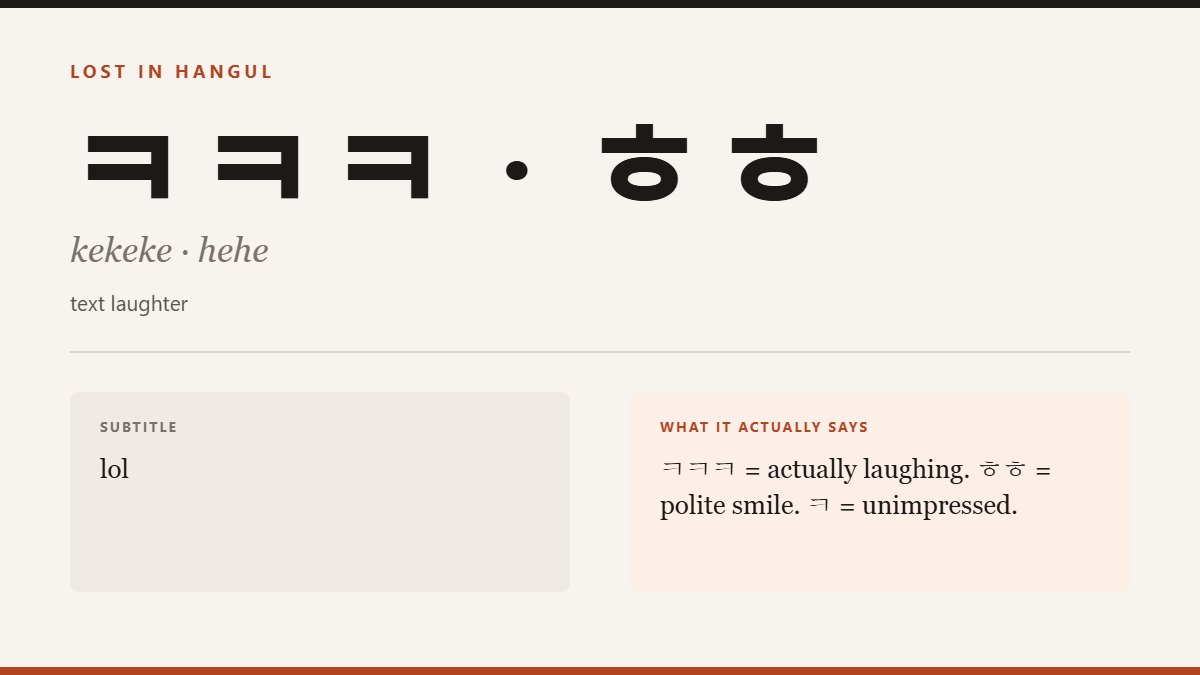
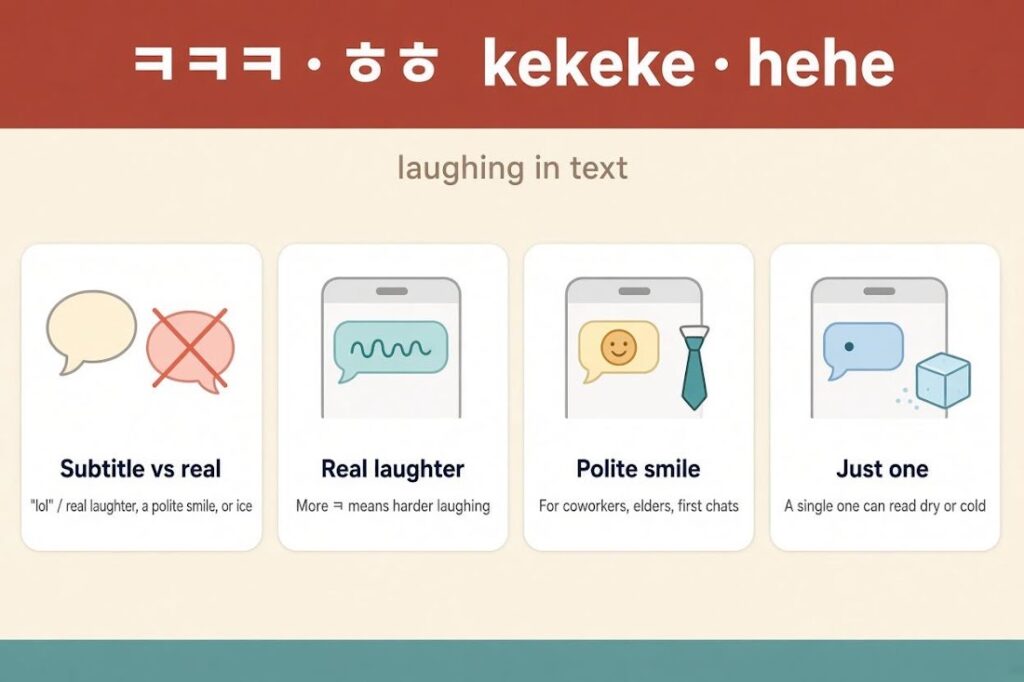
Short version: ㅋㅋㅋ is laughing, and ㅎㅎ is smiling. Both appear constantly in Korean texts, but they carry different warmth. More ㅋ means harder laughter, a single ㅋ can read as dry or sarcastic, and ㅎㅎ is the soft, polite one you might send to a teacher or a new acquaintance.
Where they come from
Both are consonants of the Korean alphabet used on their own. ㅋ is the “k” sound, standing for 크크 or 키키, a snicker. ㅎ is the “h” sound, standing for 하하 or 흐흐, a softer laugh. Typing only the consonant is faster, and the habit took hold with early internet chat and phone texting.
Fans outside Korea sometimes romanise ㅋㅋㅋ as “kkk,” which Korean speakers find a little awkward for obvious reasons. “Kekeke” is the more common spelling.
What each one feels like
| Text | Feel | Typical use |
|---|---|---|
| ㅋ | Flat, dry, can be sarcastic | “Nice try.” |
| ㅋㅋ | Light amusement | Everyday reply |
| ㅋㅋㅋㅋㅋ | Genuinely laughing | Friends, a good joke |
| ㅎㅎ | Gentle smile, polite | Coworkers, elders, first chats |
| ㅎ | Curt, can feel cold | Ending a conversation |
| ㅋㅋㅋㅋㅋㅋㅋㅋ (long) | Can’t breathe | Something truly funny |
The rule of thumb is that more characters means more warmth, up to a point. A single ㅋ or ㅎ after a long message can feel like a brush-off. That is why people add a second one almost automatically.
ㅋ vs ㅎ in real life
Many people use ㅋㅋ with friends and ㅎㅎ with people they are less sure about. ㅎㅎ says “I’m being pleasant,” which suits a message to a manager or a parent’s friend. With close friends, ㅎㅎ can sound slightly distant or even a bit awkward, as if you are being careful.
Preferences vary by age and person, so none of this is strict. Some people only ever use ㅎㅎ. Some older parents send ㅋㅋㅋ with enthusiasm. But the general feel is widely shared, and people do notice when someone switches.
The neighbours
- ㅠㅠ or ㅜㅜ — crying eyes. Sadness, or cute pleading.
- ㄱㄱ — “go go,” let’s go
- ㅇㅇ — “yes,” short for 응응
- ㄴㄴ — “no no”
- ㅇㅋ — “okay”
ㅇㅇ deserves a warning. It is a casual yes, fine among friends, but it can come across as lazy or curt. Sending ㅇㅇ to someone older is not a good idea.
What subtitles do
When a drama shows a text message on screen, subtitles usually render ㅋㅋㅋ as “lol” or “haha,” and ㅎㅎ often the same way. The distinction disappears. That matters when a plot turns on it — a crush replying with a single ㅋ, or a character counting how many ㅋ someone sent. Korean viewers read that as a clear signal. The English “lol” makes every reply look the same.
Read next
- “TMI” in Korean means the opposite of TMI in English
- The Korean words that copy sounds and shapes — and vanish in subtitles
- "Heol" (헐) — the one-syllable jaw drop
Last reviewed: September 26, 2026