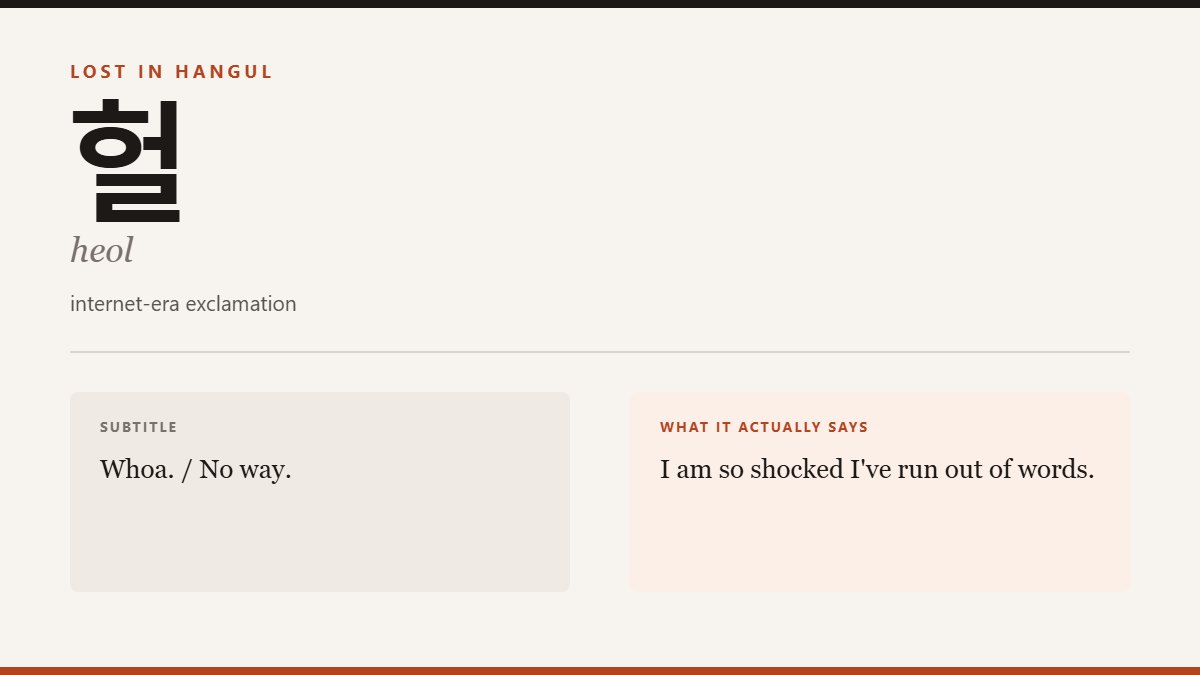
Short version: 헐 is an exclamation of disbelief. Something surprising, absurd, or a little outrageous has just happened, and 헐 is the sound of your jaw dropping. It is casual and slightly theatrical, and it can be said with delight, horror, or exasperation.
How it is used
- A friend says she got engaged after three weeks of dating: 헐.
- You check your phone bill and it is triple what you expected: 헐…
- Someone tells you the café you love is closing: 헐, 진짜?
- A coworker shows you a message the boss sent at 2 a.m.: 헐, 미쳤다.
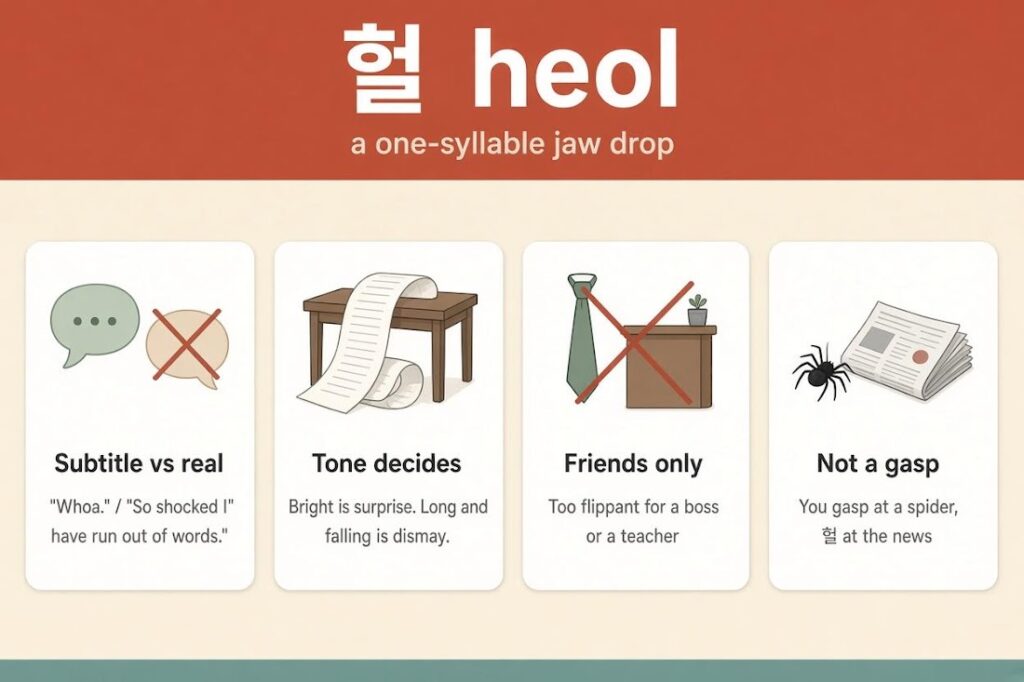
Tone does all the work. A short, bright 헐! is surprise. A long, falling 헐… is dismay. Paired with a flat face, it can be sarcastic.
It also works in text. A reply of just “헐” to a long message means “I read it, and I’m stunned.” That is a complete, polite-enough reply among friends.
Where the word comes from
Honestly: nobody knows for certain. 헐 spread widely with internet chat and texting in the 2000s, and that is where most Korean speakers under fifty picked it up. Some people point to older exclamations in regional speech; others see it as an internet coinage from the sound of a sharp breath out. None of these are documented well enough to call settled.
What is clear is that it moved from online slang into everyday speech and stayed there. Twenty years later, it no longer sounds like internet language to most people. It sounds like how people talk.
Variations you will see
| Form | Feel |
|---|---|
| 헐 | The standard reaction |
| 헐… | Dismay, “oh no” |
| 헐 대박 | Shock plus “that’s huge” (good or bad) |
| 헐랭 | Playful, cutesy version |
| 헉 | A different word: a gasp, more sudden and physical |
헉 is worth separating from 헐. 헉 is the sound of being startled — seeing a bug, missing a step. 헐 is a reaction to information. You 헉 at a spider and 헐 at the news.
Who can you say it to
Friends, siblings, people your age or younger. It is not rude as a word, but it is informal, and saying it directly to a teacher, a boss, or a stranger’s grandmother would sound flippant. With them, Korean speakers switch to 어머 or 정말요? or simply widen their eyes.
Older speakers do use 헐 now, especially in family group chats, and it tends to be received as endearing. It has lost most of the “young people’s slang” feel it had in the 2000s.
What subtitles do
“Whoa,” “No way,” “What?”, “Seriously?” — all reasonable. The loss is register. 헐 tells you the speaker is relaxed with the listener. When a character who has been using careful speech suddenly lets out a 헐 in front of someone, it signals that the guard has dropped. English “whoa” can be said to anyone, so that small social signal does not come through.
Read next
- “Daebak” (대박) — one word, four completely different meanings
- “Aigoo” (아이고) — one sound doing six different jobs
- “Injeong” (인정) — the one-word agreement that took over Korean variety
Last reviewed: September 26, 2026