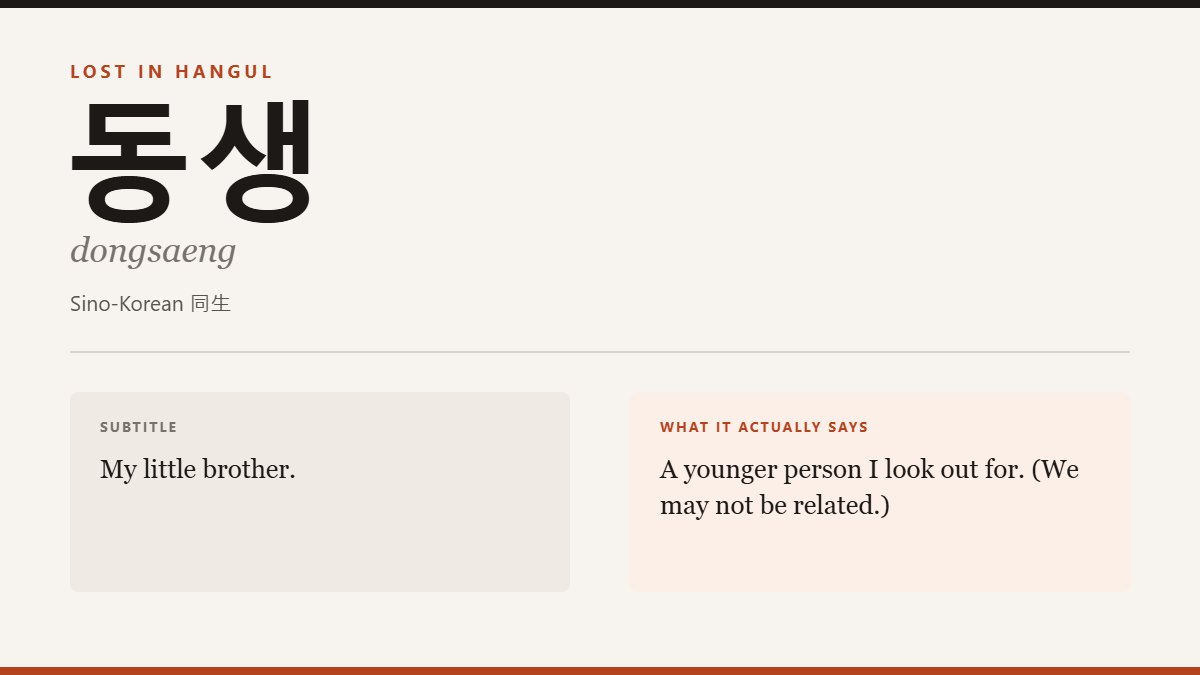
Short version: 동생 means younger brother or sister. But Korean uses it far more widely than that. A younger friend, a junior at work, the neighbour’s kid you’ve known for years — all can be your 동생. The word describes a relationship of age and care, not only of blood.
The family meaning
In the family, 동생 is anyone younger than you who shares your parents. English splits by gender; Korean splits by age first and adds gender only when needed:
- 남동생 — younger brother
- 여동생 — younger sister
- 동생 — younger sibling, gender unstated
Older siblings get separate words that also depend on your own gender: 형 and 누나 if you are male, 오빠 and 언니 if you are female. Younger siblings do not. Your 동생 is your 동생 whoever you are.
The wider meaning
Outside the family, 동생 describes anyone younger you are close to. The most common phrase is 아는 동생, “a younger person I know,” used the way English says “a friend of mine” — except it tells you the friend is younger.
- 회사 동생 — a younger colleague you’re friendly with
- 동네 동생 — a younger person from your neighbourhood
- 친한 동생 — a younger friend you’re close to
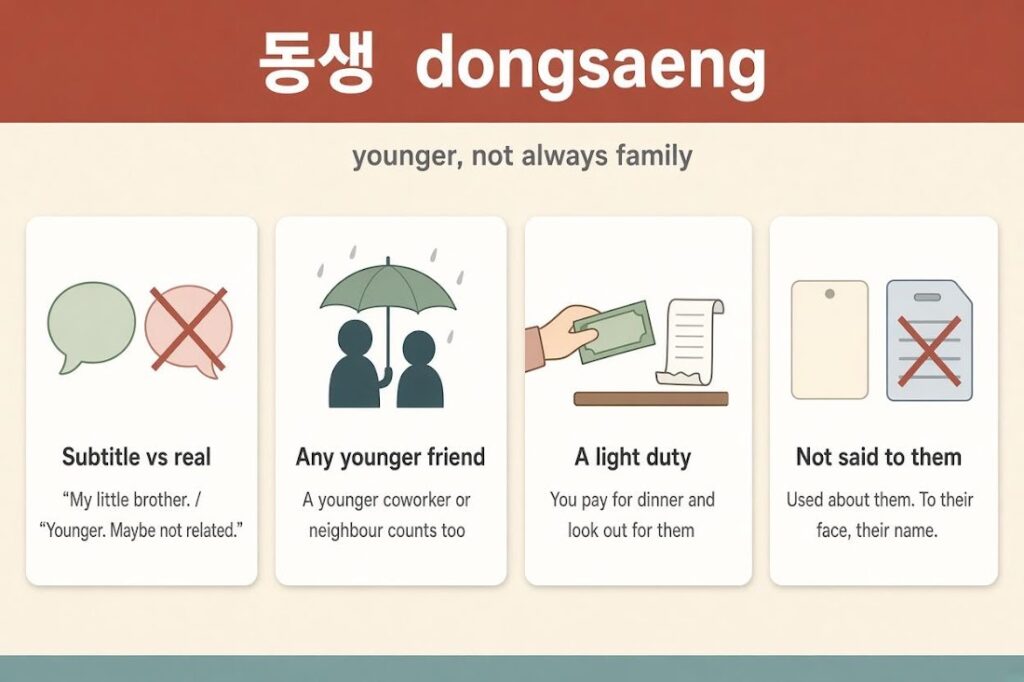
There is a light obligation built in. Calling someone your 동생 implies that you’ll look out for them: pay for dinner, give advice, defend them. In return, they give you a measure of respect. It is the same relationship that 형, 누나, 오빠 and 언니 describe from the other side.
Where the word comes from
동생 is Sino-Korean, from 同生 — “same” and “born.” In older usage it could mean siblings in general. Over time it narrowed to mean the younger ones, and then widened again socially to include people who are not related at all.
You don’t call someone “동생“
Here is a detail that trips learners up. 동생 is a word you use about someone, not usually to them. When you speak to your younger sister, you call her by name: 지민아, not 동생아. Compare that with the older-sibling terms, which are exactly what you call people to their face: 형! 언니!
This asymmetry says something about the system. The younger person has to use a title for the older one. The older one gets to use a first name.
You will sometimes hear 동생 used to someone directly in a playful or slightly condescending way, often by an older man to a younger one: “야, 동생.” It sounds like “listen, kid.” Not warm, not quite rude.
What subtitles do
“My little brother” or “my little sister” when the relationship is family, which is right. For the wider meaning, subtitles usually go with “a friend” or “a guy I know,” which is also fine. What drops out is the age information and the unspoken duty that comes with it.
When a character introduces someone as 제 동생이에요 and they turn out not to be related, Korean viewers do not blink. English viewers, having read “This is my little brother,” may be confused two scenes later.
Read next
- Hyung, Nuna, Sunbae — three words your subtitle turned into “you”
- “Maknae” (막내) — the youngest is a job, not a fact
- Why she calls him “Oppa” (오빠) — and why the subtitle just uses his name
Last reviewed: September 26, 2026