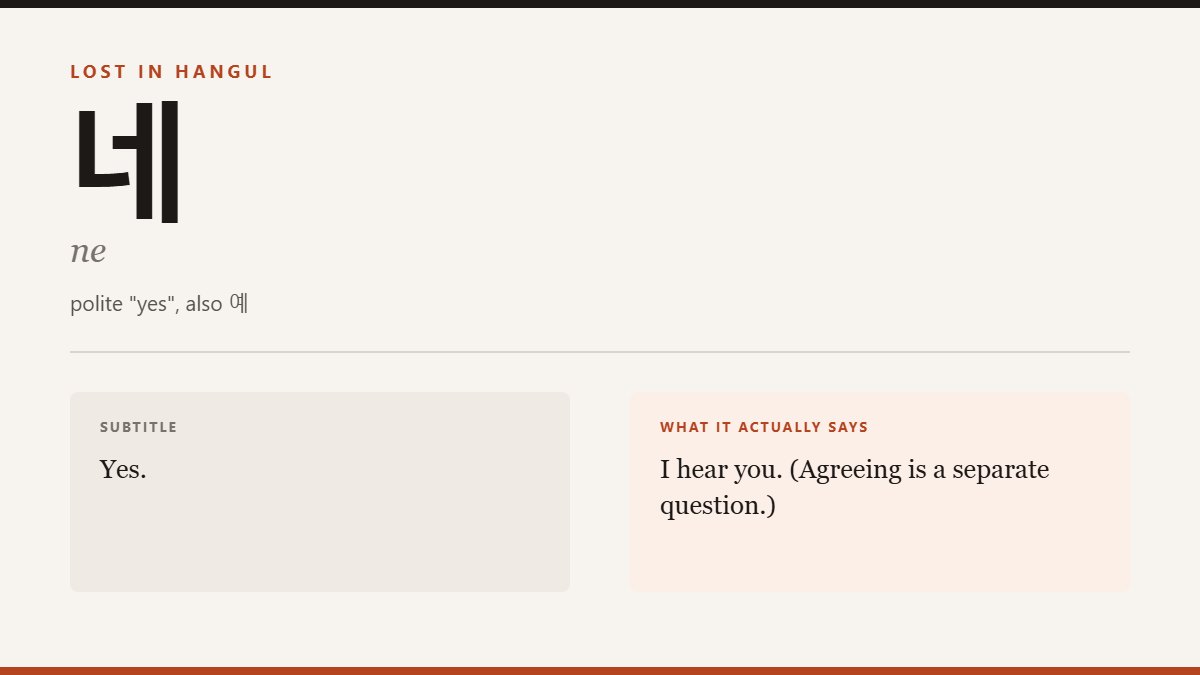
Short version: 네 is the polite word for yes, but most of the time it is not saying yes to anything. It is saying “I am listening,” “I heard you,” or “go on.” And when you answer a negative question with it, it agrees with the question, which can flip its meaning compared to English.
Five jobs, one syllable
| How it sounds | What it means |
|---|---|
| 네. (flat, short) | Yes / understood / okay, I’ll do it |
| 네, 네, 네… (repeated while someone talks) | I’m listening, keep going |
| 네? (rising) | Sorry? / What did you say? / You’re kidding |
| 네! (answering your name) | Yes? I’m here |
| 네… (trailing off) | Well… / I suppose so |
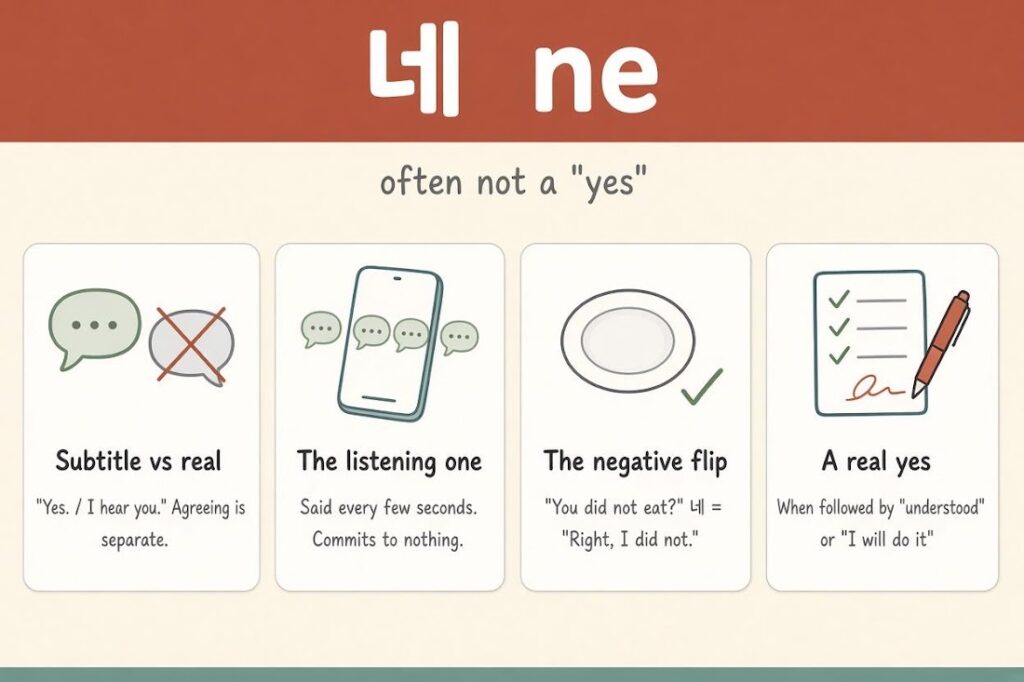
The second one is the big one. On a phone call, a Korean speaker will say 네 every few seconds while the other person talks. It is the equivalent of “mm-hm,” and it commits to nothing. A foreign manager who hears a string of 네 and concludes the team has agreed to the plan has misread the room.
The negative-question flip
This is where learners get caught. In English, you answer the facts: “You didn’t eat?” — “No, I didn’t.” In Korean, you answer the question: you are saying whether the question is right.
- 안 먹었어요? — “You didn’t eat?”
- 네, 안 먹었어요. — “Right. I didn’t eat.”
- 아니요, 먹었어요. — “No, that’s wrong. I did eat.”
So a bare 네 to “You’re not coming?” means “Correct, I’m not coming.” English speakers hear “yes” and assume the opposite. Japanese works the same way as Korean here, which is one reason the confusion is so familiar to people who study both.
Where the word comes from
네 is native Korean. Its twin 예 is the older and slightly more formal form, and both are standard. In practice 네 is what most people say day to day, and 예 sounds a touch more traditional or deferential. You will hear 예 more from older speakers and in very formal settings.
The casual equivalents are 응 and 어, used with friends and people younger than you. Saying 응 to your boss would be rude; saying 네 to your little brother would sound cold or sarcastic.
When 네 really does mean yes
It does, often. The way to tell is what follows it. 네, 알겠습니다 (“Yes, understood”) and 네, 할게요 (“Yes, I’ll do it”) are commitments. 네 on its own, in the middle of someone else’s sentence, is not.
A useful habit if you work with Korean speakers: when something matters, ask an open question afterwards (“So when can you have it done?”) rather than reading a 네 as agreement. People will not be offended. It is what Korean speakers do with each other.
What subtitles do
Subtitles have two lines and a time limit, so the listening 네 is almost always cut. A scene where one character says 네 six times while the other explains will show no text at all for those, which is correct. What goes missing is the rhythm: a character who stops saying 네 mid-conversation has stopped listening, and Korean viewers feel that shift immediately.
The rising 네? is usually “What?” or “Excuse me?” That works. The negative-question answer is where subtitles are forced to translate the meaning rather than the word — “Right, I didn’t” — and that is the correct choice, even though it means a 네 is subtitled as “No.”
Read next
- “Ani” (아니) — the word that usually is not “no”
- “Gwaenchanayo” (괜찮아요) — it also means “no thank you”
- The moment they switch to 반말 — what just happened between them
Last reviewed: September 26, 2026