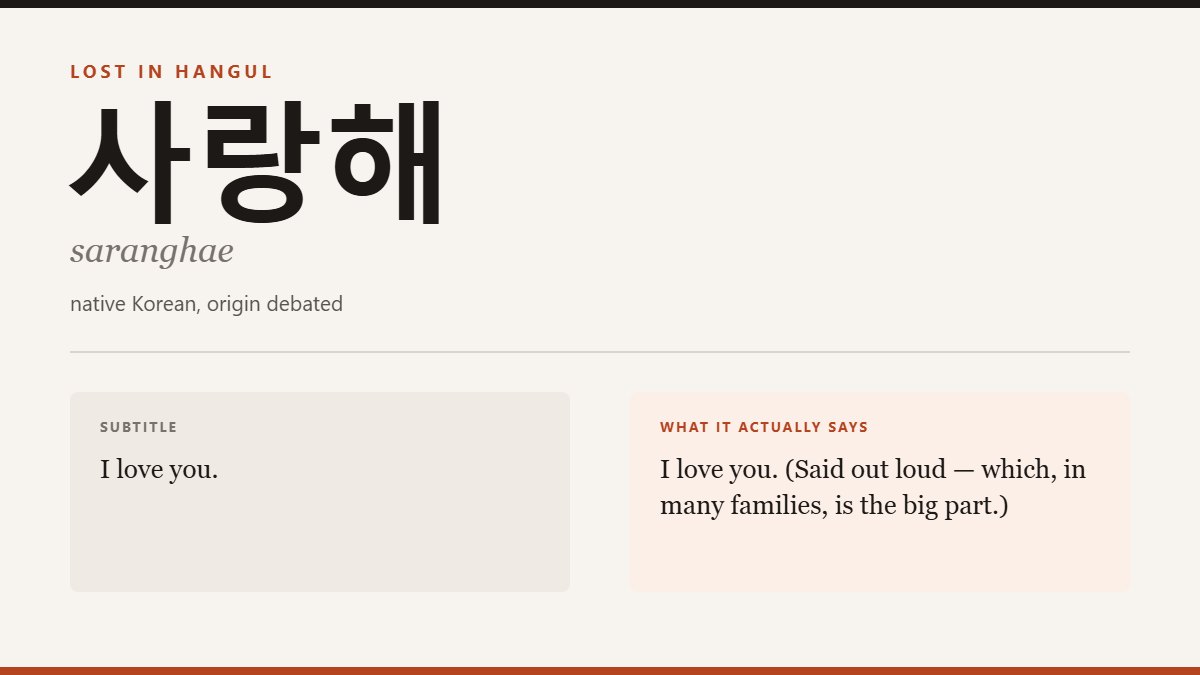
Short version: 사랑해 means “I love you.” The words are the same as English, but the frequency is not. In many Korean families, especially older generations, love was shown through food, sacrifice and worry rather than said aloud — so when a Korean father says 사랑해, it can land much harder than the English suggests.
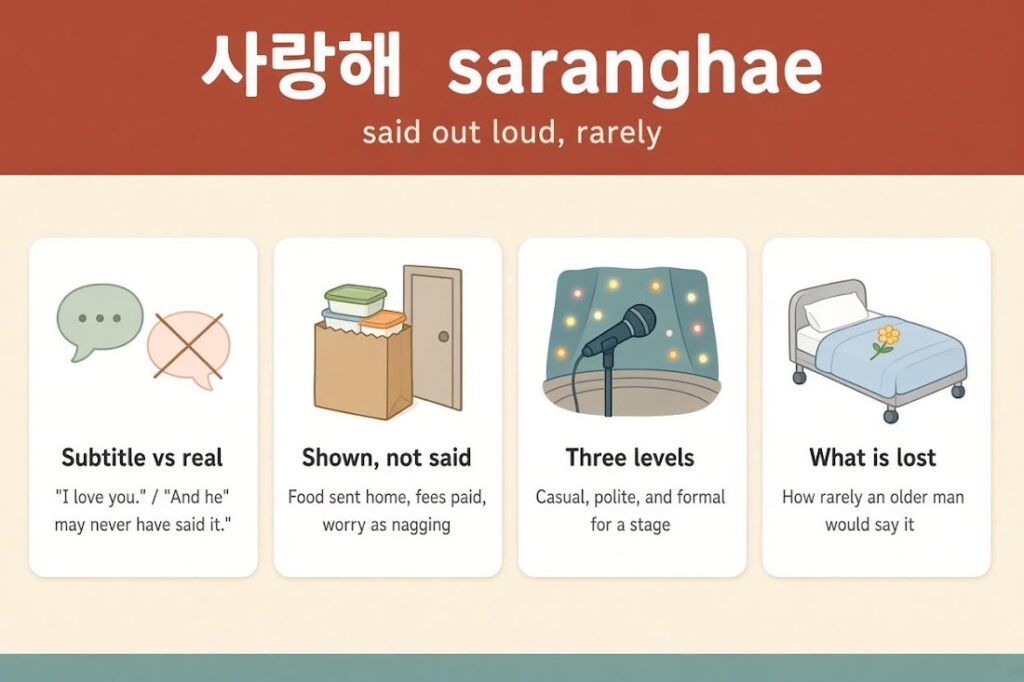
The forms
| Form | Level | Used with |
|---|---|---|
| 사랑해 | Casual | Partner, children, close friends |
| 사랑해요 | Polite | Parents, fans, anyone older |
| 사랑합니다 | Formal | Speeches, audiences, cards |
사랑합니다 sounds odd whispered to a partner. It is the form you hear from a stage, from a shop greeting, or in a formal letter. Idols end concerts with 사랑합니다 to a stadium of fans.
Where the word comes from
Here the story is genuinely interesting. In fifteenth-century Korean texts, the ancestor of 사랑하다 is usually read as meaning “to think of” or “to long for,” not specifically romantic love. Over time it shifted toward “to love.” Whether the word ultimately comes from the Chinese 思量 (“to consider, to think about”) is debated: some linguists support the connection, others doubt it. The shift from “to think of someone” to “to love them” is well attested either way.
The older sense survives in a nice way. To love someone, in the earliest Korean records, was to keep them in mind.
Saying it vs showing it
Many Korean adults over forty will tell you their parents never said 사랑해. That was not coldness. Love in that generation was expected to show up as action:
- 밥 먹었어? — “Have you eaten?”
- Food sent home in containers after every visit
- Paying school fees without a word about it
- Worry, expressed as nagging
Younger families say 사랑해 far more often, and there was even a period when schools and TV campaigns encouraged children to say it to their parents. So the word is in transition. What is ordinary for a twenty-year-old may still be a big deal for a sixty-year-old.
You will also hear 사랑 in many compounds that aren’t romantic: 사랑니 (wisdom tooth, literally “love tooth,” because it comes in at the age of first love), 짝사랑 (unrequited love), 내리사랑 (love that flows down from parents to children).
What else people say
Between couples, 좋아해 (“I like you”) often comes first and is the words of a confession. 사랑해 is a step further. Saying 사랑해 too early can feel heavy; that pressure is closer to English than many learners expect.
What subtitles do
“I love you” — the only choice, and correct. What is lost is the weight in context. When a gruff grandfather in a drama finally says 사랑한다 on a hospital bed, Korean viewers know what it costs him. The English viewer sees three ordinary words. The emotional punch of the scene depends on knowing how rarely he would have said them.
Read next
- “Bap meogeosseo?” (밥 먹었어?) — not really a question about food
- “Jeong” (정) — the bond English never got a word for
- “Mungkeulhada” (뭉클하다) — the lump in the throat, named directly
Last reviewed: September 26, 2026