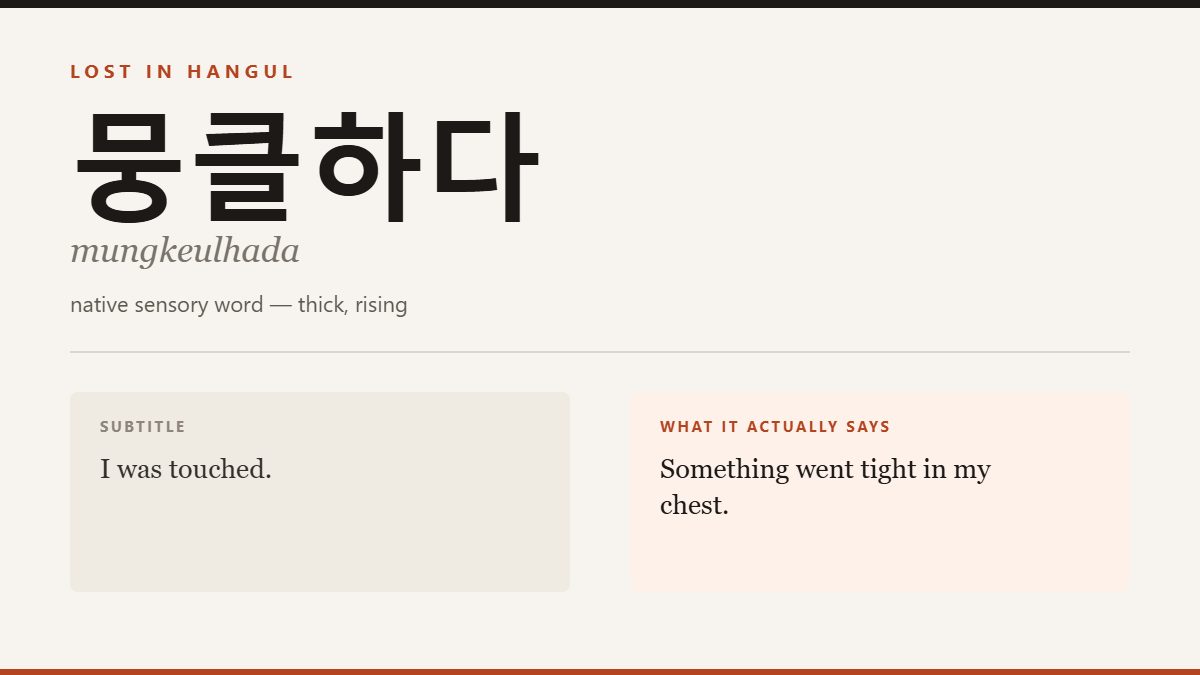
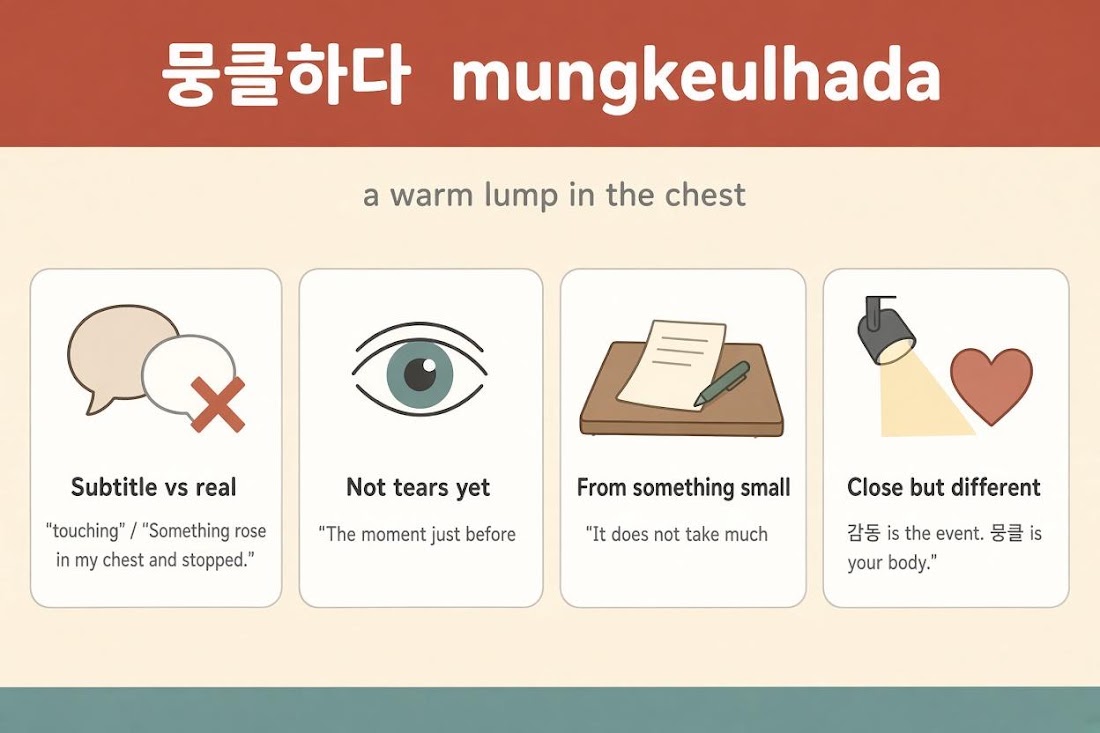
Short version: 뭉클하다 is the lump in the throat. The sudden thickening in the chest when something moves you, before any tears arrive and often instead of them.
Where the word comes from
Native Korean, and it belongs to the large family of Korean sensory words built on a doubled or shaped root — the same pattern behind 답답하다 and 찡하다. Words in this family describe a physical sensation first and get pointed at emotions second.
So 뭉클 names a feeling located in the body: something rising and settling, thick, in the chest or throat. English “touched” and “moved” are metaphors about motion. Korean names the sensation directly.
When it happens
- A parent says something plain and unexpected.
- An old friend turns up without being asked.
- A performer thanks the people who carried them, and means it.
- A final episode ends the way it should have.
- Someone who never says anything kind says one thing.
The trigger is almost always sincerity arriving without warning. It is not for sad things and it is not for grand things. It is for the small true moment.
The near relatives
| Word | The sensation |
|---|---|
| 뭉클하다 | Thick, rising, in the chest and throat |
| 찡하다 | A sharp sting, closer to the nose and eyes |
| 울컥하다 | A surge. Often anger, sometimes tears, always sudden. |
| 감동하다 | To be moved. General, and much more formal. |
감동 (感動) is the Sino-Korean word and the one dictionaries offer for “moved”. It is correct, neutral and flat. 뭉클 is what people actually say when it happens to them.
What subtitles do
“I was touched”, “that got me”, “it was moving”. All fine and all of them describe the emotion from outside, which is exactly what the Korean avoids doing.
The usual sign that a subtitle has flattened it: a character puts a hand on their chest and says something short, and the English reads like a polite compliment.
Read next
- “Jeong” (정) — the bond English never got a word for
- “Eogulhada” (억울하다) — wronged, and unable to prove it
- “Aswipda” (아쉽다) — a shame, and not the same as 서운하다
Last reviewed: September 21, 2026