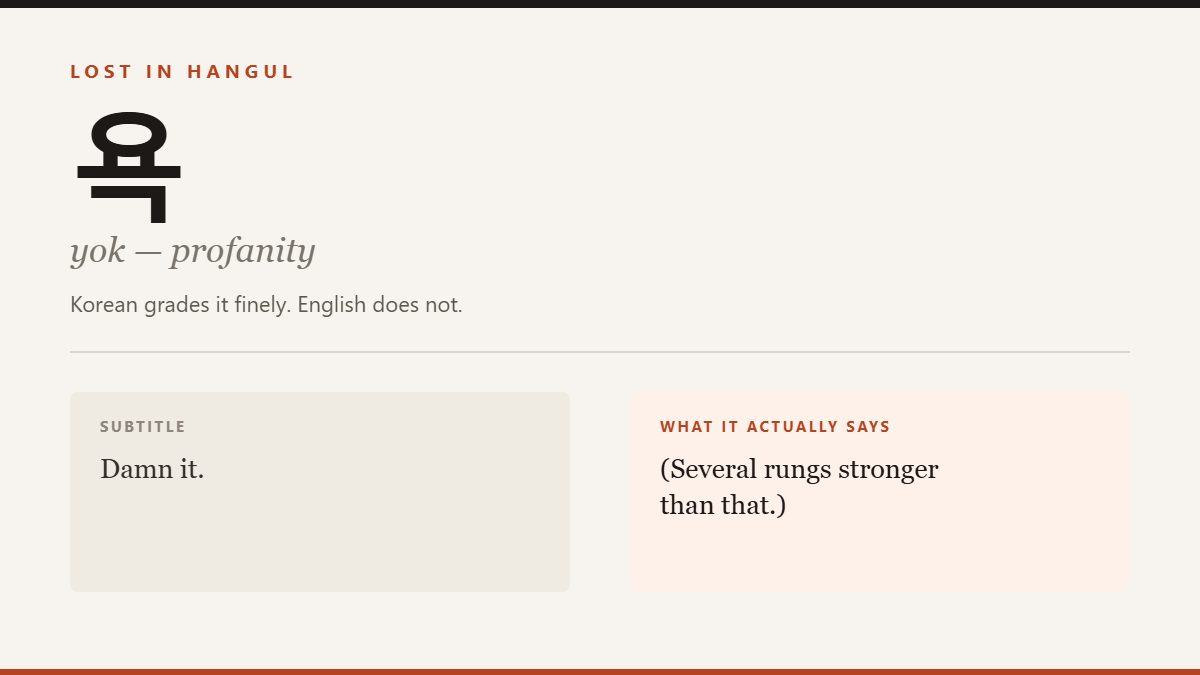
Short version: Korean swearing is systematically softened in official subtitles. It is not prudishness, and it is only partly about broadcast rules. Most of it comes down to a mismatch in how the two languages grade profanity.
Korean profanity is graded finely
Korean has a long ladder between “mildly rude” and “genuinely obscene”, and each rung is doing social work. There are words that are coarse among friends and fighting words to a stranger, words that are normal from an older person and shocking from a younger one, and words that are fine in Seoul dialect comedy and not fine at a dinner table.
English profanity is graded too, but the ladder is shorter and the rungs are further apart. A subtitler translating the middle of the Korean ladder has to choose between an English word that is too mild and one that is too strong.
So they round down
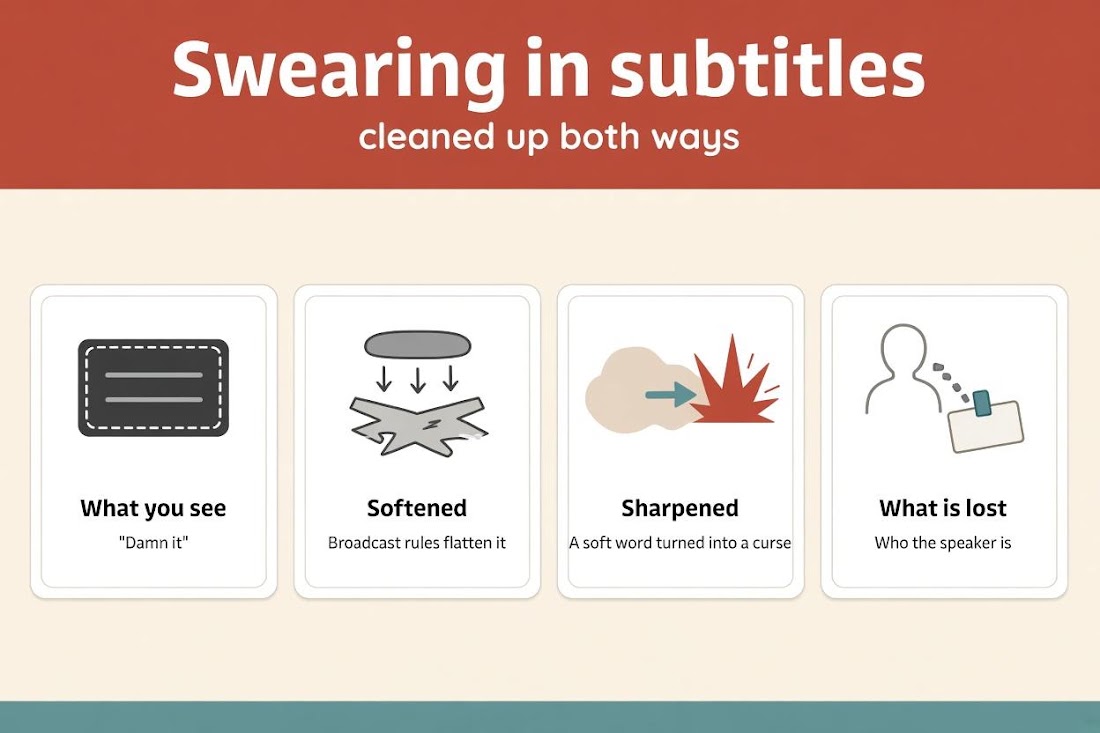
Given that choice, subtitlers almost always round toward the milder end. Two reasons.
- Platform ratings. Strong English profanity changes a content rating in ways the original did not intend. A Korean programme rated for teenagers can end up with an English track that reads as adult.
- Reading, not hearing. Written profanity lands harder than spoken profanity. A word that passes in dialogue can look aggressive sitting on screen in text.
That second point is underrated and it is the real reason subtitles run cleaner than dubs of the same show.
What you lose
Mostly characterisation. In Korean, who swears, at whom, and how hard is a constant stream of information about status and self-control. A character who swears upward has done something serious. A character who never swears and then does has changed.
Flatten all of that to “damn” and the information goes. The most common casualty is the scene where somebody crosses a line and the English subtitle shows an ordinary argument.
The one that is not profanity at all
Worth knowing: 진짜 and 아니 carry a lot of the heat in Korean arguments, and neither is a swear word. Subtitlers sometimes compensate by putting an English expletive where the Korean had only an intensifier — which is a reasonable trade of literal accuracy for emotional accuracy.
So the subtitle can be cleaner than the Korean in one line and dirtier in the next, and both choices can be right.
How to read around it
Watch the reactions rather than the words. In Korean drama, other characters’ faces tell you exactly how bad a line was. If everyone freezes and the subtitle says “shut up”, the subtitle is not what happened.
Read next
- Two lines, forty characters: the rules subtitlers actually work under
- The moment they switch to 반말 — what just happened between them
- The Korean words subtitles always delete (and why translators do it)
Last reviewed: September 21, 2026