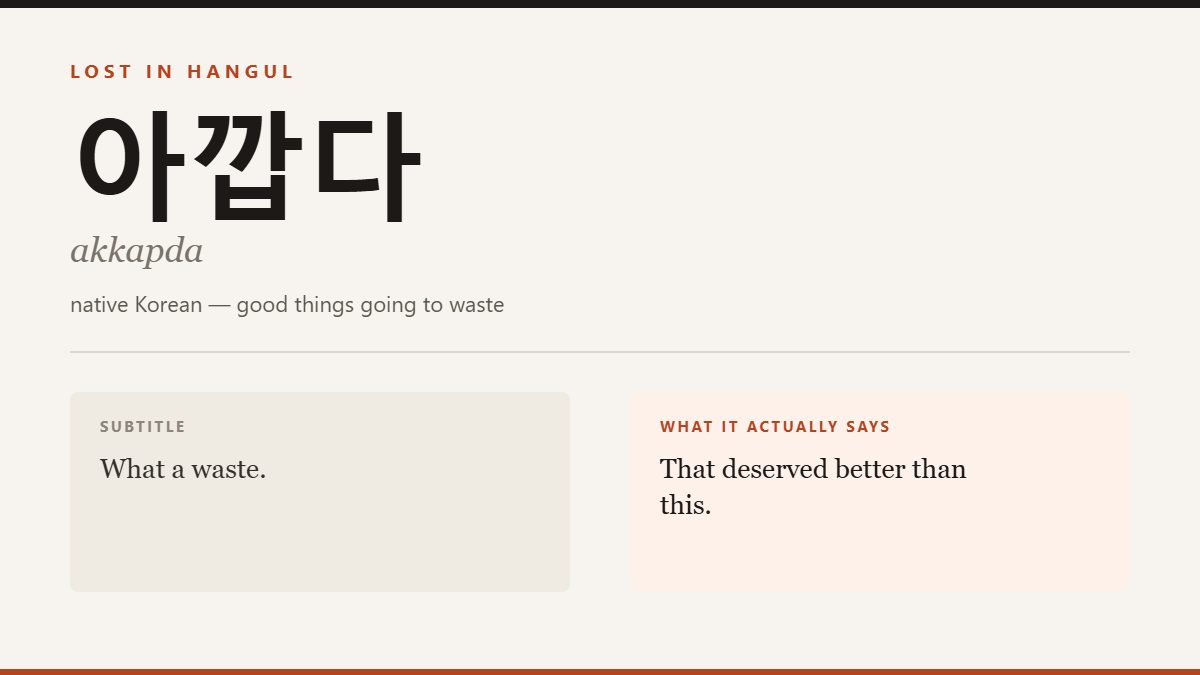
Short version: 아깝다 is the feeling that something good is being wasted. Food going in the bin, money spent badly, talent unused, a chance that will not come again. English “what a waste” gets the situation and misses that Korean feels it as a small physical pang.
Where the word comes from
Native Korean, no hanja, and like most Korean adjectives of feeling its derivation is not clearly documented. What it does is clear enough.
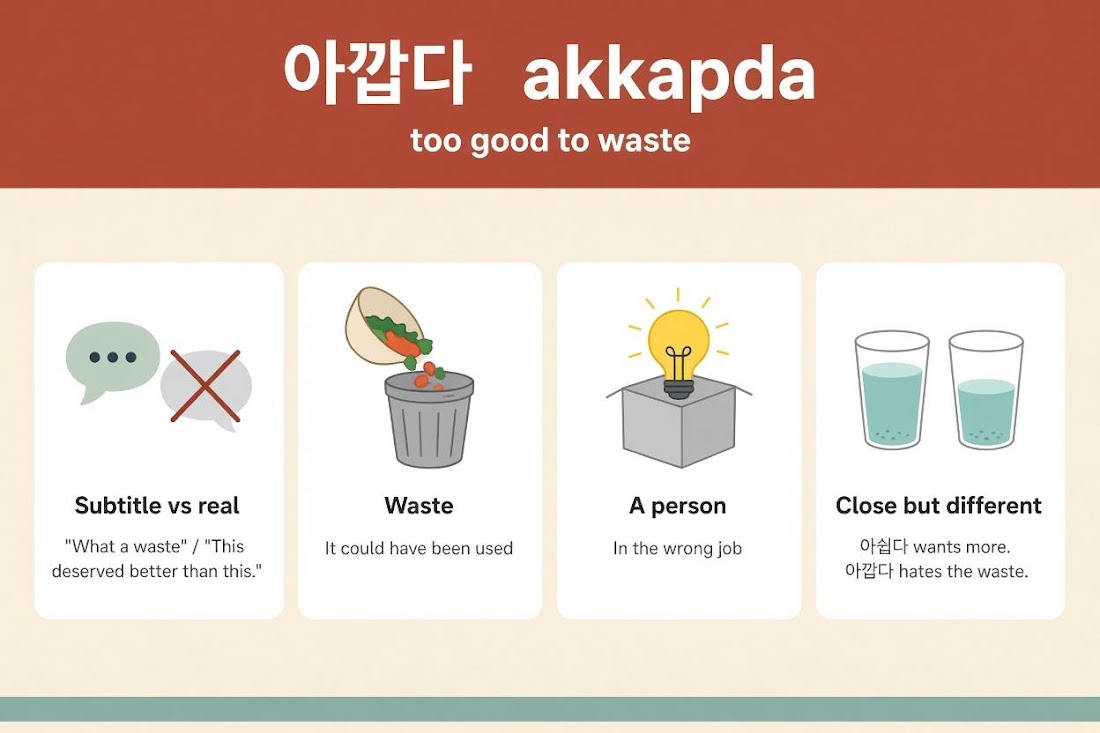
It is worth separating from 아쉽다 immediately, because the two look similar and learners mix them constantly.
| 아깝다 | 아쉽다 | |
|---|---|---|
| Core idea | Something valuable is being wasted | Something fell short, or is ending |
| Points at | The thing | The gap |
| Example | Throwing away good food | Losing by one point |
| Can be about money | Yes, constantly | Not really |
There is overlap. A narrow defeat can be both: 아쉽다 because it was so close, 아깝다 because the effort deserved better.
Where you hear it
- Food about to be thrown out. This is the canonical use and it is close to reflexive.
- Money spent on something that did not work out.
- A person with real ability doing something beneath them: 아까운 사람.
- Time. 시간 아까워 is a common and fairly blunt way of saying something is not worth doing.
- A narrow loss, where the performance deserved a better result.
The use that says the most
아까운 사람 — “a wasted person” — is said about someone whose talent is going nowhere, and also, gently, about someone who died young. In the second sense it is one of the more affecting things Korean does with a very ordinary word.
English “such a waste” said about a person sounds harsh. The Korean does not, because the word is built around value rather than judgment.
And the one that is a warning
아깝다 aimed at money you are about to spend means “do not”. 그 돈이 아까워 — that money would be wasted — is how Korean talks someone out of a purchase, and it is more effective than saying it is too expensive, because it says the thing is not worth the money rather than that you cannot afford it.
What subtitles do
“What a waste”, “that’s a shame”, “such a pity”. All reasonable. What goes is the specific sense that something of value is being lost, which is why the Korean gets used about food and talent and time with the same word.
Read next
- “Aswipda” (아쉽다) — a shame, and not the same as 서운하다
- “Seounhada” (서운하다) — the hurt you feel slightly embarrassed about
- “Dapdaphae” (답답해) — not frustrated. Something tighter than that.
Last reviewed: September 21, 2026