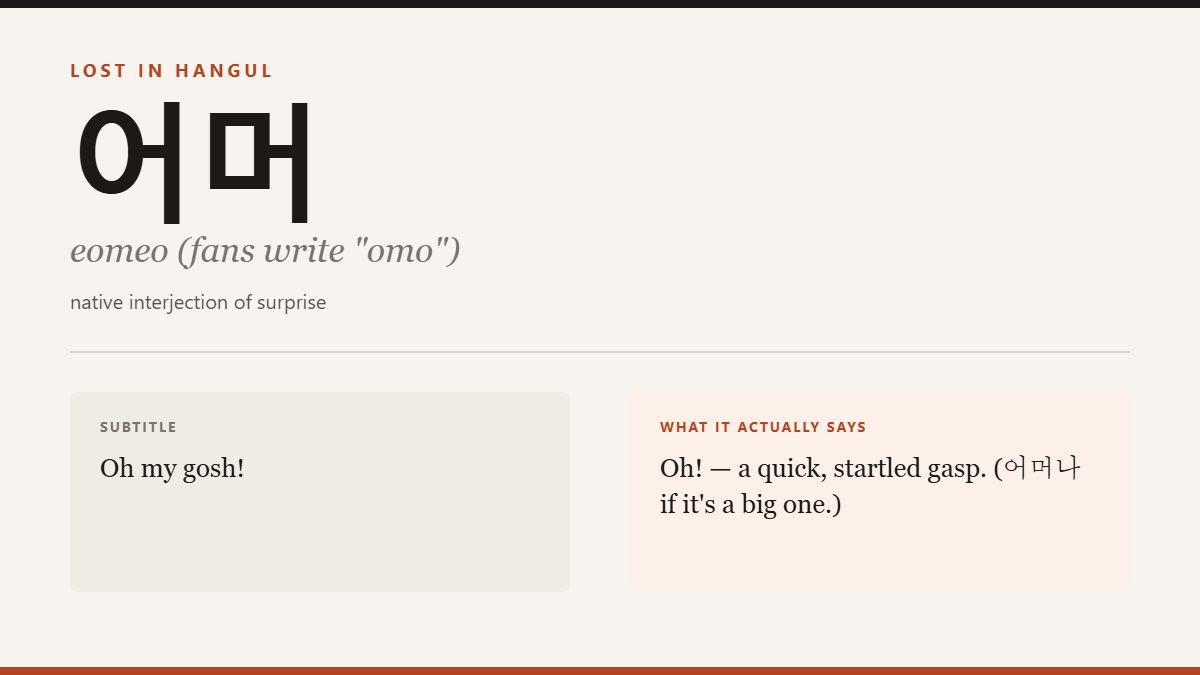
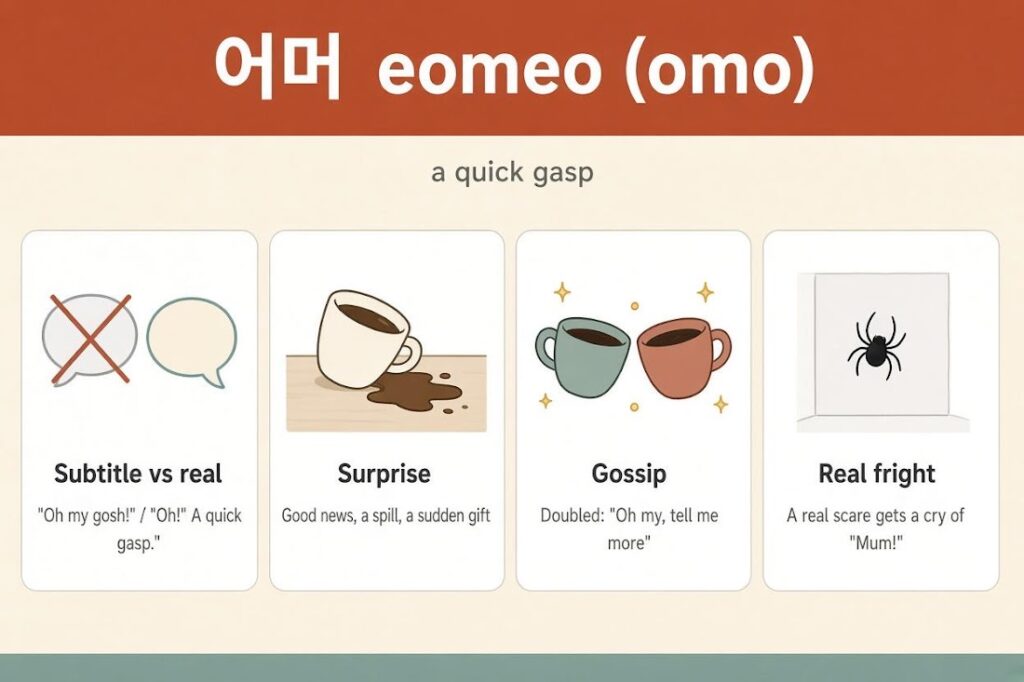
Short version: 어머 is a gasp. Something surprising, embarrassing or delightful just happened: “oh!”, “oh my!” The longer 어머나 is bigger and more theatrical, 어머머 is the sound of hearing juicy gossip, and 엄마야 is what slips out when you are genuinely frightened. Fans often write it “omo,” which is close to how it sounds.
The family
| Form | When | Roughly |
|---|---|---|
| 어머 | Any surprise, small or big | Oh! / Oh my! |
| 어머나 | A bigger, more theatrical surprise | Oh my goodness! |
| 어머머 / 어머 어머 | Gossip, mild scandal | Oh my, oh my… |
| 엄마야 | Real fright: a bug, a sudden bang | Aah! (literally “Mum!”) |
| 어머, 웬일이야 | Delighted disbelief | No way! What’s all this? |
세상에 — literally “in the world” — often comes right after it: 어머, 세상에! is close to “Oh my, good heavens!”
Who says it
어머 is strongly associated with women. That isn’t just a stereotype: Korea’s standard dictionary, after defining it as the sound you make when startled, adds that it is “often used by women.” Men say it too, just less often; they are more likely to reach for 어, 헉, 와 or 아이고.
It is used at every age. 어머 is everyday; 어머나 sounds a little more dramatic, or a little older.
Where the word comes from
It is a native Korean interjection. The obvious guess is that it’s connected to 어머니, “mother,” and the longer cousins 어머나 and 에구머니 make that guess tempting, while 엄마야 really is someone calling for Mum. But for 어머 itself the link isn’t documented: it’s an attractive guess, not an established origin.
Calling on your mother in surprise isn’t unique to Korean — Italian “mamma mia!” is the famous parallel — but 엄마야 is very much alive, and adults of any age will yelp it at a spider.
Is it polite?
Yes. Unlike 헐, which marks the listener as someone you’re relaxed with, 어머 is an interjection that can be said to anyone. 어머, 죄송해요 after bumping into a stranger is perfectly natural. That’s one reason people switch from 헐 to 어머 in front of elders.
Similar but different
- 헐 — a jaw-drop at news. Casual, younger in feel.
- 헉 — a sharp intake of breath, more physical.
- 아이고 — sighs, aches and laments; older in feel.
- 대박 — “that’s huge,” a verdict rather than a gasp.
In text, 어머 어머 and 어머나 세상에 are common in family chats and comment sections, usually reacting to photos of babies, weddings or something shocking in the news. The doubled form signals enthusiasm, not double shock.
What subtitles do
엄마야 is the one translators can’t win. Subtitled literally as “Mum!”, it reads as if a grown woman is calling for her mother in the middle of the scene; subtitled as “Ah!”, the childlike reflex is gone. The plain 어머 is easy by comparison — “Oh!”, “Oh my!” — though the gossip version suffers: 어머머, said with relish over a neighbour’s scandal, becomes a flat “Oh my,” and the delight drains out of it.
Read next
- “Heol” (헐) — the one-syllable jaw drop
- “Aigoo” (아이고) — one sound doing six different jobs
- “Daebak” (대박) — one word, four completely different meanings
Last reviewed: October 4, 2026