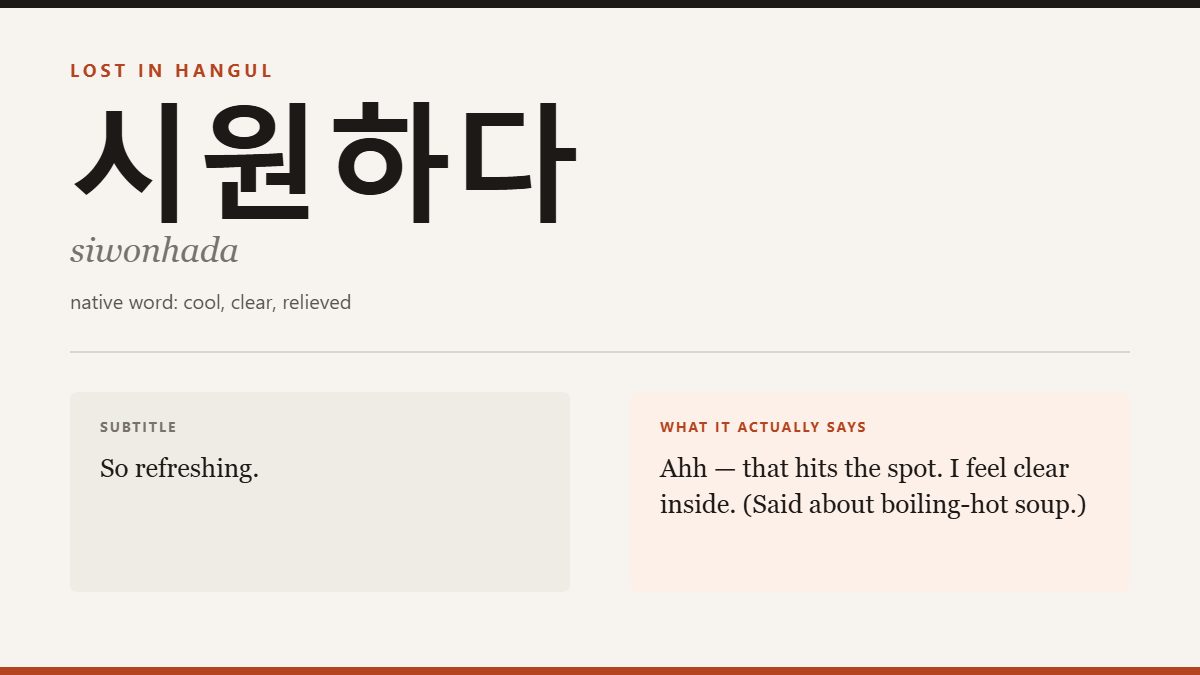
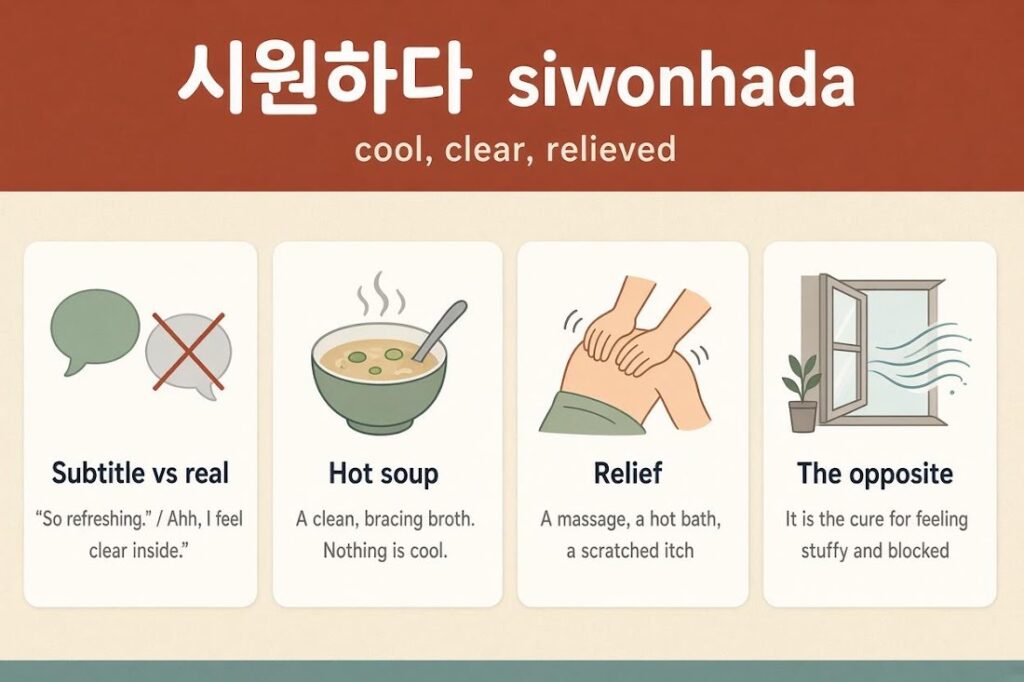
Short version: 시원하다 means cool in a pleasant way — a breeze, a cold drink. But Koreans also say it about a steaming bowl of soup, a hard massage, a hot bath, and the feeling of a problem finally solved. The thread running through all of them is relief: something stuffy, heavy or blocked has been cleared.
The literal meaning
- 바람이 시원하다 — the breeze is nice and cool
- 시원한 맥주 — an ice-cold beer
- 오늘 날씨 시원하네 — it’s pleasantly cool today
It is always pleasant. 춥다 is cold you feel — the weather, a chill — and it’s unwelcome. 차갑다 is neutral, “cold to the touch”: a glass of water can be 차갑다 and lovely, or a hand can be 차갑다 and worrying. 시원하다 adds “and that feels good.”
The meaning that confuses everyone
A man takes a spoonful of scalding hangover soup, closes his eyes and sighs: 아, 시원하다. Nothing in the bowl is cool. He means the broth is clean and bracing, and that it is clearing out the heavy, queasy feeling inside him. Clear, light broths — bean sprout soup, dried pollack soup, clam soup — are the classic 시원한 국물, and they are often eaten precisely for that effect.
This isn’t slang or a figure of speech. Korea’s standard dictionary lists it as one of the word’s ordinary senses: food that is cold and fresh, or hot in a way that leaves your insides feeling clear.
The same logic covers:
- Sinking into a hot bath or sauna: 어, 시원하다.
- Someone kneading a stiff shoulder: 아, 시원해!
- Scratching an itch, a big sneeze, stretching after a long drive.
속이 시원하다 — relief inside
속 is “the inside” — the stomach, the gut, the heart. 속이 시원하다 means your insides feel clear and light: the relief when a bully finally gets told off, or when you’ve said what you’ve been holding in for months. 속 시원하게 말해 봐 is “Just say it. Get it off your chest.”
From there the word spreads further. 시원하게 means cleanly, decisively: 시원하게 이겼다 is “won convincingly.” A person who is 시원시원하다 is frank and decisive, never fussy. And 시원섭섭하다 — cool-and-sad — is the mixed feeling at the end of something, like leaving a job: relieved it’s over, sorry it’s over.
Where the word comes from
시원하다 is native Korean, with no hanja behind it. All of these meanings — cool breeze, clear broth, open view, relief — are listed together under the one word. In Korean they never felt like separate meanings, because the shared idea is not temperature. It’s the absence of anything stuffy or blocked.
The opposite: 답답하다
| Blocked | Cleared |
|---|---|
| 답답하다 — stuffy, stifled | 시원하다 — open, relieved |
| 속이 답답하다 — heavy inside | 속이 시원하다 — cleared inside |
| 고구마 — the dry, stuck plot | 사이다 — the fizzy scene that clears it |
If you’re eating with Korean friends, 국물이 시원하네요 after the first spoonful of a clear or spicy broth is exactly the right thing to say. It is a compliment to the broth, and it tells everyone at the table you’ve understood something about Korean food. Rich, milky soups such as 설렁탕 get different praise: 진하다 (“rich”) or 구수하다 (“savoury, comforting”).
What subtitles do
“Refreshing,” “hits the spot,” “that’s good.” “Refreshing” confuses English viewers when the soup is visibly steaming. “Hits the spot” keeps the satisfaction and loses the clearing. And 시원섭섭하다 usually becomes “bittersweet,” which is close but not quite: bittersweet mixes happy and sad, while 시원섭섭 mixes relief and loss.
Read next
- “Dapdaphae” (답답해) — not frustrated. Something tighter than that.
- “Sokssanghae” (속상해) — upset, from the inside
- “Jal meokgetseumnida” (잘 먹겠습니다) — not “bon appétit”
Last reviewed: October 4, 2026